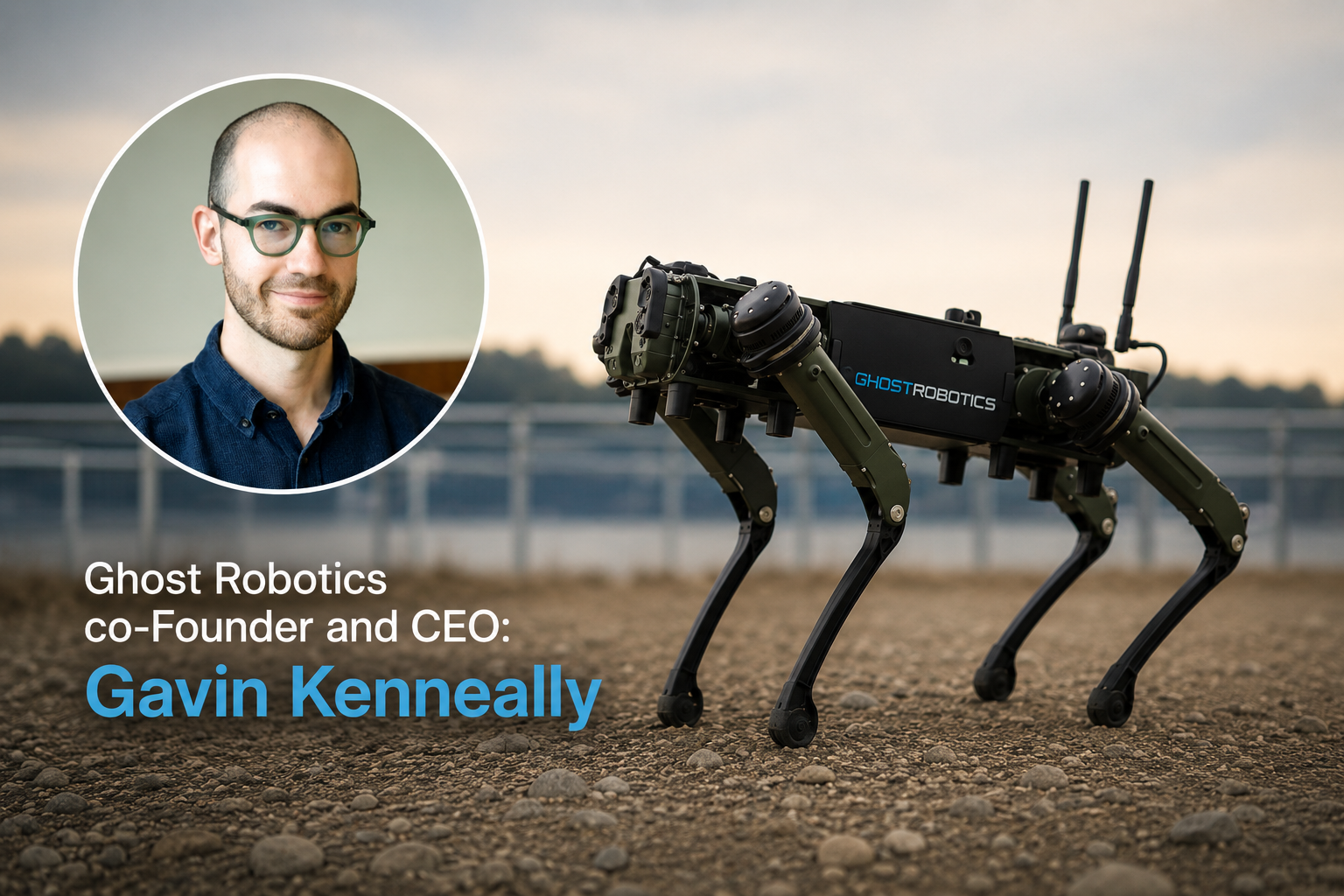
A Six Degrees Profile: Ghost Robotics Co-Founder and CEO Gavin Kenneally
In early April, a parking garage under construction at the Children’s Hospital of Philadelphia partially collapsed in the Grays Ferry neighborhood, killing one ironworker and trapping two more, both presumed dead, in the rubble. The structure that remained was, as one engineer told the Philadelphia Inquirer, a house of cards: precast concrete slabs stacked off-site and lifted into place, with little holding them together. Pulling the wrong piece could trigger another progressive collapse. Rescue crews could not safely walk in.
By Thursday afternoon, according to the Inquirer’s reporting, a robotic dog was walking the site.
The article did not name the manufacturer. But the scene — Philadelphia, a structure too dangerous for human responders, a quadruped sent in ahead of them — is the one Gavin Kenneally has spent the last ten years building toward.
Kenneally is the co-founder and CEO of Ghost Robotics, headquartered a few miles from the Grays Ferry site. Ask him about the robotics company everyone else compares his company to, and he doesn’t take the bait. Boston Dynamics has been around his entire professional career, he’ll say, evenly. They make impressive science. Their videos go viral. They’ve been at it for two decades.
At the time of Ghost Robotics’ birth, Boston Dynamics was, per Kenneally, “…weren’t shipping anything into real-world applications.”
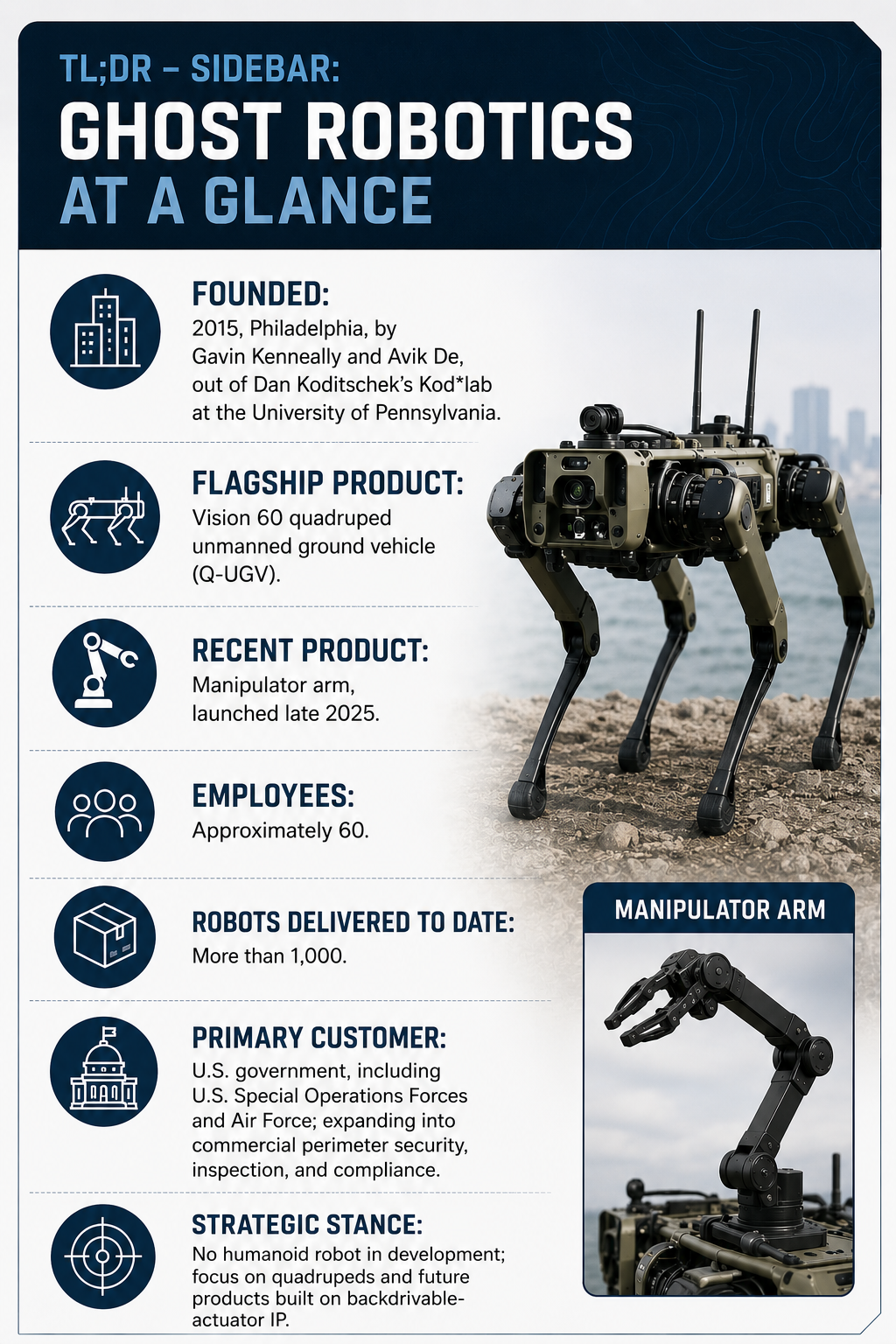
That gap — between the spectacle of robotics and the business of it — is the negative space that Ghost Robotics was built to fill. Kenneally has spent the last ten years building a quadruped robotics company that is, by the standards of its industry, almost defiantly unglamorous. Sixty employees. Over a thousand robots delivered. A revenue base anchored in U.S. defense contracts and slowly diversifying into the dirtier corners of the industrial economy: oil and gas, construction, mining, perimeter security for Air Force bases and data centers.
No humanoids. No nine-figure raises at a forty-billion-dollar valuation. No viral parkour reels.
“We’re not just trying to go viral, make videos, raise a bunch of money,” Kenneally says. “We want to be shipping more and more robots.”
The Penn Origin
Ghost Robotics began, in the way many robotics companies begin, in a university lab. Kenneally and his co-founder Avik De were PhD students in Dan Koditschek’s lab at the University of Pennsylvania — Kenneally working on actuators, De on the control side. The two had landed on what would become the company’s founding technical idea: that a lot of the mechanical complexity that legged robots had traditionally relied on — series elastic elements, force-torque sensors, intricate hardware loops — could be pushed out of the hardware and into software.
“We changed how the actuators were built,” he says. “…no series elastic, no force-torque sensors, kind of pulled out some of the complexity, pushed it all into software with some custom motor controllers and different ways of designing robots.”
The result was a robot that was simpler, more rugged, more scalable and one that could feel the ground through its legs because the legs were so directly coupled to the motors. The technical bet was that this architecture would be more robust in the field. The business bet was harder: in 2015, when they founded the company, there wasn’t really a legged robotics industry to sell into. Their first plan was modest: sell some research kits to other labs.
Ambition arrived next.
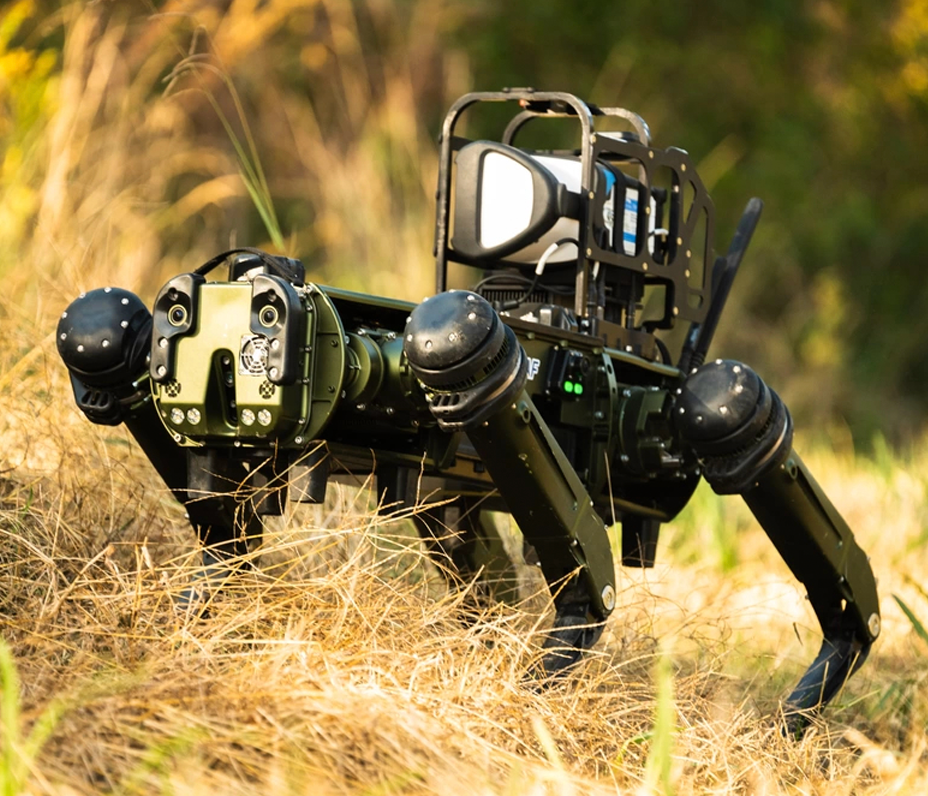
The Vision 60 quadruped robot by Ghost Robotics with a CBRN (Chemical, Biological, Radioactive, Nuclear) sensor that provides real-time environmental monitoring of hazardous sources, such as chemical spills and gas leaks, keeping the human analyst in emergency response, military operations and industrial monitoring out of harm’s way.
Finding the North Star
The pivot point came when Kenneally and De realized their robots could do something more than impress academic conferences: they could go into places where sending a person was a bad idea.
“We want to be helpful, as helpful as we can in that situation.”
“We realized early on that the government space was the most ripe for us,” Kenneally says, “because the robots were getting competent enough that we could have them — the robots be used to go into very dangerous environments, instead of putting people in harm’s way. So that was kind of the North Star.”
That North Star — keep humans out of harm’s way — has functioned as both mission statement and product strategy. Ghost Robotics now works closely with U.S. Special Operations Forces, and Kenneally expects that adoption to grow “at the tip of the spear,” as he puts it, where staying a few meters further from danger can change outcomes. The Vision 60, the company’s flagship quadruped, has been adopted across the Department of Defense and was the first base-security robot deployed at an Air Force installation.
Government remains Ghost’s number-one customer base. It’s also a customer base Kenneally is candid about the limits of.
“Government orders, they’re great when you have them,” he says. “They tend to be quite large. But then there could be a continuing resolution or something. You don’t get any orders the following year, and then they come back the year after that.”
Hence the diversification push.
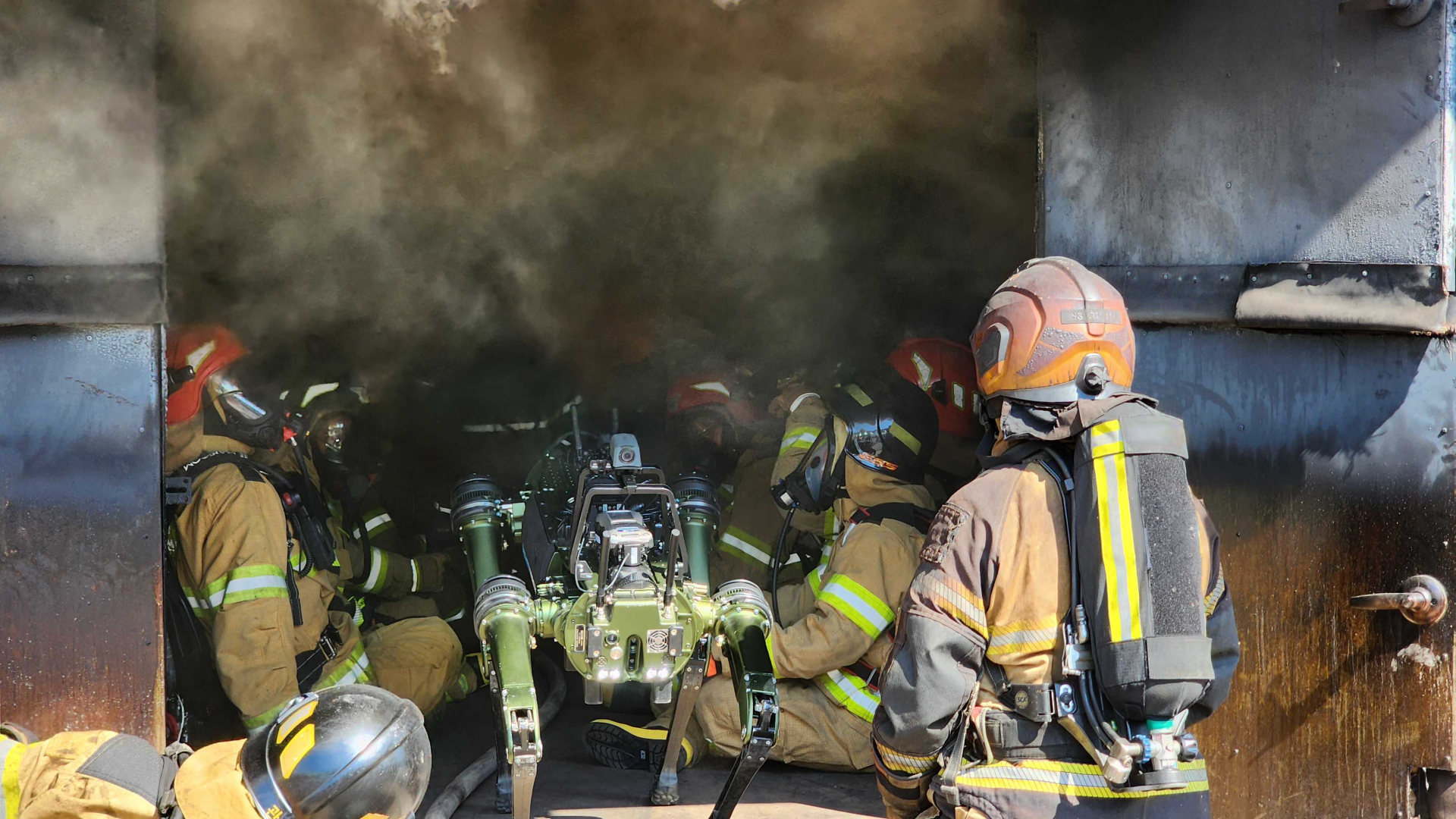
The Vision 60 quadruped robot by Ghost Robotics can withstand extreme temperatures. Shown in use with the Seoul Fire Department, the rugged quadruped supports public safety efforts by reducing risk and increasing efficiency in critical scenarios.
From the Perimeter Outward
The pattern Kenneally has noticed is that commercial and industrial applications look strikingly similar to defense applications. A robot built tough enough to walk the perimeter of an Air Force base — large facility, harsh outdoor environment, long mission duration — turns out to be a robot built tough enough to walk the perimeter of a construction site, a data center, an oil field, or a mine. The hardware barely changes. The sensors and software get tuned.
“Maybe a different sensor, maybe a different software,” he says, “but it’s mostly the same application.”
Perimeter security forms the foundation. Inspection layers on top. Compliance walks come next: one Ghost customer has the robot end each day verifying that fire extinguishers are in place and that doors are closed and locked. The Vision 60 is sold alongside a small ecosystem — wireless charging stations the robots autonomously return to, PTZ camera options, and, since late 2025, a top-mounted manipulator arm that lets the robot open doors and handle objects.
The arm is the kind of product Kenneally describes as a “last-mile” piece: not a moonshot, but the thing that makes the rest of the system genuinely turnkey for a customer.
Three Things Ghost Won’t Chase
Ask Kenneally what Ghost Robotics is, and the answer comes easily enough — a small, focused company shipping rugged quadrupeds to customers who need them. Ask what Ghost is not, and the answer is sharper, and more revealing. There are three trends currently defining the robotics conversation, and Ghost has deliberately stepped away from all of them.
The first is the financing model. Kenneally’s most pointed views are reserved for how his peers have capitalized themselves.
“That sets you up for kind of this, like, boom-or-bust strategy.”
“You’ll see these high-profile fundraises, where they raise hundreds of millions or billions of dollars at, like, crazy valuations,” he says. “Five billion, forty billion, depending on who it is. That sets you up for kind of this, like, boom-or-bust strategy, where basically, you know, you raise a ton of money — your revenue really has to become exponential and grow just absolutely crazy to justify those kinds of valuations.”
That math, he argues, is good for investors — who diversify across many bets — and structurally bad for the companies themselves. Ghost Robotics turned ten in October. Kenneally wants another decade. He says the company tries to build “something more sustainable with real-world applications, rather than trying to create videos that get a bunch of views and let us raise money, and we’re making these crazy promises.”
The second is robots-as-a-service. Pressed on whether Ghost will follow the rest of the industry into a per-hour leasing model, Kenneally offers what may be the most original framing of the conversation. The RaaS pitch, he points out, is fundamentally about competing with hourly wage labor: what does the robot cost per hour, and what is the worker’s wage per hour?
That isn’t the business Ghost is in.
“We’re really not in that kind of one-to-one industry,” he says. “More so we try and augment. Keep humans out of harm’s way, or augment — the kind of many-to-one approach.”
One operator monitoring several robots patrolling a facility is not the same product as one robot replacing one warehouse picker. The economics, and the sales conversation, are different. Ghost does offer maintenance packages and has partnered with Holman on a lease structure for customers who need operating-expense rather than capital-expense purchases. But the company has not bet the business on recurring per-hour revenue.
The third — inevitably — is the humanoid. It is the question every legged-robotics CEO is asked now, and Kenneally’s answer is unequivocal.
“We’re not going to be building humanoids.”
His reasoning is partly competitive — there are already half a dozen U.S. companies and dozens of Chinese companies in the space — and partly structural. “I’m a little concerned humanoids is already kind of a race to the bottom,” he says. “There’s not gonna be that much of a moat for the Chinese companies that are building things at much lower price points.” There is, he notes, a sensitivity around foreign-made humanoids in U.S. commercial deployments — data access, surveillance vectors — but he’s wary of relying on that as a durable moat for American humanoid companies. The price gap, he thinks, will eventually win.
What Ghost will do instead is leverage its core actuator IP — the backdrivable motors that let the Vision 60 feel the ground through its legs — into new product categories that are inherently force-controlled and inherently safer around humans. He won’t say what those products are. He will say they’ll be Ghost products, sold turnkey, not parts shipped to competitors. Selling components, he says, is its own race to the bottom.
Three trends, three refusals, one underlying logic: each of them, in Kenneally’s reading, is a path that promises explosive upside and quietly forces the company into a structural position it can’t defend. The mega-raise demands hockey-stick revenue the market may not deliver. RaaS reframes the product as a wage substitute, a fight Ghost’s robots aren’t built to win. Humanoids put a small American company in a price war with dozens of Chinese ones. The discipline isn’t austerity. It’s a refusal to be cornered.
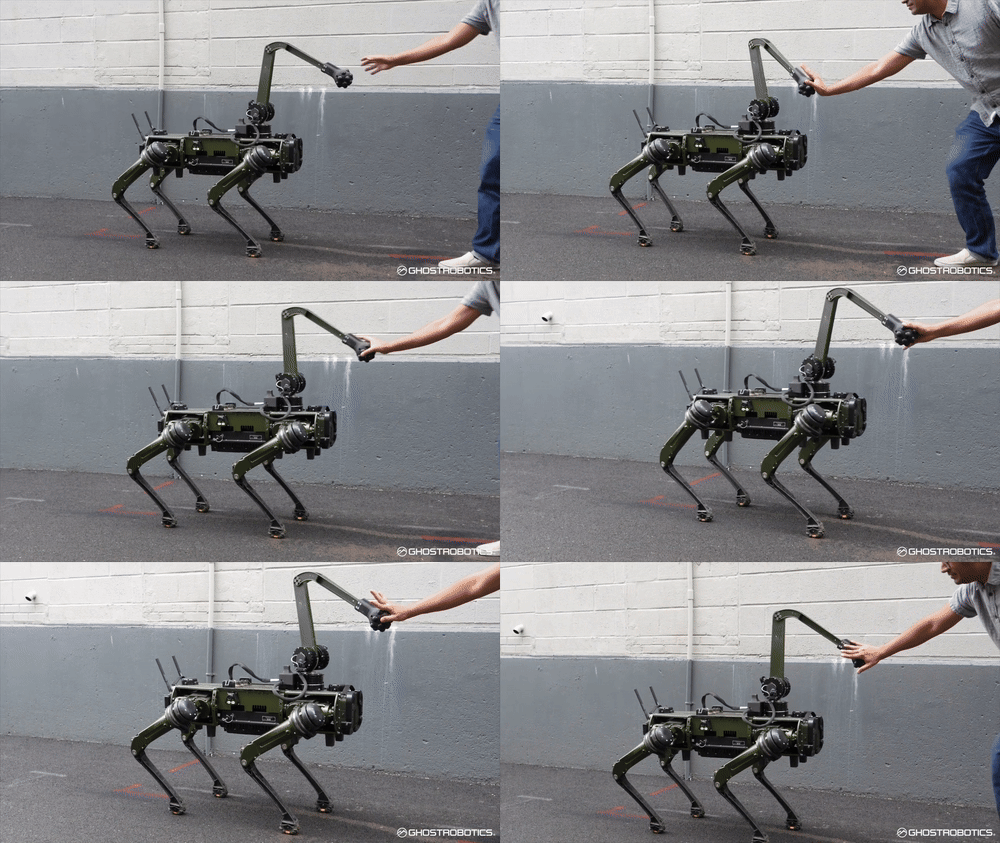
Adding new tools, like an arm, to the platform is the long-term goal. Not humanoids.
The Good Idea Fairy
The biggest internal challenge at a sixty-person robotics company isn’t talent or capital, Kenneally says. It’s the gravitational pull of customer enthusiasm.
“At Ghost, we call it the good idea fairy."
“You talk to a customer and they’re like, oh, I could use the robot in this way or that way, and they kind of want to stretch you in lots of different directions,” he says. “We call it in-house the good idea fairy.”
For a small company competing against much larger ones, the constant temptation is to build one-off integrations and bespoke payloads that don’t scale. Ghost’s discipline — the choice not to chase every interesting use case — is, in Kenneally’s telling, what has kept the company alive long enough to turn ten. The North Star (keep people out of harm’s way) is also a filter. Most requests that arrive through the front door can be sorted by it.
Ten Years Out
Asked where he wants Ghost Robotics in 2036, Kenneally reaches for an analogy that, coming from a robotics CEO in 2026, lands almost as a thesis statement against the prevailing wind of his industry.
“More of a Star Wars world than the one-humanoid-robot being the be-all and end-all.”
Different morphologies, he means, for different jobs. A protocol droid is not an astromech is not a probe droid is not a battle droid. The future Kenneally is building toward has many robots, each shaped by its task, none of them required to be a general-purpose mechanical human.
It is a quieter vision than the one currently dominating the robotics news cycle. It is also, in its way, the same bet Ghost Robotics made in a Penn lab a decade ago: that the path to a real robotics industry runs through robots that ship, not robots that go viral. The dog walking into the Grays Ferry rubble was someone’s. Whoever built it, that’s the market Kenneally saw coming.
So far, the bet has held.