Hyundai Motor Company Plans Massive Deployment of Humanoid Robots Across U.S. Factories
Hyundai Motor Company is preparing one of the largest industrial humanoid robot deployments ever attempted, with plans to introduce more than 25,000 Atlas-based robots into its manufacturing operations over the next several years.
According to reports from Yonhap News Agency, the rollout is expected to begin at Hyundai’s Georgia Metaplant in 2028 before expanding to Kia’s Georgia facility in 2029.
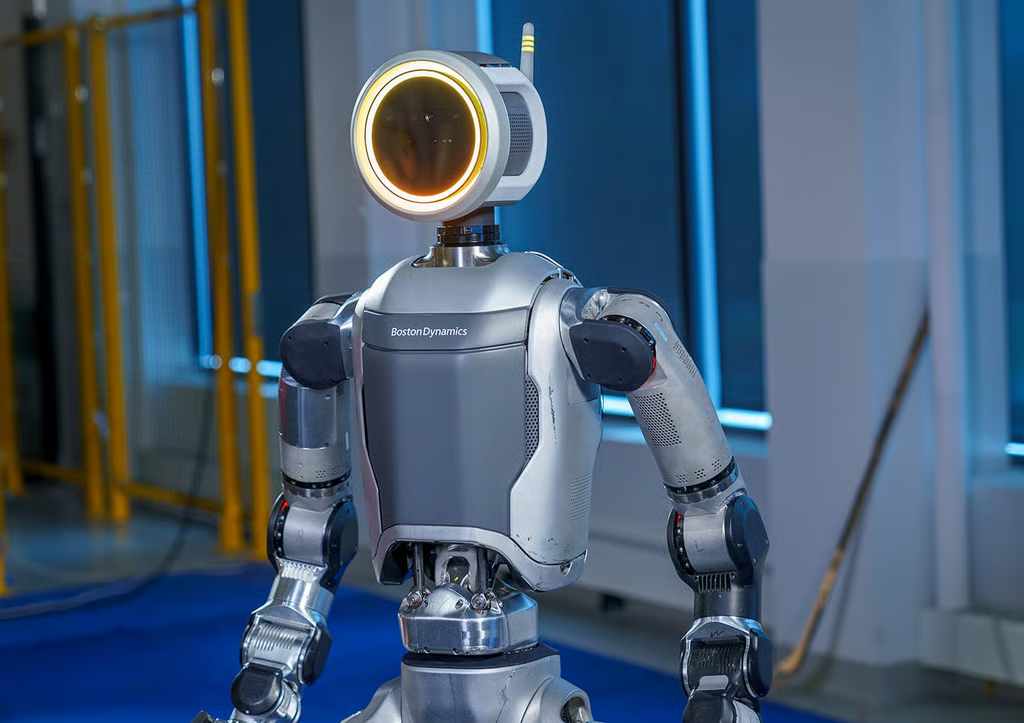
The robots will be based on the Atlas humanoid platform developed by Boston Dynamics, which Hyundai acquired a controlling stake in back in 2021. While Atlas has become widely known online for acrobatic demonstrations and viral videos, Hyundai now appears ready to test whether humanoid robots can perform meaningful industrial labor at scale inside real factories.
The planned deployment marks a major shift not only for Hyundai, but for the broader humanoid robotics industry. Until now, many humanoid robot demonstrations have remained confined to controlled pilots, carefully staged warehouse environments, or research labs. Hyundai’s strategy suggests the company is attempting something much larger: integrating humanoid robots directly into high-volume manufacturing operations.
From Automaker to Physical AI Company
The initiative is part of Hyundai’s broader effort to reposition itself beyond traditional automotive manufacturing and toward what executives increasingly describe as a mobility and AI-driven technology company.
During recent investor relations briefings hosted by JPMorgan Chase, Hyundai outlined a long-term strategy centered on combining artificial intelligence with real-world robotic systems — what many in the industry now call Physical AI.
Under the plan, Hyundai aims to manufacture roughly 30,000 Atlas humanoid robots annually by 2028. More than 25,000 of those units are expected to be deployed internally across Hyundai’s manufacturing ecosystem.
The robots are expected to take on physically demanding and repetitive industrial tasks such as:
lifting heavy components,
transporting materials,
supporting factory logistics,
and handling repetitive assembly-related operations.
According to reports, Hyundai intends to introduce the robots gradually in order to gather operational data, refine safety systems, and improve performance before larger-scale deployment.
That gradual rollout may prove critical. While humanoid robotics has advanced rapidly in recent years, deploying thousands of robots inside dynamic industrial environments introduces enormous technical and operational challenges around reliability, safety, uptime, maintenance, and human-robot coordination.
Building the Humanoid Supply Chain
Hyundai’s ambitions extend well beyond simply deploying robots.
The company is also investing heavily in the underlying supply chain required for mass-scale humanoid production, particularly actuators — the motors and mechanical systems that function as robotic joints and muscles.
According to Yonhap, Hyundai plans to produce more than 300,000 actuator units annually at U.S.-based facilities. The move reflects growing recognition across the robotics industry that component manufacturing and vertical integration may become major competitive advantages as humanoid production scales.
Actuators are widely considered one of the most expensive and technically critical components inside humanoid robots. Improving production efficiency and lowering actuator costs could significantly impact whether humanoid systems become commercially viable at industrial scale.
Hyundai is already using its Seoul headquarters as a real-world robotics testing environment, deploying service-style robots for security, delivery, and facility management applications.
The company is also preparing to launch a Robot Metaplant Application Center in the United States. According to investor briefings cited by Yonhap, the center will use AI systems developed with Google DeepMind to train and improve robotic performance.
Atlas Moves From Viral Videos to Factory Floors
The Atlas humanoid platform has recently demonstrated increasingly advanced manipulation and mobility capabilities, including lifting and transporting heavy and awkward objects such as refrigerators.
Boston Dynamics says the system relies heavily on reinforcement learning and large-scale simulation training, allowing robots to practice millions of virtual task variations before operating in real-world environments.
Atlas also uses proprioception — the robot’s internal awareness of its own movement, balance, and positioning — enabling it to adapt dynamically while carrying unstable or shifting loads.
These capabilities are becoming increasingly important as robotics companies attempt to move beyond tightly scripted demonstrations toward robots capable of handling variability inside real operational environments.
The Next Major Humanoid Test
Hyundai’s strategy places it in growing competition with other major humanoid developers, including Tesla and its Optimus program.
But unlike some competitors pursuing broader consumer or generalized robotics visions, Hyundai’s initial focus appears far more industrial and operationally grounded.
The company’s factories provide something many humanoid robotics firms lack:
controlled deployment environments,
clear economic incentives,
existing logistics infrastructure,
and massive repetitive labor demand.
That could give Hyundai an important advantage in proving whether humanoid robots can generate measurable industrial value rather than simply impressive demonstrations.
The real test, however, will not be whether Atlas can dance, jump, or perform choreographed tasks.
It will be whether thousands of humanoid robots can reliably show up every day, operate safely around human workers, maintain uptime inside high-pressure manufacturing environments, and ultimately justify their cost.
If Hyundai succeeds, it may mark the moment humanoid robots begin transitioning from technology spectacle to industrial infrastructure.
