Multiply Labs Taps NVIDIA Robotics and AI to Scale Cell and Gene Therapy Manufacturing
Multiply Labs, a robotics company focused on biomanufacturing automation, has announced a major milestone in its effort to scale production of cell and gene therapies by integrating NVIDIA’s Isaac and GR00T technologies into its development pipeline.
The move signals a shift for an industry that has long depended on manual, highly specialized processes to produce advanced therapies. While cell and gene therapies hold promise for treating cancer, autoimmune disorders, and rare diseases, manufacturing remains difficult to scale due to labor-intensive workflows, variability, and high costs.
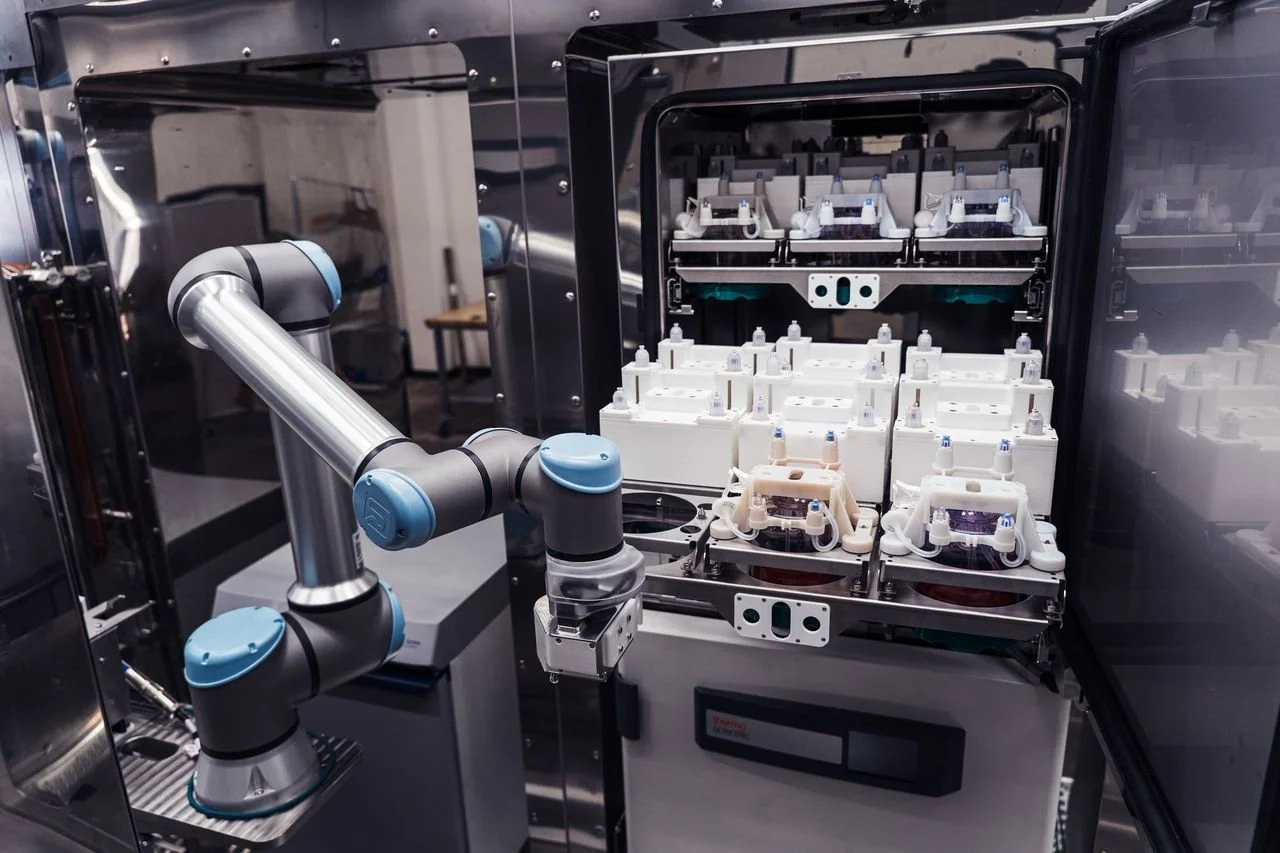
Multiply Labs is developing robotics-first biomanufacturing systems designed to improve consistency, traceability, and throughput. The company’s platform uses four robotic arms operating in parallel and is targeting up to 100 times more patient doses per square foot of cleanroom space compared to traditional manual methods.
To accelerate development, Multiply Labs is leveraging NVIDIA’s robotics and AI infrastructure across three main areas:
Digital Biomanufacturing Twins
Using NVIDIA Isaac Sim, Multiply Labs is building high-fidelity digital twins of its robotic systems to simulate hardware, test automation strategies, and validate software before deployment. This approach is intended to reduce trial-and-error on physical systems and increase confidence prior to on-site execution.
Training and Generalizing Manipulation Skills
The company is exploring NVIDIA Isaac GR00T foundation models to develop manipulation behaviors relevant to biomanufacturing, including material handling, assembly tasks, and adaptation to real-world variability.
Perception Pipelines from Expert Demonstrations
Multiply Labs is also building perception workflows using NVIDIA FoundationPose and FoundationStereo to learn advanced biomanufacturing steps from expert demonstrations. The goal is to capture high-quality training data in true GMP environments without disrupting scientists’ work.
“Advanced biomanufacturing is one of the highest value applications for robots,” said Fred Parietti, co-founder and CEO of Multiply Labs. “By combining our robotic approach with NVIDIA’s simulation, perception, and foundation model technologies, we accelerate development and unlock the next level of scalability for hardware and software systems, driving our robots towards broader patient impact.”
NVIDIA framed the collaboration as an example of physical AI moving into high-impact domains. “Advanced biomanufacturing is a powerful frontier for physical AI,” said Stacie Calad-Thomson, North America Business Development Lead for Healthcare and Life Sciences at NVIDIA. “Multiply Labs is helping translate advances in robotics and AI into meaningful patient impact by increasing reliability and scalability for advanced therapies.”
Multiply Labs’ platform is built around cloud-controlled robotic systems designed specifically for pharmaceutical manufacturing. The company’s team includes engineers and pharmaceutical scientists, and its customers include large global organizations in advanced therapy manufacturing.
As demand for personalized medicine grows, the integration of robotics, simulation, and AI-driven perception is increasingly seen as a path toward making cell and gene therapies more accessible, reliable, and economically viable at scale.
