Tennant’s $250 Million Robotics Bet Signals the Next Phase of Autonomous Cleaning
For decades, floor cleaning was seen as one of the quieter corners of industrial automation. Autonomous scrubbers moved slowly through warehouse aisles after hours, performing repetitive work largely unnoticed by the public. But that market is now becoming a serious robotics battleground — and Tennant Company wants to move fast enough to avoid being disrupted by it.
The Minnesota-based cleaning giant says it plans to grow its robotics business from roughly $85 million in annual sales today to $250 million within the next two years. If successful, autonomous systems would account for nearly 20% of the company’s total revenue, transforming robotics from a side business into a core pillar of Tennant’s future.
That goal reflects something much bigger happening across the robotics industry: autonomous mobile robots are no longer confined to warehouses and logistics centers. They are increasingly moving into everyday operational infrastructure — cleaning floors, transporting materials, and handling repetitive service tasks inside human environments.
A 150-Year-Old Company Reinvents Itself Again
Founded more than 150 years ago, Tennant built its reputation through traditional industrial cleaning equipment. But the company now sees autonomy as essential to staying competitive in a rapidly changing market.
To accelerate the shift, Tennant recently expanded its long-running partnership with Brain Corp, the San Diego-based company providing the autonomous navigation and spatial recognition technology powering many of its robotic cleaners.
The partnership dates back eight years, and Tennant introduced its first robotic floor cleaner in 2018. Since then, the company has launched multiple autonomous products and now plans to introduce ten additional robotic cleaning systems over the next two years.
That level of acceleration required organizational changes internally. Tennant created a dedicated robotics venture inside the company, bringing together engineering, manufacturing, service, sales, and marketing teams under a unified robotics strategy.
Pat Schottler, Tennant’s former chief marketing and technology officer who now leads the robotics effort as senior vice president of robotics, summarized the challenge directly:
“We have to move much more quickly.”
That urgency reflects a reality many legacy industrial companies are beginning to face: robotics is no longer optional infrastructure innovation. It is becoming a survival issue.
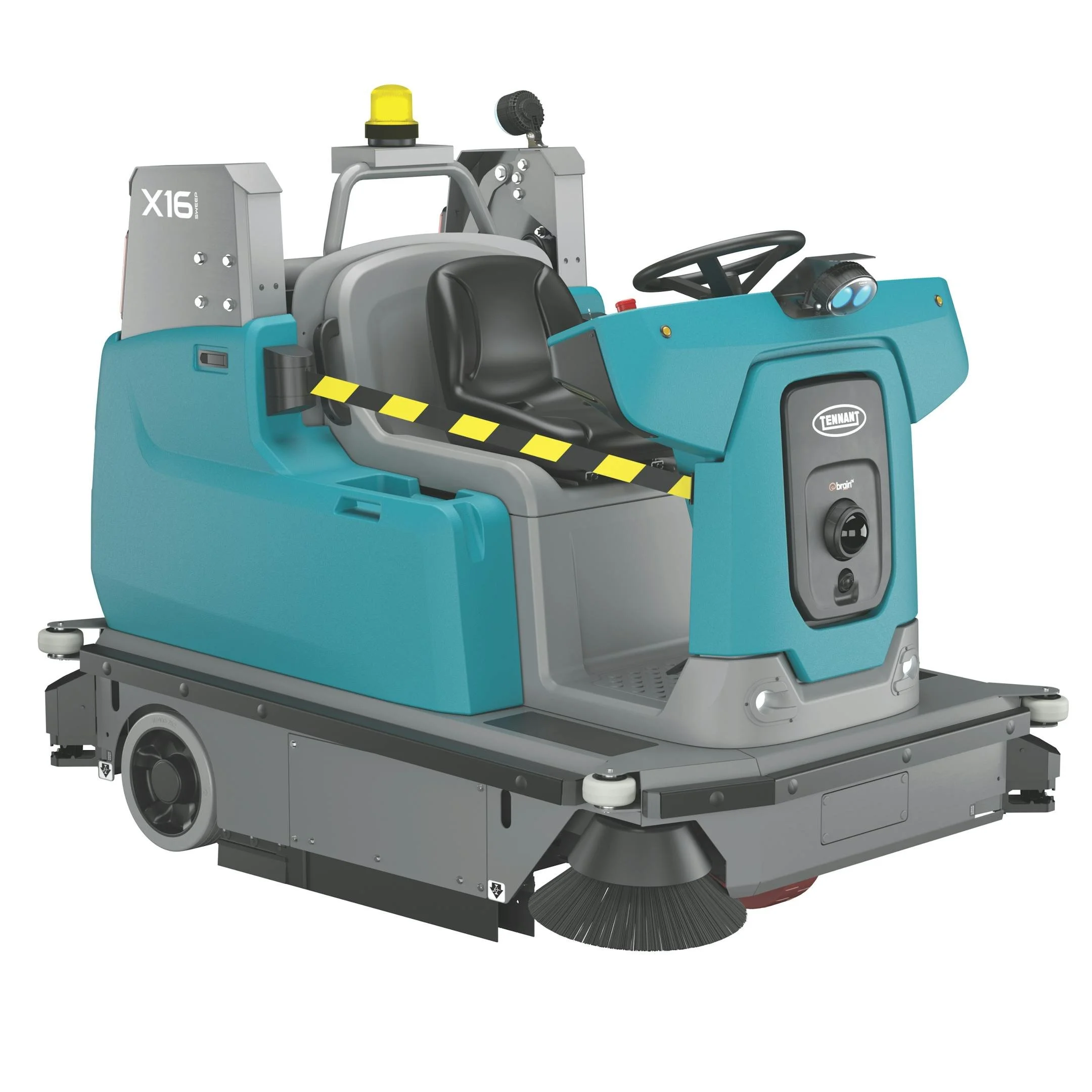
Tennant Co.'s new robotic sweeper, the X16, is one of 10 new AMR devices it expects to introduce in the next two years
The Cleaning Robot Market Is Becoming Crowded
Autonomous floor cleaning may sound niche, but it has quietly become one of the most commercially successful service robotics categories in the world.
Unlike humanoids or highly dexterous robots, robotic floor cleaners solve a narrowly defined operational problem. They operate in structured environments, perform repetitive tasks, and offer measurable labor savings. That combination has allowed adoption to scale faster than many flashier robotics sectors.
But success attracts competition.
Tennant now faces pressure from established industrial cleaning rivals like Nilfisk and Kärcher, both of which have expanded into autonomous systems. At the same time, robotics startups see cleaning as one of the clearest pathways to recurring commercial deployment.
Schottler openly acknowledged the threat:
“There is a real risk of disruption in this industry.”
That statement could apply to much of robotics today. Across sectors, established manufacturers are discovering that autonomy changes competitive dynamics. The winners are not necessarily the companies with the best traditional hardware, but those capable of integrating AI navigation, fleet management, service infrastructure, software updates, and operational data into a scalable platform.
From Big Box Stores to Smaller Spaces
One of the most important developments in Tennant’s roadmap is not just the number of robots it plans to launch, but where those robots are expected to operate.
Early autonomous cleaners were often designed for large, predictable environments such as warehouses, airports, or warehouse retail stores. Their size and navigation requirements limited deployment flexibility.
Tennant’s new systems aim to expand beyond those environments.
The company recently introduced two new robotic products:
The X16 Sweep, Tennant’s first autonomous sweeper
The X2 ROVR, a smaller robotic scrubber designed for tighter environments
The X16 Sweep is particularly notable because sweeping and scrubbing are often sequential workflows. Floors typically need larger debris removed before scrubbing begins. Tennant’s strategy allows the robotic sweeper and robotic scrubber to operate together as coordinated systems.
That may sound simple, but it represents an important shift in robotics deployment. The future of commercial robotics is unlikely to involve single standalone machines operating independently. Instead, many facilities may eventually rely on coordinated fleets of specialized robots working in sequence.
This is where autonomy begins moving from “robotic appliance” to “robotic operations platform.”
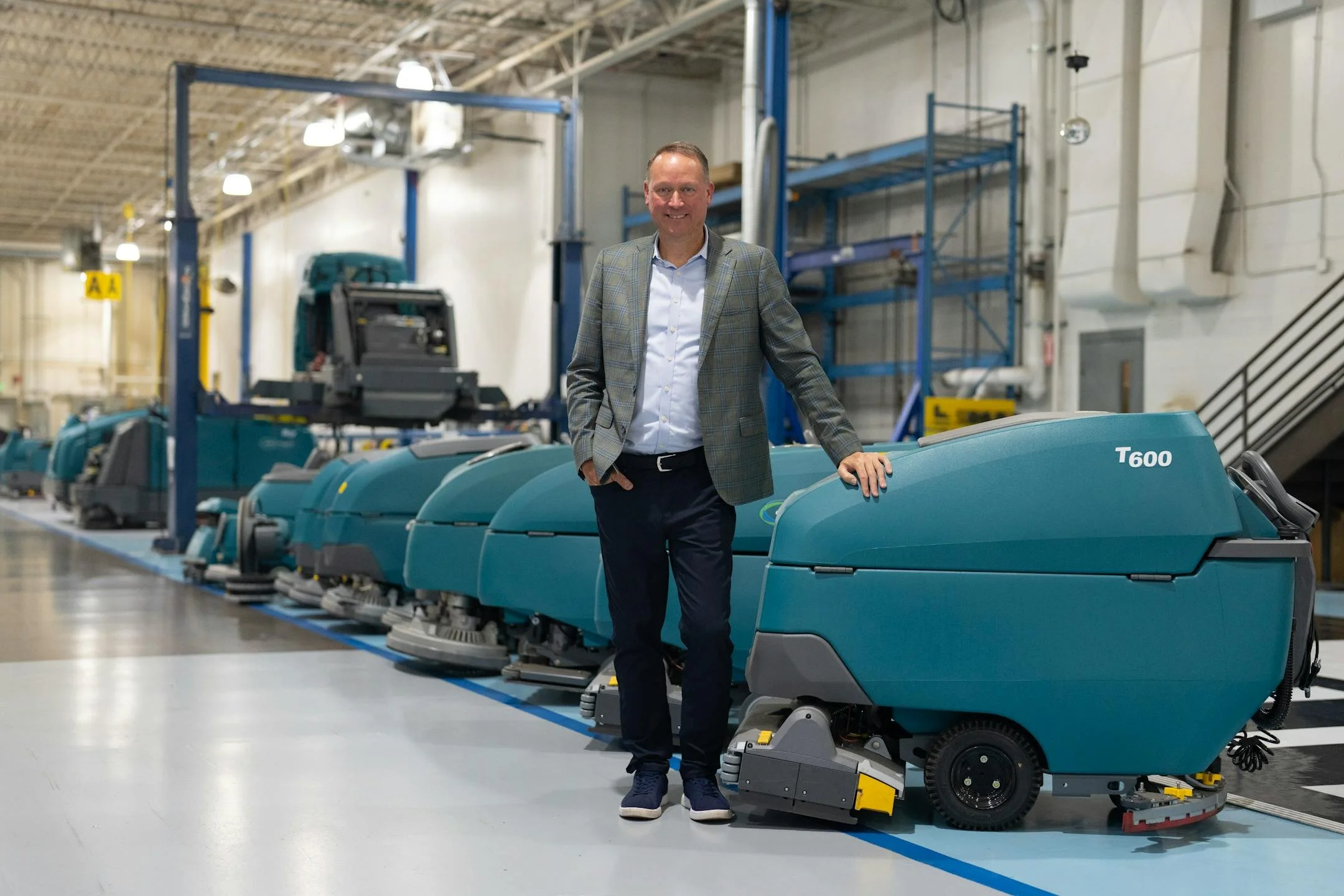
Dave Huml, president and CEO of Tennant, next to cleaning machines at Tennant's manufacturing site
The Labor Story Behind Cleaning Robots
Like many commercial robotics deployments, Tennant’s growth is tied closely to labor realities.
Cleaning work is repetitive, physically demanding, and increasingly difficult to staff consistently. Labor shortages across logistics, retail, manufacturing, and facility services continue pushing companies toward automation solutions that can operate reliably during overnight shifts or supplement existing workers.
Importantly, most cleaning robots today are not fully replacing human workers. Instead, they are reshaping workflows.
Humans still handle edge cases, setup, consumables, exceptions, and detailed cleaning tasks. The robot handles long-duration repetitive movement across large floor areas. This “human-plus-robot” operational model is becoming one of the most commercially viable forms of robotics deployment across industries.
In many ways, cleaning robots represent the broader future of service robotics: narrow autonomy solving operational pain points inside controlled environments.
Growth Amid Operational Turbulence
Tennant’s robotics momentum comes during a turbulent financial period for the company.
The company reported $27 million in autonomous mobile robot sales during the first quarter — an 85% increase year-over-year. That growth helped offset broader operational disruptions tied to a troubled enterprise software rollout that impacted ordering and fulfillment processes late last year.
Overall quarterly sales declined 3% to $297.9 million, while net income fell sharply due to software modernization and one-time costs.
Yet despite those challenges, Tennant continues increasing investment into robotics rather than slowing it down.
That decision reflects a growing belief across industrial markets that autonomy is becoming foundational infrastructure, not an experimental side project.
The Bigger Picture: Quiet Robots, Big Market
Cleaning robots rarely generate the headlines associated with humanoids or AI-powered assistants. But commercially, they may represent one of the most important robotics categories currently scaling in the real world.
They operate daily.
They generate recurring revenue.
They produce measurable ROI.
And increasingly, they gather operational data that can improve future deployments.
That combination matters.
While much of the robotics world remains focused on futuristic demonstrations, companies like Tennant are quietly building large-scale autonomous businesses around narrow but practical use cases.
The next major robotics revolution may not begin with humanoids walking into homes.
It may begin with machines cleaning floors after hours — reliably, repeatedly, and profitably.
