A new autonomous robot designed to inspect the inner infrastructure of the Large Hadron Collider has earned international recognition for its innovative approach to maintaining one of the most complex scientific machines ever built.
The robot—called PipeINEER—was developed through a collaboration between the UK Atomic Energy Authority (UKAEA) and CERN, the European Laboratory for Particle Physics. The project recently received a “Highly Commended” recognition at the Collaborate to Innovate Awards, an engineering award that celebrates breakthrough partnerships in technology development.
Designed specifically for the harsh conditions inside the Large Hadron Collider (LHC), PipeINEER represents a new class of inspection robot capable of navigating spaces far too small and dangerous for human engineers.
A Robot Built for Extreme Environments
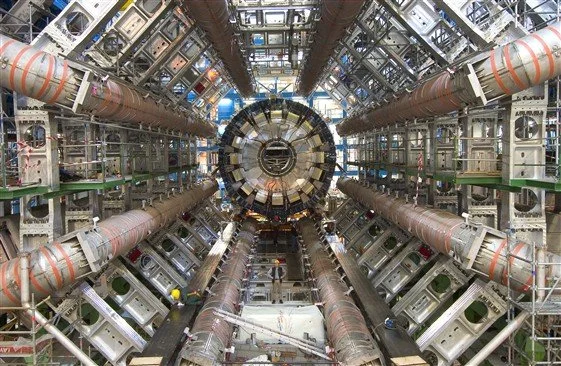
The Large Hadron Collider, located near Geneva on the French–Swiss border, is a 27-kilometre circular particle accelerator buried underground. Within the collider, particles travel at nearly the speed of light through beamlines surrounded by powerful superconducting magnets cooled to approximately –271°C, only a few degrees above absolute zero.
These beamlines operate under ultra-high vacuum conditions, making inspection and maintenance extremely difficult. Much of the infrastructure is also embedded deep within the collider’s structure, meaning traditional inspection methods often require partial disassembly of equipment.
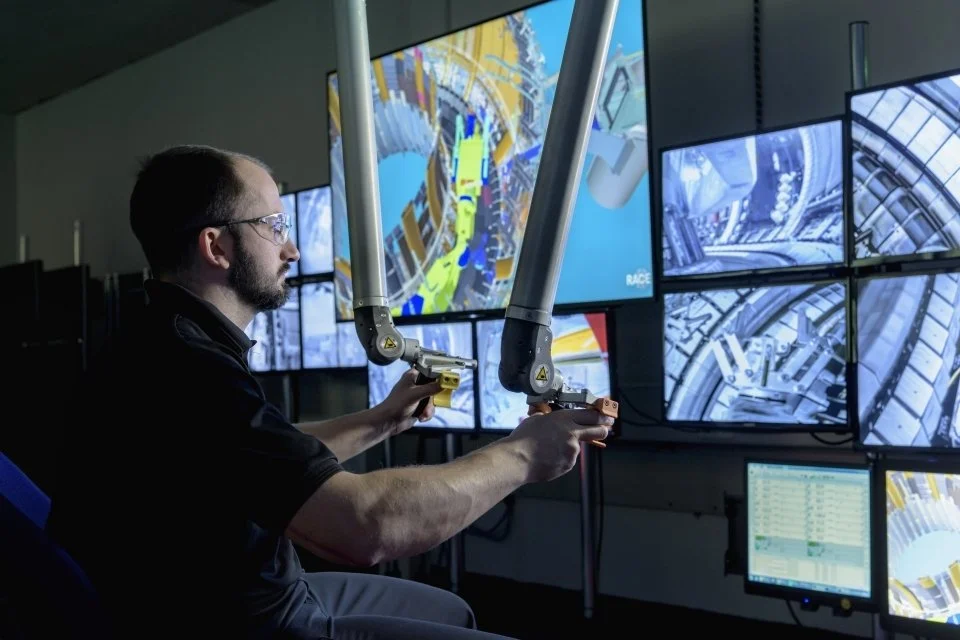
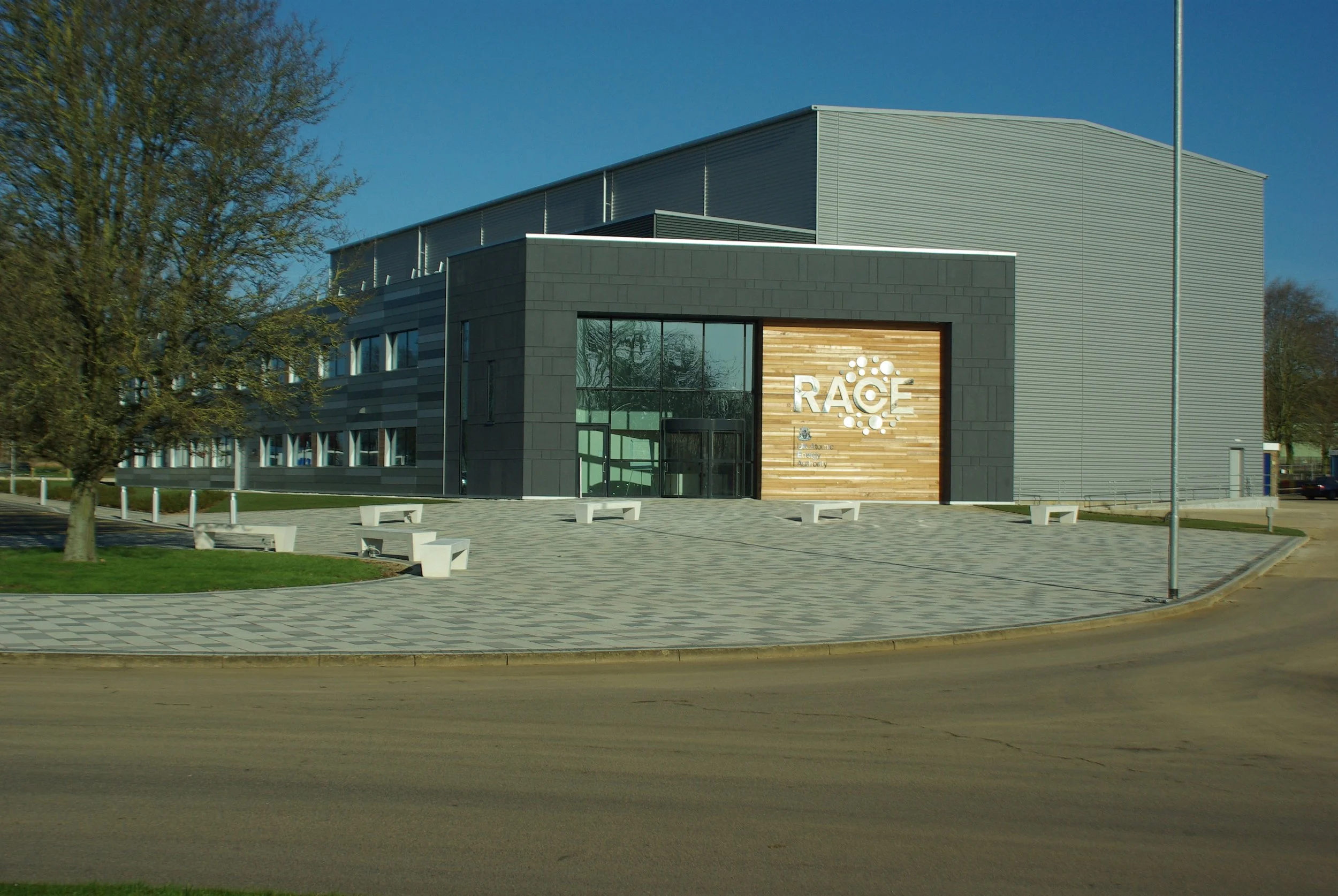
To address this challenge, CERN partnered with UKAEA’s robotics center RACE (Remote Applications in Challenging Environments), which specializes in robotic systems designed for hazardous environments such as nuclear facilities, fusion reactors, and space structures.
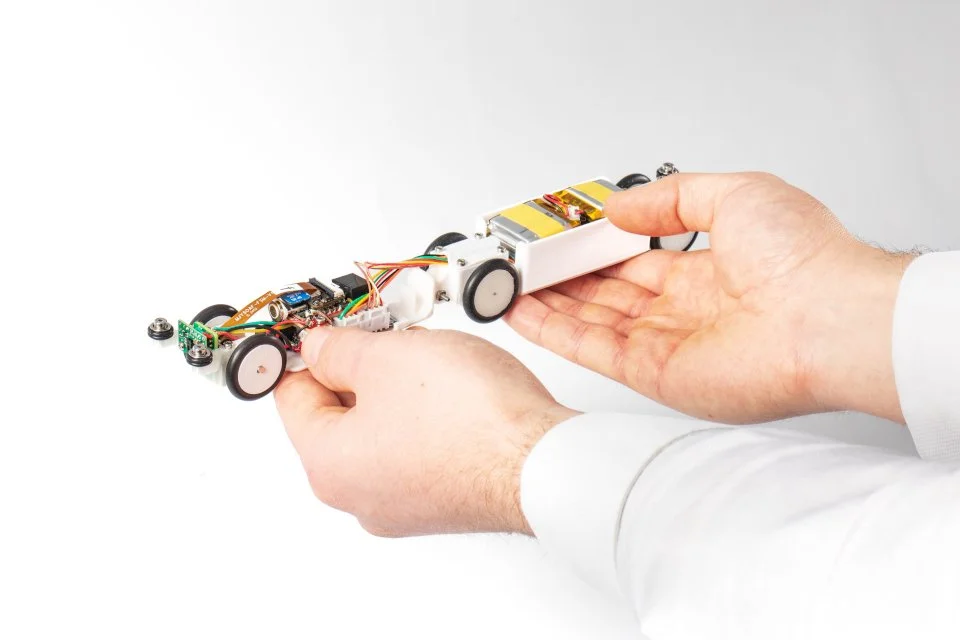
The result of that collaboration is PipeINEER—a robot engineered to move autonomously through narrow pipes that form the collider’s beamline.
Big Challenge, Small Robot
Despite the complexity of the environment it operates in, PipeINEER itself is remarkably small.
The robot measures just 20 centimeters long and is designed to travel through openings as small as 3.7 centimeters by 3.7 centimeters. Once deployed inside the beamline, it can travel up to six kilometers on a single battery-powered mission—roughly the length of 60 football fields placed end to end.
As it moves through the collider, PipeINEER captures high-resolution images of internal components and uses artificial intelligence trained on real LHC imagery to identify potential defects or abnormalities.
If a problem is detected, the robot returns to its starting point and reports the precise location of the issue. Engineers can then target that specific section of the collider rather than dismantling large sections of infrastructure to locate the problem manually.
This approach dramatically reduces both maintenance time and operational costs, while minimizing disruptions to scientific experiments.
Monitoring a Critical Component of the Collider
One of the primary inspection targets for PipeINEER is a set of components known as Plug-In Modules (PIMs). The Large Hadron Collider contains roughly 2,000 of these modules, which help maintain electrical continuity along the beamline.
Within the modules are thin metal contacts called RF fingers that help manage electrical signals as particles move through the collider. Over time, the extreme temperature fluctuations inside the accelerator can cause these components to deform slightly.
Even small distortions can create obstructions inside the beamline, potentially disrupting experiments or causing costly downtime.
By inspecting these areas autonomously, PipeINEER allows CERN engineers to detect and resolve problems before they escalate.
Collaboration Across Scientific Frontiers
The project highlights the importance of collaboration between scientific institutions and robotics experts working in extreme environments.
Nick Sykes, Director of RACE at UKAEA, said the partnership demonstrates how expertise developed for fusion energy research can benefit other major scientific infrastructure.
“This award highlights the power of international collaboration, bringing together UKAEA and CERN alongside the wider global scientific community,” Sykes said. “By combining our remote handling experience with CERN’s scientific excellence, we’re helping ensure the Large Hadron Collider operates safely and efficiently for years to come.”
For CERN engineers, the robot represents a major step forward in maintaining the world’s most powerful particle accelerator.
“PipeINEER will transform how we inspect and maintain the LHC,” said Dr. Giuseppe Bregliozzi, leader of CERN’s Beam Vacuum Operation Section. “It marks a major step forward in keeping our experiments running smoothly.”
Next Steps for PipeINEER
The PipeINEER robots are currently still in the development phase. Later in 2026, the system will undergo extended testing totaling more than 60 kilometers of operation to validate its performance and reliability.
If those tests are successful, final production units will be manufactured toward the end of 2026, with CERN technicians expected to begin operating the robots in early 2027.
For the Large Hadron Collider—a machine responsible for some of the most important discoveries in modern physics, including confirmation of the Higgs boson—the ability to inspect critical components autonomously could play a vital role in keeping experiments running for decades to come.
And for robotics researchers, PipeINEER offers another example of how small autonomous systems are increasingly being deployed to solve big scientific problems in places humans cannot easily reach.
