Humanoid Walks Into the Record Books
In November, a human-shaped robot quietly did something no humanoid had ever done before: it walked more than 100 kilometers across China under its own control.
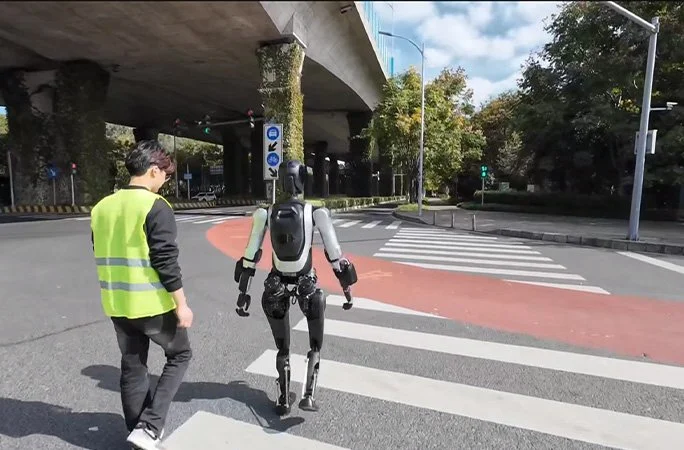
The robot, AgiBot A2, was developed by Agibot Innovation (Shanghai) Technology Co., Ltd.. Between November 10 and November 13, it completed a 106.286-kilometer (66-mile) journey—earning the record for the longest distance ever walked by a humanoid robot.
This wasn’t a lab demo or a staged treadmill test. AgiBot A2 walked for 56 hours, 7 minutes, and 49 seconds, traveling from Jinji Lake in Suzhou to the Bund in Shanghai. To put that in perspective, it’s roughly 16 times the length of the Las Vegas Strip, covered step by step.
Not a Stunt—A Systems Test
Long-distance humanoid walking isn’t about speed or spectacle. It’s about stability, endurance, perception, and failure recovery—the unglamorous problems that determine whether humanoids can operate in the real world.
Before the attempt, AgiBot A2 underwent hundreds of hours of testing focused on one core challenge: not falling. Earlier in August, the robot successfully completed a 24-hour fully autonomous walk in temperatures approaching 40°C (104°F), a stress test broadcast live online.
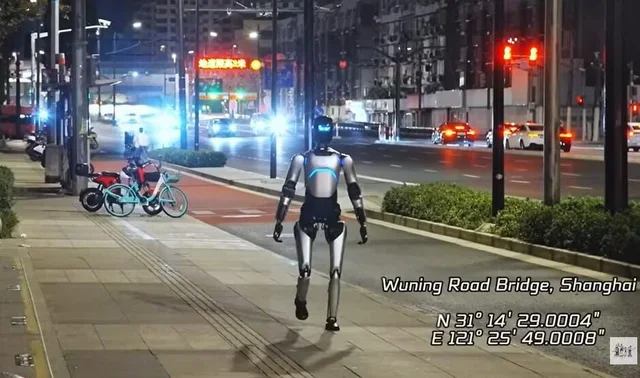
That preparation mattered. Over the four-day journey, the robot encountered uneven pavement, traffic crossings, pedestrians, cyclists, and changing environmental conditions—exactly the kind of variability humanoids struggle with outside controlled environments.
Fully Autonomous, No Strings Attached
Crucially, AgiBot A2 was not remotely controlled and was not guided by humans during the walk. It relied entirely on onboard systems to perceive its surroundings, maintain balance, and navigate toward its destination.
This matters because autonomy—not just motion—is the real bottleneck for humanoids. Walking in a straight line is easy. Walking for days without supervision is not.
Adding to the surreal quality of the journey, AgiBot A2 features a digital face screen, capable of winks and simple expressions. As it moved through cities and along roads, passersby stopped, stared, and pulled out phones—many unsure whether they were watching a robot, a performance, or something in between.
Why This Walk Matters
This wasn’t about beating a distance record for its own sake. It was a systems-level demonstration of durability, energy management, locomotion control, and environmental awareness—core capabilities required for humanoids to move beyond short demos and into sustained real-world operation.
The image of a humanoid robot quietly walking from Suzhou to Shanghai captures something important about the current phase of robotics: progress is no longer just about flashy tasks, but about endurance, reliability, and integration into human spaces.
AgiBot A2 didn’t sprint, jump, or lift heavy objects. It just kept walking.
And sometimes, that’s how history is made.