LimX Raises $200M to Build Embodied Intelligence for Humanoid Robotics
LimX Dynamics has raised roughly $200 million in a Series B funding round, signaling growing global confidence in embodied intelligence as the next frontier of humanoid robotics. The Chinese autonomous robotics company is focused on developing general-purpose legged robots—both humanoids and quadrupeds—that can learn, adapt, and move fluidly in real-world environments.
The funding round drew a diverse mix of institutional and industrial investors. Institutional backers included UAE-based Stone Venture, Oriental Fortune Capital, and Shenzhen Co-Stone Asset Management, while strategic industrial investors such as JD.com, Zhongding Sealing, NRB Corp., and Kyland point to strong downstream interest in deployment and commercialization.
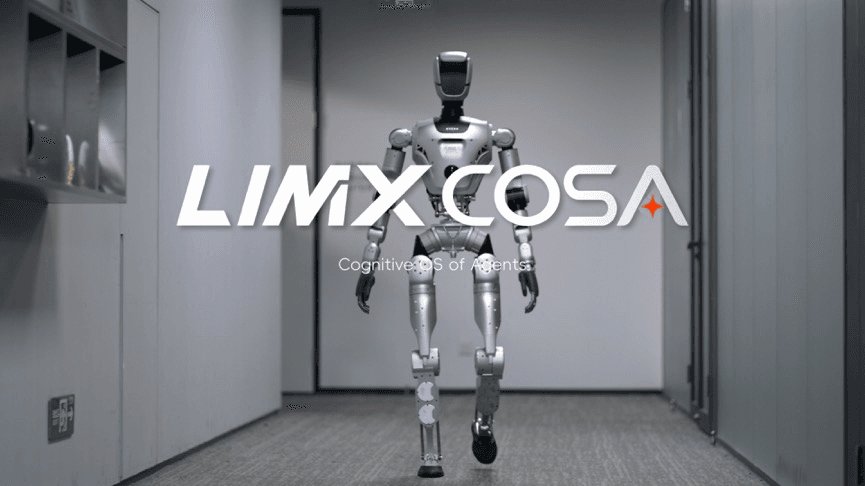
At the core of LimX’s approach is embodied intelligence—a branch of physical AI where learning is driven not just by data, but by interaction. Rather than training intelligence in isolation, LimX’s systems learn through movement, sensing, and continuous feedback from the physical world. Each interaction refines future behavior, allowing robots to better understand balance, force, and spatial relationships over time.
This philosophy is embodied in LimX’s software platform, COSA (Cognitive OS of Agents), which functions as a physical-world-native, agentic operating system. COSA provides the “brain” of LimX robots, coordinating whole-body motion and integrating low-level models that manage complex physics. The company likens COSA to a cerebellum for robots—smoothing motion, reducing hesitation, and enabling more natural, fluid movement compared with traditional control stacks.
COSA is paired with LimX’s hardware platform, Tron 2, a modular system of limbs and torso components that allows builders to rapidly assemble different robot morphologies. Together, the software and hardware platforms support a range of configurations, including dual-arm humanoids, bipeds, quadrupeds, and wheeled-biped hybrids, depending on task requirements.
LimX’s flagship humanoid robot, Oli, stands 165 centimeters tall and weighs 55 kilograms. In demonstrations, Oli can walk over obstacles, navigate uneven terrain, and identify and manipulate small objects such as tennis balls. While some movements retain an uncanny quality common to early humanoids, Oli appears notably nimble relative to many peers currently on the market.
It’s worth noting that LimX’s most polished demonstrations take place in controlled office environments, where variability and chaos are limited. More revealing footage shows the system grappling with edge cases—missed grasps, object slips, and recovery behaviors—highlighting both the progress and the remaining challenges of embodied AI in practice.
According to LimX, the combination of COSA and the Tron 2 platform allows companies to tailor robots quickly for specific applications. Potential use cases span inspection, warehousing, palletizing, hazardous environments, and even domestic or office settings. Rather than betting on a single humanoid form factor, LimX is positioning itself as a flexible platform provider for the emerging era of physical AI.
With $200 million in fresh capital and a modular, embodied-intelligence-first strategy, LimX is placing a big bet on the idea that the future of humanoid robotics will be learned in motion—not just trained in code.
