AGIBOT Hits 10,000 Humanoid Robots—A Tipping Point for Embodied AI
In an industry long defined by demos, prototypes, and cautious pilot programs, AGIBOT just did something different: it scaled.
The company announced the rollout of its 10,000th humanoid robot—an achievement that signals more than manufacturing success. It marks a transition point for humanoid robotics itself, from technical validation to operational deployment at scale.
For years, the central question surrounding humanoids was simple: Can they work?
AGIBOT’s milestone suggests the question is changing: Can they scale?
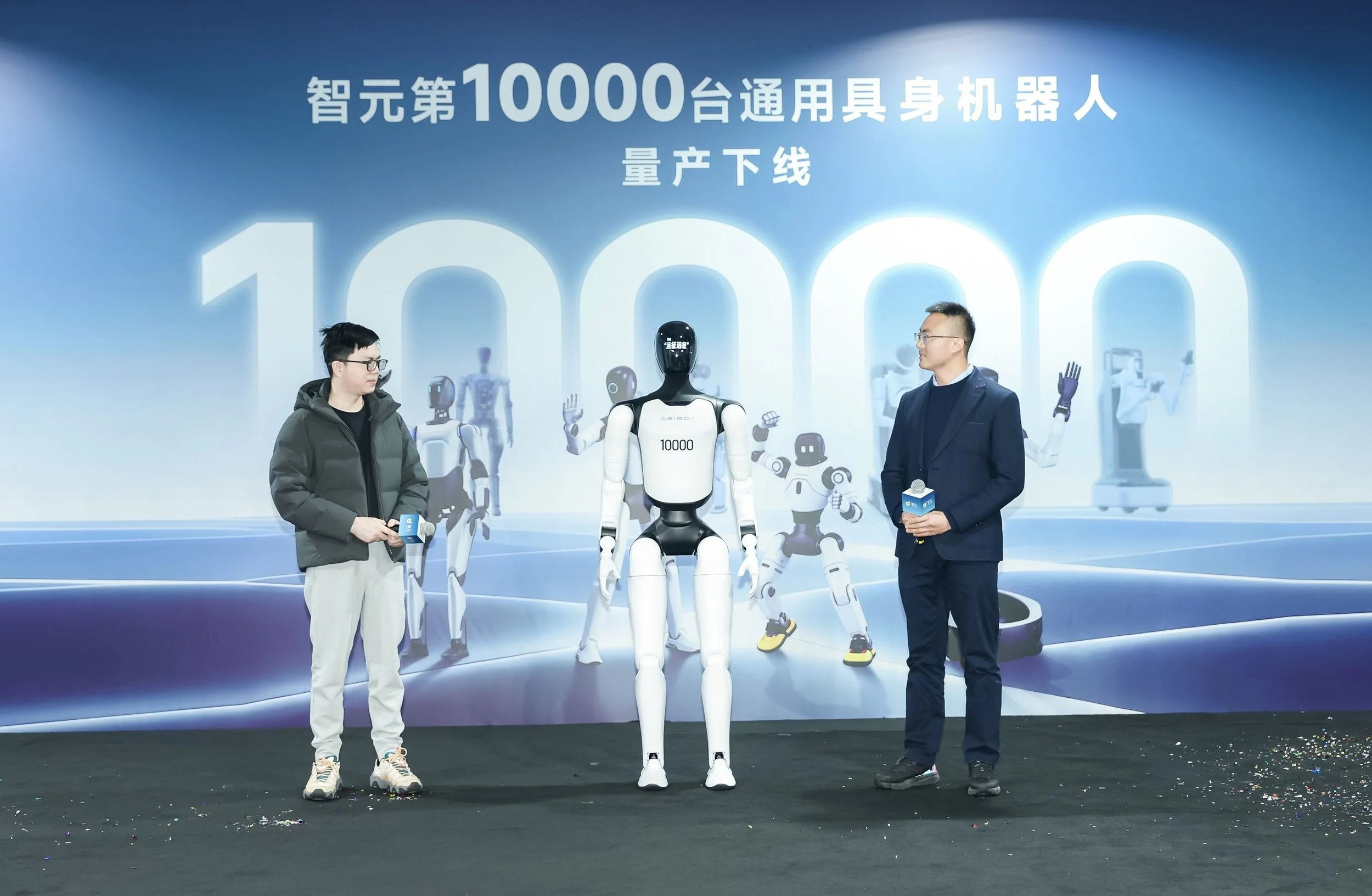
From Prototype to Production Curve
The most telling part of AGIBOT’s announcement isn’t the number—it’s the trajectory.
~2 years to reach the first 1,000 units
~1 year to reach 5,000
Just 3 months to double from 5,000 to 10,000
That curve isn’t incremental—it’s exponential. And in hardware, that matters.
This kind of acceleration reflects something deeper than demand. It signals a maturing supply chain, improved manufacturing repeatability, and tighter integration between hardware and software systems. In other words, the robotics stack is stabilizing.
As CTO Peng Zhihui put it, the milestone is “not simply about producing more robots,” but about a “fundamental shift” in the ability to scale.
Deployment Is the Real Story
Equally important: these robots aren’t sitting in warehouses.
AGIBOT reports that a significant portion of its humanoids are already deployed across:
Logistics and warehouse environments
Retail and showroom navigation
Hospitality and service roles
Education settings
Early-stage industrial workflows
This breadth matters. It suggests that humanoids are not being confined to a single “killer app,” but are instead finding footholds across multiple domains—each with different requirements, constraints, and economic models.
That’s messy. But it’s also how real markets form.
The Global Signal
This is not a China-only story.
AGIBOT’s deployments now span Europe, North America, Japan, South Korea, Southeast Asia, and the Middle East. More importantly, the company points to a shift from pilots to repeat deployments—arguably the clearest signal that customers are moving from experimentation to adoption.
For years, robotics has struggled with the “pilot trap”: successful demos that never translate into scaled rollouts. Crossing that gap is where most robotics companies stall.
AGIBOT appears to be pushing through it.
Scale Changes the Game
At 10,000 units, something else happens: feedback loops.
When thousands of robots operate in real-world environments, they generate continuous streams of operational data—failures, edge cases, human interactions, environmental variability. That data feeds back into system improvement, tightening performance over time.
This is where embodied AI starts to look more like software.
Progress is no longer driven by isolated breakthroughs in labs, but by iterative refinement across deployed systems. Hardware improves. Software adapts. Supply chains optimize. And each layer reinforces the others.
A Milestone—But Not a Finish Line
It’s worth keeping perspective.
10,000 units is significant—but it’s not yet ubiquitous. Humanoids are still early in their deployment lifecycle, and major challenges remain: manipulation reliability, safety in dynamic environments, cost structures, and clear ROI in many use cases.
But milestones like this matter because they shift the conversation.
The humanoid debate is no longer just about whether these systems will work. It’s about how fast they will integrate, where they will deliver value, and what infrastructure—technical, regulatory, and social—needs to evolve alongside them.
AGIBOT’s announcement doesn’t end the humanoid story.
But it does move it firmly into its next chapter.
