China's Octopus Arm in Orbit Could Change Who Owns the Sky
China's orbital ambitions have produced some genuinely striking experiments in recent years — hatching a butterfly in zero gravity, hosting a barbecue in orbit. But among the flashier demonstrations, a quiet test conducted this month may be the most consequential of all.
The Yuxing 3-06 satellite, also known as the Hukeda-2, launched on March 16 carrying an unusual payload: a robotic arm modeled on the flexible, multi-jointed reach of an octopus tentacle. According to CCTV, the craft has now successfully completed a demonstration of that appendage — inserting a nozzled tip into its own dummy fuel port while traveling at roughly 16,800 miles per hour in low Earth orbit. It is a small movement with enormous implications.
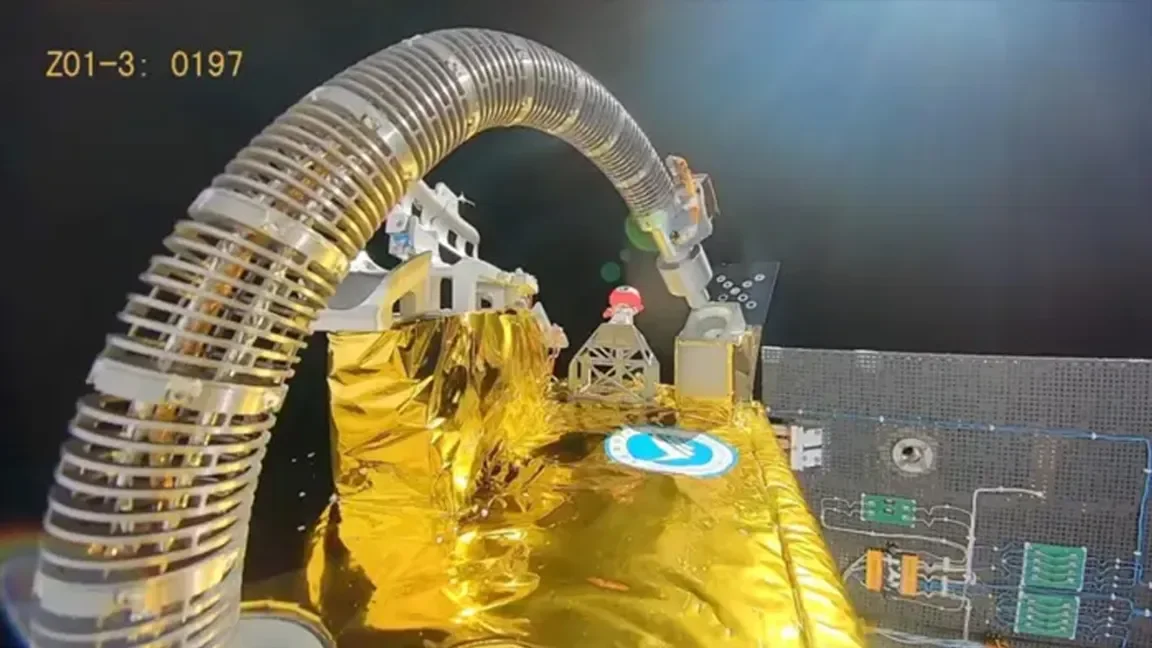
How the Arm Works
The robotic tentacle is not a conventional rigid arm. It is an assemblage of spring-loaded tubes articulated by individually motorized cables, designed to navigate the peculiarities of microgravity with a compliance that rigid systems struggle to achieve. That flexibility matters enormously in orbit, where the tiniest miscalculation in docking geometry can send spacecraft tumbling.
The demonstration encompassed two distinct phases: a compliance control test — essentially proving the arm can move precisely and safely — and a refueling test, in which it successfully connected with a fuel port. Both were completed successfully, according to state media.
Why This Changes Everything
Every satellite currently in low Earth orbit carries a finite quantity of propellant. That fuel is what allows a satellite to maintain its orbital position, fighting against the faint but persistent drag of residual atmospheric gas. When the tank runs dry, the satellite can no longer hold its position and eventually spirals back toward Earth — becoming space junk, and requiring a replacement launch that can cost tens of millions of dollars per craft.
The mathematics of that situation are what make orbital refueling so strategically and commercially significant. A functioning space gas station would not merely extend the lifespan of individual satellites — it would fundamentally alter the economics of operating a megaconstellation. Instead of a continuous cycle of expensive replacements, operators could refuel existing assets and keep them operational for far longer.
A Commercial First
The concept of LEO refueling is not new. DARPA's Orbital Express mission demonstrated fuel transfer between experimental spacecraft as far back as 2007. But the Orbital Express system was purpose-built to explore the mechanics of the problem — a research exercise, not a commercial product.
The Yuxing 3-06 is different. According to its developers, the fuel-arm platform is being positioned as a viable aerospace product within a stated large-scale commercial production program. The successful demo is described as the first step toward an operational, commercial space refueling station — which would be a world first. For China, which already operates over 1,100 satellites as part of an expanding megaconstellation, the ability to refuel that infrastructure in orbit could prove to be a decisive strategic advantage.
Whether the technology can ultimately be made technically reliable and financially viable at scale remains to be proven. But the arm moved, the connection was made, and the clock on that question has started.
