Agovor Raises AU$3 Million to Advance Autonomous Horticulture Robotics
New Zealand-founded agritech robotics company Agovor has secured AU$3 million in a pre-seed funding round aimed at accelerating the development and deployment of autonomous robotic systems for horticulture. The investment signals growing industry confidence in smaller, practical automation solutions designed to address labor shortages and sustainability pressures across specialty crop production.
The oversubscribed round was led by Tenacious Ventures, with co-investment from Hort Innovation Australia through the Hort Innovation Investment Fund, alongside participation from an individual investor through the Active Investor Plus (AIP) scheme facilitated by Invest New Zealand.
Practical Robotics for Real-World Farming
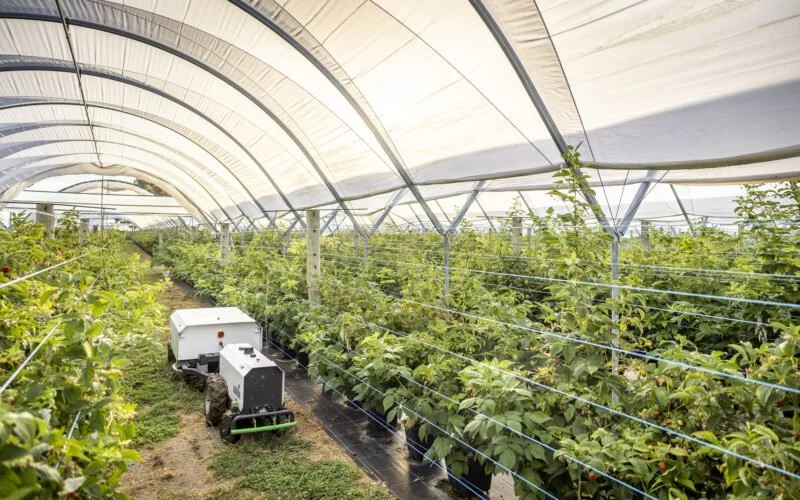
Agovor’s approach focuses on lightweight, affordable automation tailored to the needs of horticulture operations rather than large-scale row-crop farming. Its solution combines an electric autonomous eTractor with a series of smart towed attachments, including mowers and sprayers, designed to operate in challenging agricultural environments.
The small tractor-and-trailer units can run continuously for up to 10 hours, navigate narrow rows common in orchards and vineyards, and function in variable weather conditions including heat, rain, and wind. The system targets labor-intensive environments such as berry tunnel houses, vineyards, and specialty crop orchards where traditional large machinery can be impractical.
Co-founders Richard Beaumont and Simon Carroll said the funding reflects industry validation of their philosophy: building practical automation tools shaped by real agricultural needs.
“We built something that worked for us, and it’s been encouraging to see our first customers across New Zealand and Australia finding the same value,” Beaumont said.
Data, Fleet Management, and Sustainability Gains
Central to the platform is the Agovor Portal, a software interface that allows operators to deploy, monitor, and manage individual robots or entire fleets remotely. The emphasis on fleet-level management reflects broader trends in agricultural robotics toward scalable autonomy rather than single-machine deployment.
According to Hort Innovation Australia, early adopters are already reporting measurable benefits, including annual savings of more than $30,000, a 90% reduction in water use, and a 12.5% reduction in chemical inputs. These outcomes align with growing regulatory and market pressure to improve sustainability metrics in agricultural production.
Scaling Manufacturing and Market Expansion
CEO Mike Riley said the new funding will support accelerated research and development, alongside expanded manufacturing operations in Sydney, Australia. The company is also investing in sales and service infrastructure across both New Zealand and Australian markets as demand grows.
Agovor is expanding its workforce across engineering, manufacturing, and commercial roles, reflecting a broader trend toward regional robotics ecosystems emerging around agriculture-focused innovation hubs.
A Different Model for Agricultural Automation
While much attention in robotics has focused on humanoids or fully autonomous large-scale machinery, companies like Agovor are demonstrating a parallel pathway centered on specialized, task-focused automation. By targeting high-value horticulture sectors and designing robots that integrate into existing workflows, the company aims to lower adoption barriers for growers.
As agricultural producers increasingly seek solutions that address labor constraints while improving sustainability and operational efficiency, smaller autonomous platforms may represent one of the fastest paths toward widespread robotic adoption in farming.
