Fincantieri and Generative Bionics Partner to Develop Humanoid Welding Robot for Shipyard Operations
Italian shipbuilding giant Fincantieri has announced a new industrial partnership with robotics company Generative Bionics aimed at developing a humanoid welding robot designed to operate alongside human workers in complex shipyard environments. The collaboration reflects growing interest in deploying humanoid robots for demanding industrial tasks where flexibility, safety, and adaptability are critical.
Bringing Humanoids into Heavy Industry
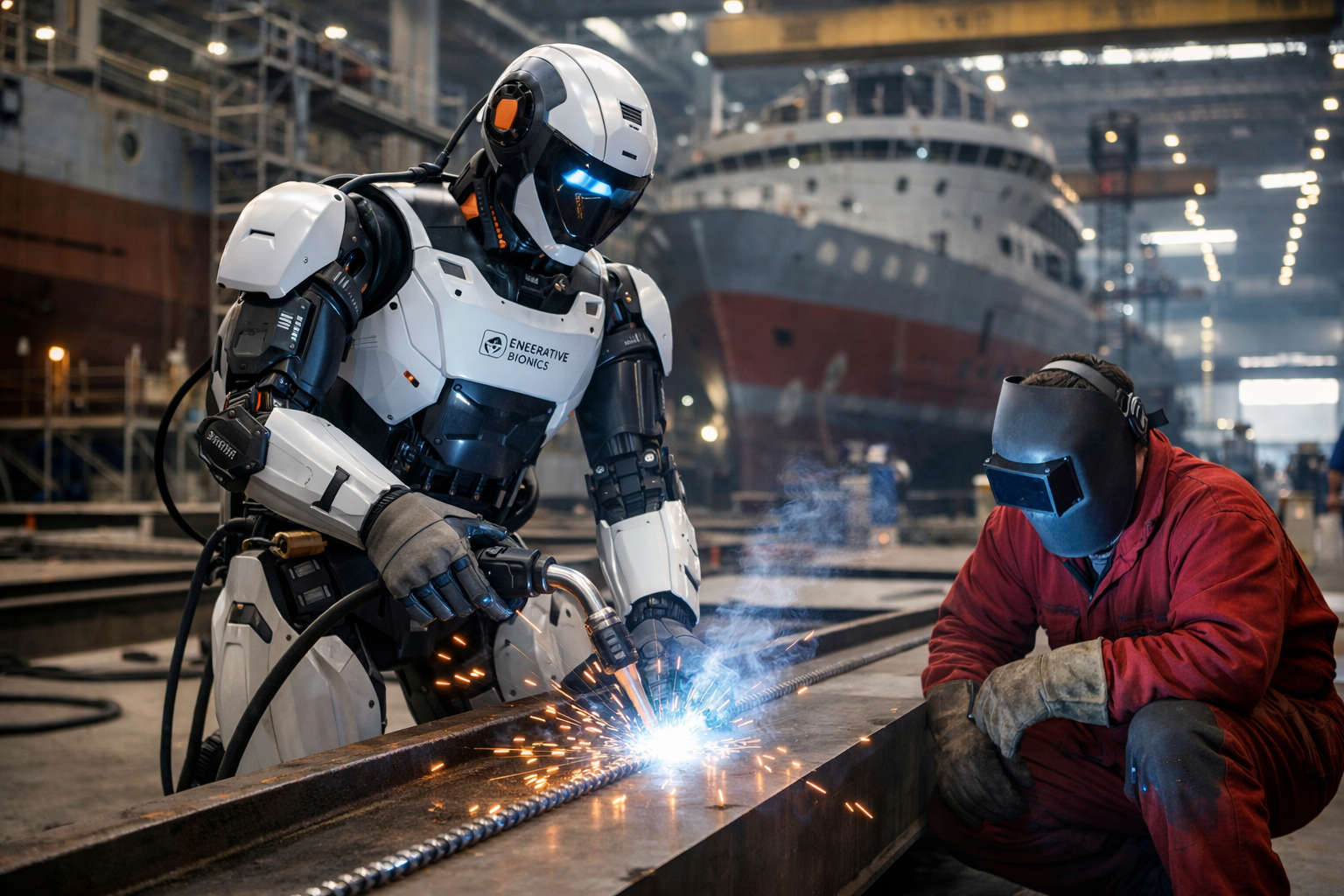
The project will focus initially on developing a humanoid robot capable of supporting specific welding activities in naval manufacturing. Unlike traditional fixed robotic welding systems, the proposed humanoid platform is intended to move through dynamic workspaces and assist in environments characterized by tight spaces, changing layouts, and high structural complexity.
The robot will integrate artificial intelligence with advanced manipulation, perception, and vision capabilities to monitor welding seams and maintain precision. Optimized locomotion systems will allow it to navigate industrial shipyards while working collaboratively with human operators.
Safety is a central requirement of the program, with the system designed to operate within regulatory frameworks without restricting existing work areas or workflows.
A Four-Year Path to Industrial Deployment
The partnership outlines a four-year development timeline focused on rapid operational integration. Initial on-site testing is expected to begin by the end of 2026 at Fincantieri’s Sestri Ponente shipyard, which will serve as the primary environment for industrial validation and certification.
Operational functionality is targeted within the first two years of the program, followed by refinement phases aimed at expanding capabilities and achieving industrial-scale certification.
For Generative Bionics, the collaboration represents one of the company’s first structured validation pathways in a high-complexity manufacturing environment—a critical milestone for humanoid robotics companies seeking to demonstrate real-world industrial viability.
Addressing Workforce and Production Challenges
The initiative aligns with Fincantieri’s broader industrial strategy, which emphasizes advanced robotics, Physical AI systems, and innovation as core pillars of its new industrial plan. Shipbuilding faces increasing production complexity alongside persistent shortages of skilled labor, creating pressure to adopt automation solutions that enhance productivity while supporting human workers.
Rather than replacing labor outright, the humanoid welding system is positioned as an assistive tool designed to reduce repetitive and ergonomically challenging tasks while maintaining high standards of safety and quality.
This approach reflects a broader trend in robotics toward collaborative systems that augment human capabilities rather than fully automate processes.
European Strategic Context
Beyond operational objectives, the partnership carries strategic implications within Europe’s push for technological sovereignty. By combining industrial expertise with advanced robotics development within the European supply chain, the project contributes to regional efforts to strengthen domestic capabilities in automation and artificial intelligence.
The humanoid welding initiative also complements other robotics validation programs underway within the Fincantieri Group, expanding the range of manufacturing activities targeted for automation using next-generation robotic platforms.
Humanoids Enter the Industrial Validation Phase
While humanoid robots have long captured public imagination, projects like this highlight a shift toward practical deployment in demanding industrial settings. Shipyards represent particularly challenging environments due to scale, variability, and safety requirements—making them a proving ground for whether humanoids can deliver measurable value beyond traditional automation systems.
As industrial companies explore Physical AI solutions, success will likely depend not only on robotic capability but also on integration into existing workflows, workforce collaboration, and regulatory acceptance.
The Fincantieri–Generative Bionics partnership signals that humanoid robotics is moving closer to real-world application—one welding seam at a time.
