Alpha Bipedal Arrives: Humanoid’s Five-Month Sprint to a New Benchmark in Robotics
Humanoid, the UK-based robotics and AI company, has unveiled HMND 01 Alpha Bipedal, a humanoid robot developed at a pace that resets expectations for the entire sector. Built from first sketch to fully operational prototype in just five months—a process that typically takes 18 to 24—Alpha reached stable walking 48 hours after final assembly. What usually takes teams weeks or months happened over a single weekend.
That speed comes from Humanoid’s tight integration of simulation and hardware design. Engineers built near-perfect digital twins using ultra-precise 3D modelling, dramatically shrinking the sim-to-real gap that slows most humanoid programs. In NVIDIA Isaac Sim and Isaac Lab, the team trained 52.5 million seconds of reinforcement-learning locomotion—about 19 months of real-world experience—in just two days. The robot then took its first physical steps after only 3.2 million seconds of additional training, needing minimal domain randomization to handle real-world pushes up to 350 Newtons.
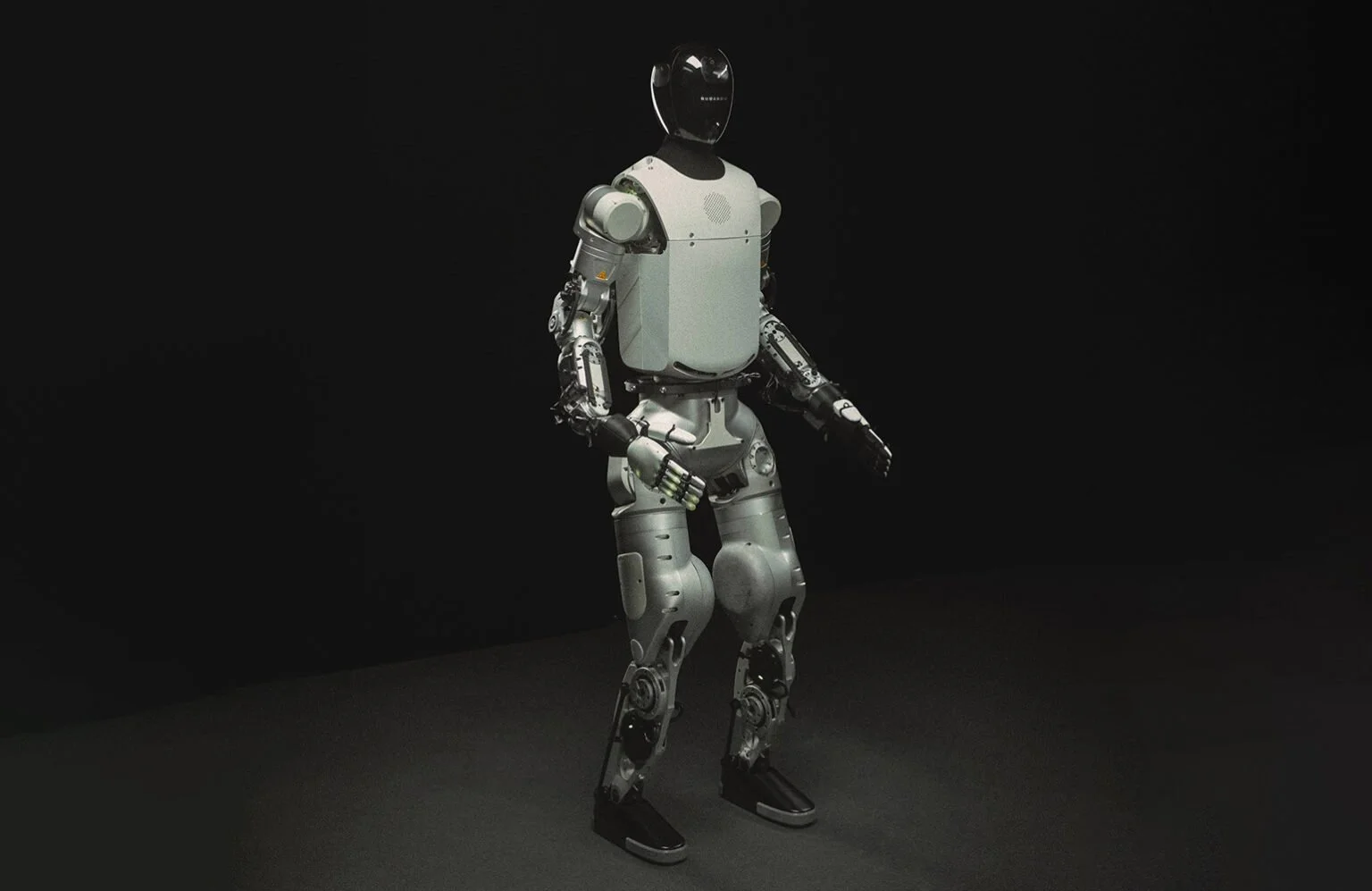
The HMND 01 Alpha Bipedal Source: Humanoid
Standing 179 cm (5'10") tall with 29 degrees of freedom, Alpha pairs upper-body strength with a bimanual payload capacity of 15 kg (33 lbs). Its modular end-effectors range from 12-DoF five-fingered hands to simple parallel grippers, while its head integrates six RGB cameras, depth sensing, and a six-microphone array. Powered by NVIDIA Jetson Orin AGX and Intel i9 processors, Alpha runs for three hours on a swappable battery and carries a full suite of haptic, force/torque, and joint-torque sensors for precise manipulation.
Founder and CEO Artem Sokolov frames Alpha as a response to widening labor shortages and mounting physical demands in both industrial and domestic environments. With manufacturing sectors facing worker gaps of up to 27% and billions of hours spent globally on unpaid care and household labor, Sokolov argues that humanoids can meaningfully augment human workers and expand quality of life.
Alpha Bipedal is built for robust, repeatable performance across industrial, household, and service settings. It can walk straight or curved paths, turn in place, sidestep, squat, hop, run, coordinate with other robots, and recover from omnidirectional pushes. A multimodal interaction system—displays, LEDs, speakers, and audio sensing—supports human engagement, while Humanoid’s KinetIQ framework enables higher-level reasoning and task execution through VLMs and VLAs.
Designed with modularity at its core, Alpha allows upgrades to hands, upper-body modules, and even garments, optimizing the platform for low total cost of ownership and fast adoption of new AI behaviors. The new biped builds on the company’s earlier wheeled Alpha platform, which has already completed its first commercial pilots in industrial and logistics settings.
With Alpha Bipedal, Humanoid positions itself as a fast-moving contender in the race to bring practical, adaptable humanoids into factories, warehouses, and eventually homes—pushing the industry toward a future where development cycles are measured not in years, but in months.
