Ant Group’s Open-Source Robotics AI Signals China’s Next Move in Embodied Intelligence
For years, the global race in robotics has focused on hardware: faster actuators, lighter materials, more agile humanoids, and increasingly theatrical demonstrations. But beneath the flips, dances, and viral videos lies a quieter bottleneck—intelligence.
This week, Chinese fintech giant Ant Group made a decisive move to address that bottleneck, open-sourcing its first artificial intelligence models designed specifically for robotics. The announcement marks a strategic shift not just for Ant, but for China’s broader robotics ecosystem: from building impressive machines to building scalable robotic “brains.”
From Fintech to Physical AI
Ant Group, best known as the fintech affiliate of Alibaba, is expanding aggressively into embodied intelligence—AI systems that perceive, reason, and act in the physical world rather than purely digital environments.
Through its robotics subsidiary, Ant Lingbo Technology (Robbyant), the company released LingBot-VLA, a vision-language-action (VLA) model designed to serve as a “universal brain” for robots. VLA models integrate perception, language understanding, and motor control, enabling robots to interpret instructions and execute physical tasks with greater autonomy.
“Our goal is to accelerate the integration of AI into the physical world so it can deliver practical value sooner,” said Robbyant CEO Zhu Xing, highlighting a core challenge facing the industry: building foundation models that are both powerful and deployable on real hardware.
The Humanoid Paradox: Spectacle vs. Utility
China already leads the world in robot deployment, spanning industrial automation and humanoid systems. Yet many of its most visible humanoids—including high-profile models from Unitree Robotics—still rely heavily on preprogrammed routines.
This gap between spectacle and utility is not unique to China. Across the global robotics industry, machines can perform dazzling demonstrations but struggle with generalization—the ability to adapt to unfamiliar tasks and environments.
Chinese AI researchers and investors increasingly view this limitation as the central obstacle to making robots economically productive. In that sense, Ant’s move is less about robotics hardware and more about redefining the core value proposition of robots themselves.
VLA Models as the New Operating System for Robots
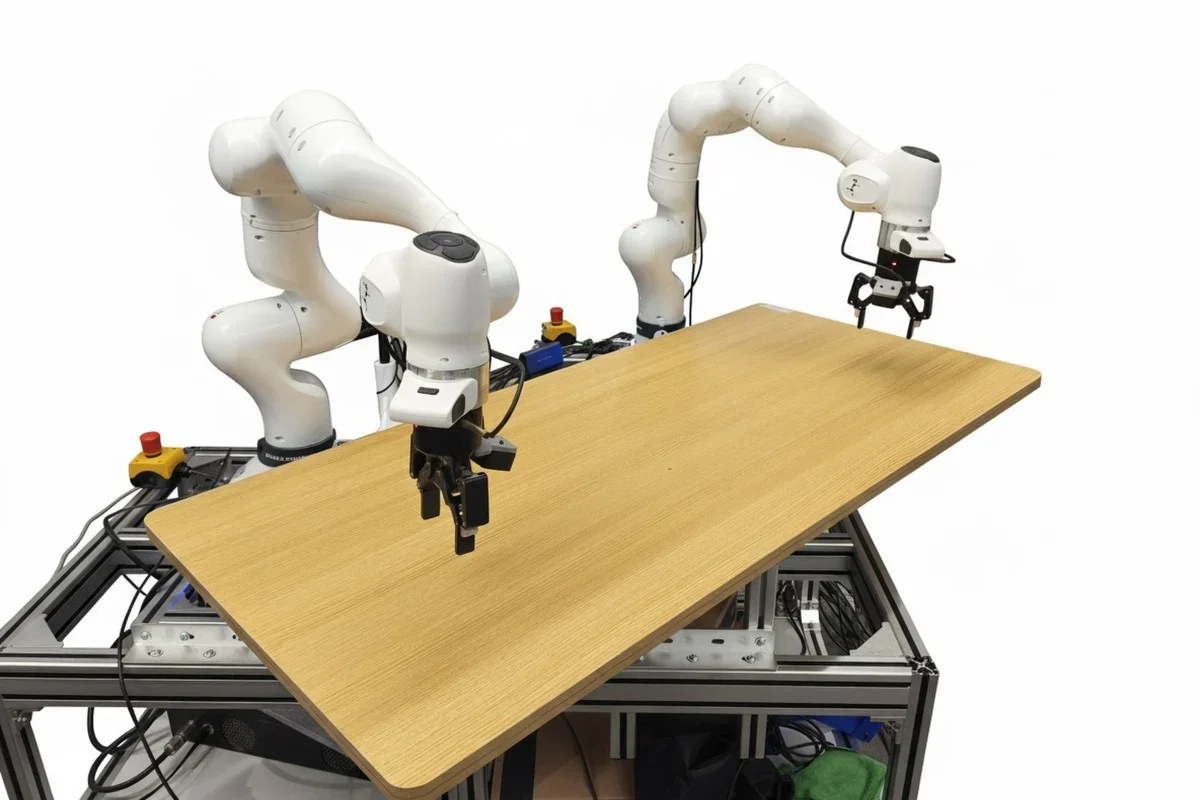
In technical testing, Ant’s LingBot-VLA was evaluated on dual-arm robots from AgiBot and other domestic firms such as Galaxea Dynamics and AgileX Robotics. The system reportedly demonstrated stronger generalization and training efficiency than competing VLA models.
Robots using the model were tested across roughly 100 tasks, including unscrewing bottle caps, loading weights onto a dumbbell, and peeling a lemon—mundane actions that highlight a deeper truth: the future of robotics will be measured less by spectacle and more by competence in ordinary tasks.
Yet the data challenge remains formidable. Ant trained its model on approximately 20,000 hours of real-world robotics data—comparable to datasets used by U.S. startup Physical Intelligence—but acknowledged that a truly universal robotic brain will require orders of magnitude more data across diverse platforms, from single-arm systems to humanoids.
World Models and the Battle for Simulation Supremacy
To address the data bottleneck, Ant also released its first world model, LingBot-World, which it claims rivals Google DeepMind’s Genie 3 system. World models allow robots to learn in simulated environments, reducing reliance on costly real-world data collection.
Ant now joins Tencent and SenseTime in pursuing world-model approaches, signaling that China’s AI giants increasingly see simulation—not just hardware—as strategic infrastructure for robotics.
This mirrors a broader global trend: the emergence of simulation, foundation models, and embodied AI as the true battleground of robotics.
Why This Matters Beyond China
Ant’s open-source move is not just a technical milestone—it’s a geopolitical and economic signal.
If robotics hardware was the first phase of China’s rise, embodied AI may be the second. By open-sourcing robotic foundation models, Ant is attempting to accelerate ecosystem adoption, attract developers, and shape the architecture of future robotic systems.
The implication is profound: the next wave of robotics competition may not be decided by who builds the best robot, but by who builds the most scalable, interoperable, and trainable robotic intelligence.
In that sense, Ant’s announcement is less about a single model and more about a strategic pivot—from robots as machines to robots as platforms.
And in the global race for physical AI, platforms tend to win.
