Australia Just Built an AI Supercomputer Next to Its Robots. Here's Why That Matters — and Where It Falls Short.
For most of the past decade, the conventional wisdom in AI infrastructure has been simple: build it bigger, build it centralized, and pipe data to it from wherever it's generated. Hyperscale cloud data centers in remote regions, fed by fiber backbones from every corner of the world, became the default.
Australia's national science agency, CSIRO, is now betting on a different model. Last week the agency unveiled Vetra, a compact, purpose-built AI computing facility located at its Queensland Centre for Advanced Technologies (QCAT) in Pullenvale — physically adjacent to Australia's largest robotics research facility. The pitch: bring the compute to the robots, not the robots to the compute.
It's a meaningful bet, and one worth examining honestly. There are real reasons it could matter, and real reasons to be skeptical.
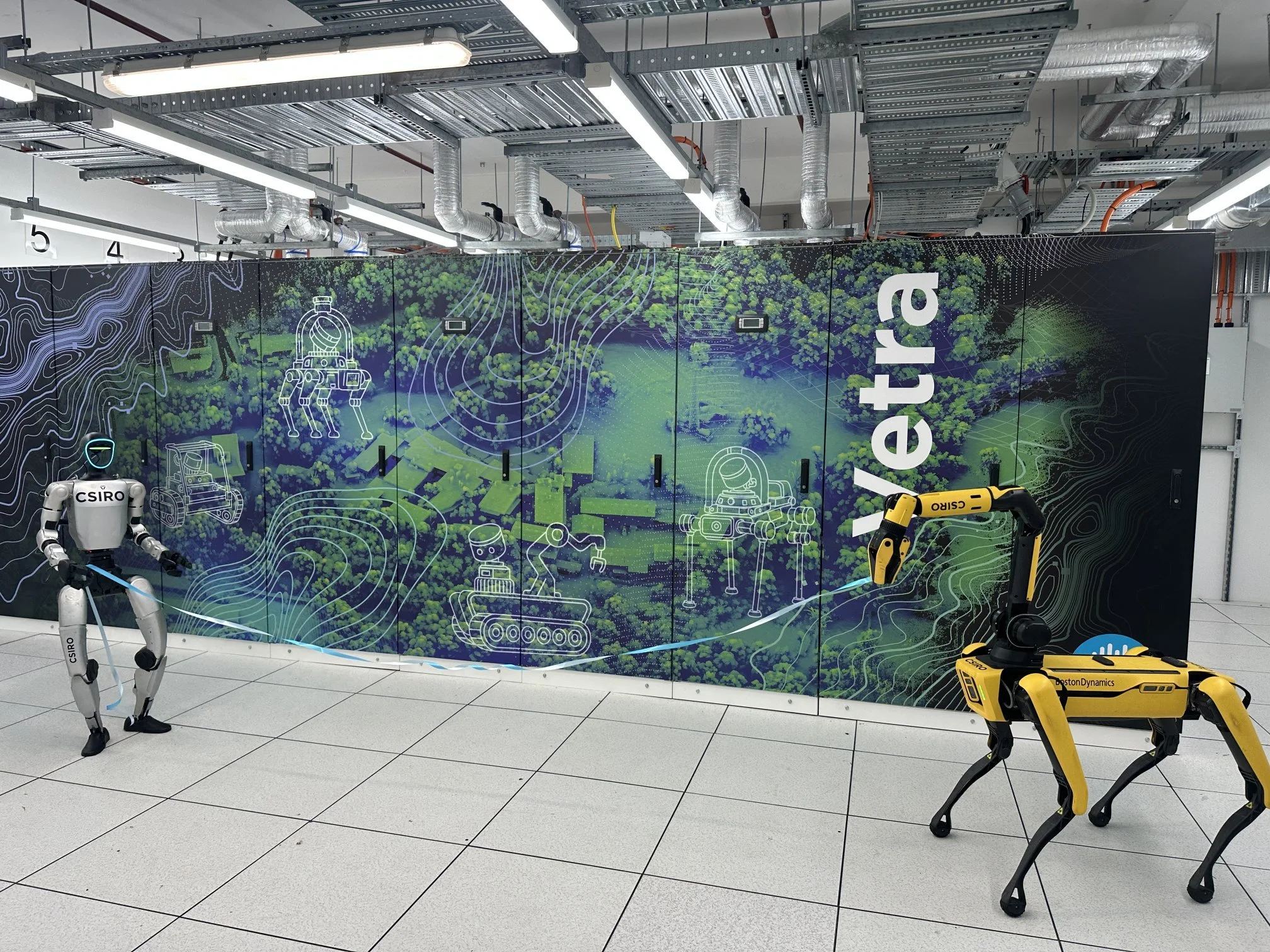
CSIRO's new AI infrastructure, Vetra, sits alongside Australia’s largest robotics research facility.
The Case for Edge AI
Vetra is what's known as an edge computing facility — AI systems that run close to where data is generated, rather than sending that data hundreds or thousands of kilometers to distant servers for processing. For applications involving physical machines that have to make decisions in real time — autonomous robots, sensing networks, safety-critical systems — the latency of a round trip to the cloud can be a dealbreaker.
Liming Zhu, director of CSIRO's Data61, frames it as a category problem with cloud-only architectures. "AI is rapidly moving beyond digital systems into the physical world, including robots, infrastructure, sensing and safety critical environments," he said. "Vetra enables real-time physical AI research by bringing high performance computing to the edge, where proximity to data allows systems to respond, learn and operate safely in complex environments in ways that are not possible with cloud only or distant data centre approaches."
Vetra packs 48 high-performance GPUs into a modular footprint and is designed to expand as demand grows. It works in concert with CSIRO's larger supercomputing systems in Canberra under what the agency calls an "edge-core-cloud" model — fast local processing first, deeper analysis sent upstream. Dr. Peyman Moghadam, who heads CSIRO's Embodied AI Cluster, argues the missing piece in robotics research hasn't been more compute in the abstract; it's been compute in the right place. "Robots and physical AI systems need to keep learning from the physical world, not just from internet datasets or simulations," he said.
The sustainability story is also legitimate. Vetra uses CO₂-based cooling and closed-loop liquid systems, which CSIRO says will save roughly 225 tonnes of carbon emissions annually — equivalent to taking about 50 cars off Queensland roads — while using almost no water under normal operation. That matters in a country where water scarcity is a real constraint on data center siting.
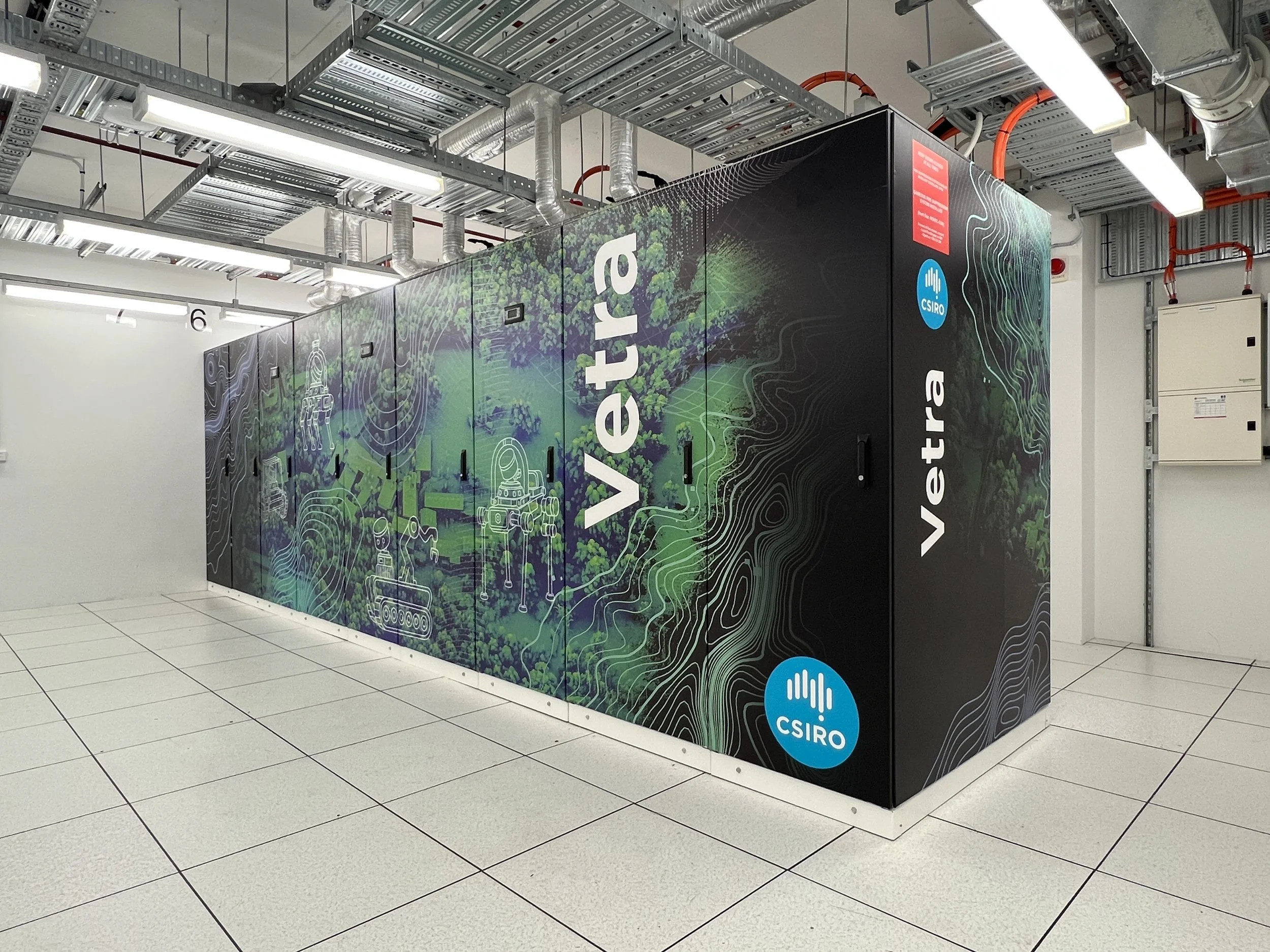
The Vetra AI infrastructure enables faster, safer learning for robotics and other AI-powered technologies.
The Case for Skepticism
The harder questions are about scale and necessity. Forty-eight GPUs is a respectable cluster, but it's not a transformative amount of compute by 2026 standards. A single modern hyperscale facility might house tens or hundreds of thousands of GPUs. Vetra is a research instrument, not a production AI factory, and the framing of it as critical infrastructure for "sovereign AI" — a phrase CSIRO uses repeatedly — invites scrutiny. Does Australia genuinely need physical proximity to data for the kinds of research happening at QCAT, or is the proximity argument partly a way to justify domestic investment in computing that could otherwise be rented from cloud providers?
The 50-cars-a-year emissions claim is also worth a second look. It's a real number, but it's small in the context of national AI infrastructure ambitions. Saving 225 tonnes of CO₂ at one facility doesn't change the math much if the broader trajectory of AI compute is exponential growth.
There's also an open question about who actually benefits from edge AI infrastructure of this kind. CSIRO frames Vetra as a model that "can be replicated and exported to other locations" — suggesting commercial spinout potential. But edge AI is a genuinely competitive global market, and small-scale modular facilities like Vetra have to compete against both hyperscalers offering edge zones and specialized startups building purpose-built robotics compute.
The Bigger Picture
Vetra's significance probably isn't the facility itself. It's the architectural argument it's making — that AI's move into the physical world will require a different topology than the one that's emerged for cloud AI. If that's right, more facilities like Vetra will follow, in Australia and elsewhere. If it's wrong, or if cloud and edge converge faster than expected, Vetra will read as a useful research tool rather than a model anyone else copies.
Either way, it's a real bet by a national science agency on what physical AI will need to thrive. That's worth paying attention to.
