How a £50 Sensor Glove Could Transform Robotic Hands
For decades, robotics engineers have chased a deceptively simple goal: giving machines hands that move with human-like precision. Grippers have become stronger. Vision systems have become smarter. AI models have become more capable. Yet true dexterity—the fluid, adaptive intelligence of the human hand—has remained stubbornly out of reach.
Now, researchers at the University of Edinburgh believe they have found a critical missing piece.
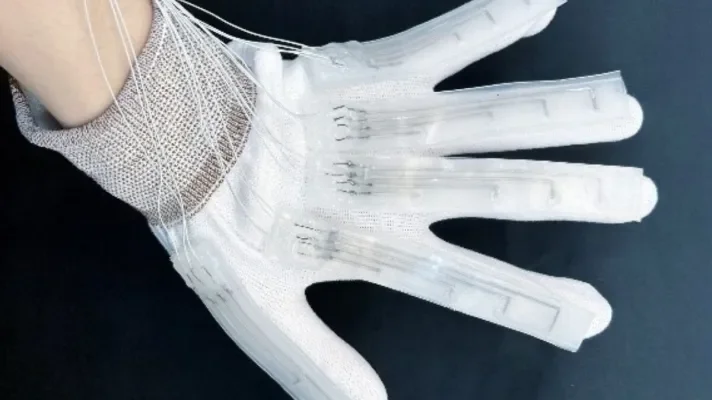
Scottish scientists have developed a low-cost sensor glove that captures human hand movements with unprecedented fidelity, potentially enabling robots to learn not just how to grasp objects, but how to manipulate them with nuance, speed, and grace.
“This high-fidelity gesture data is the missing link needed to teach robots not just how to hold an object, but how to manipulate it with human-like agility and grace,” said Dr. Yunjie Yang, who led the research at the University of Edinburgh’s School of Engineering.
A New Kind of Human Data for Robots
The glove, which costs roughly £50 to produce, is embedded with flexible sensors made from liquid metal electrodes housed in silicone. These sensors detect subtle changes in finger bending and spacing by measuring variations in electrical capacitance.
Unlike many existing motion-capture systems—which often rely on rigid hardware or external cameras—the glove directly captures the continuous, fluid transitions of the hand in motion. This allows researchers to record fine-grained gestures that traditional systems frequently miss.
In testing, participants wearing the gloves performed a range of hand gestures. The system detected movements with more than 99% accuracy. When compared with simultaneous camera-based tracking, the glove’s data closely matched reconstructed hand shapes and motions, outperforming current technologies by nearly 10%.
The result is something robotics has long lacked: a rich, precise dataset of how humans actually use their hands in real-world tasks.
Why Dexterity Matters More Than Strength
Robotics has historically prioritized power and precision over dexterity. Industrial robots excel at repetitive tasks in structured environments. But as robots move into less predictable domains—hospitals, homes, warehouses, space missions—the limitations of current manipulation systems become glaring.
Human hands are not just tools; they are adaptive interfaces with the physical world. They adjust grip force, alter posture mid-motion, and coordinate multiple fingers in real time. Teaching robots to replicate even a fraction of this capability requires data that captures the complexity of human motion.
That is where Edinburgh’s glove technology could be transformative.
By translating human gestures into machine-readable data, the system could accelerate advances in humanoid robotics, surgical robots, prosthetics, and teleoperation systems. It could also reshape how robots are trained, shifting from scripted motions to learning directly from human demonstrations.
From Lab to Real-World Impact
The research team is already looking ahead. Future versions of the glove may incorporate full tactile sensing across the palm, mimicking the human sense of touch. Working with Edinburgh Innovations, the university’s commercialization arm, the researchers aim to translate the technology into real-world applications, supported in part by a European Research Council commercialization grant.
Potential use cases span healthcare, space exploration, prosthetics, virtual and augmented reality, and next-generation humanoid robots—fields where whole-body sensing and fine motor control are essential.
The Bigger Picture: Data as the New Bottleneck
The significance of this work extends beyond hardware innovation. As robotics increasingly converges with AI, the limiting factor is no longer just algorithms or compute—it is data.
Vision-language-action models, tactile learning systems, and imitation learning frameworks all depend on high-quality human behavioral data. Without accurate representations of how humans move, feel, and manipulate objects, robots will remain powerful but clumsy.
Edinburgh’s sensor glove highlights a broader shift in robotics: the realization that understanding humans may be just as important as building machines.
If robots are to operate safely and effectively in human environments, they will need more than stronger motors and smarter code. They will need a deeper understanding of the physical intelligence embedded in human hands.
And sometimes, the breakthrough that brings machines closer to human capability doesn’t come from billion-dollar hardware—but from a £50 glove.
