When Houses Become Products: Inside South Korea’s Robot-Built Factory
In a warehouse on the outskirts of Hwaseong, South Korea, something unusual is happening to the idea of a house. Walls are no longer raised on muddy construction sites. Modules are no longer assembled under shifting weather and unpredictable labor conditions. Instead, robotic arms cut timber, move panels, clamp joints, and assemble structural components in a choreographed sequence that looks less like construction and more like manufacturing.
What once felt like science fiction—the idea of robots building wooden houses—has quietly become industrial reality.
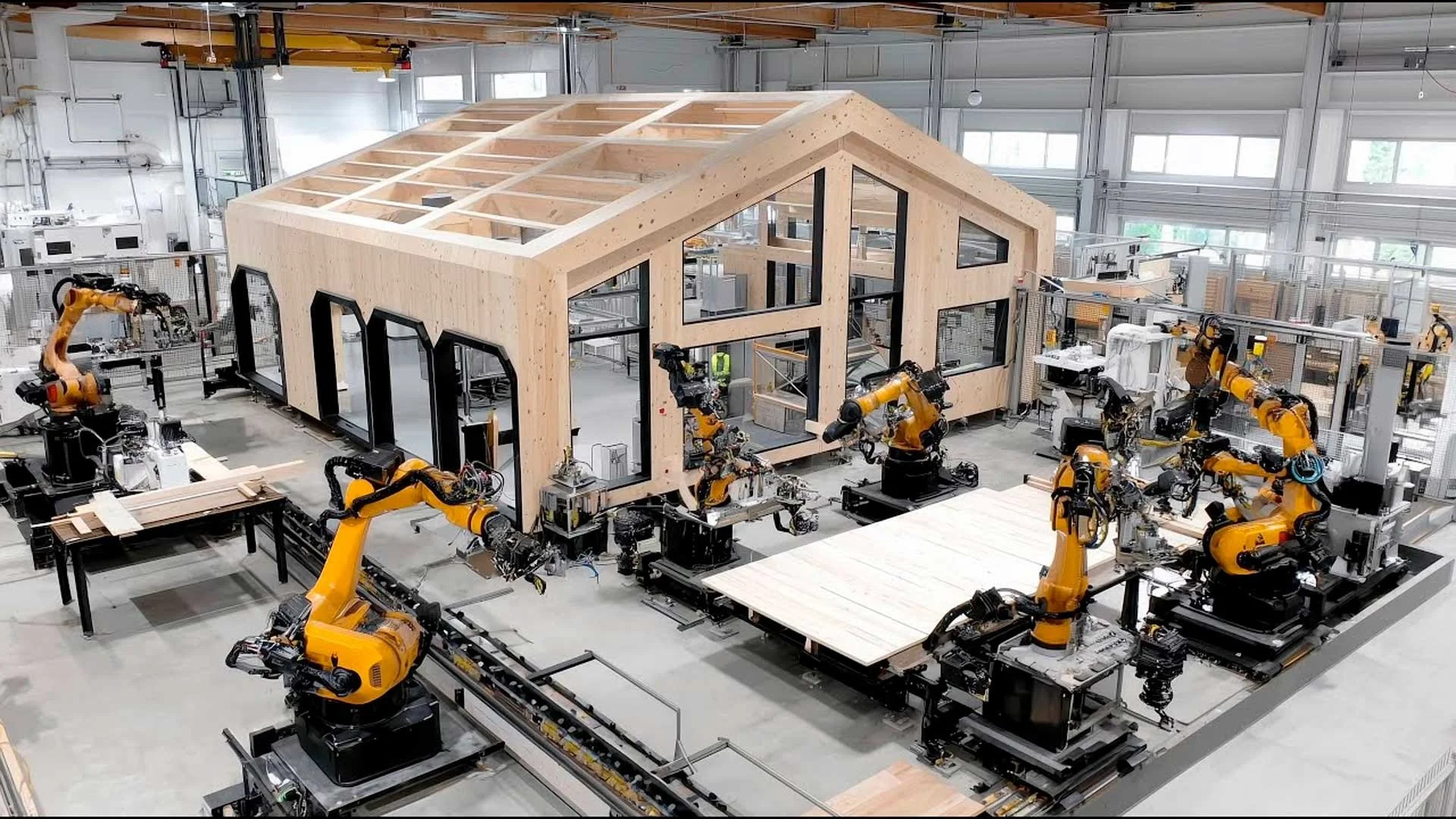
An automated factory in South Korea uses industrial robots to produce modular wooden houses on a large scale and reduce steps on the construction site.
The facility is operated by Gonggan Jaejakso, known internationally as Space Factory, a company pioneering modular and prefabricated construction by relocating much of the building process into a controlled factory environment. Its ambition is straightforward but disruptive: treat housing not as a bespoke craft executed on-site, but as a product assembled on a production line.
By shifting construction indoors, the company aims to eliminate many of the industry’s chronic inefficiencies. Weather delays, labor shortages, inconsistent workmanship, and fragmented workflows are replaced with standardized processes, predictable timelines, and automated precision. In this model, the house is no longer “built” in the traditional sense—it is manufactured.
A field report by the Korean technology outlet ZDNet describes a highly automated facility where robotic systems handle repetitive and physically demanding tasks, while human workers increasingly act as supervisors, inspectors, and quality controllers. According to the report, the factory is capable of dispatching roughly two houses per day, with the potential to scale to five units daily as operations mature.
The industrial logic behind this shift is gaining institutional backing. In 2025, Hyundai Engineering and Construction announced an agreement to apply off-site modular timber technologies in auxiliary condominium structures, citing Gonggan Jaejakso’s automated system as a benchmark. The system integrates Building Information Modeling (BIM) with high-precision robotic production, aligning digital design directly with physical manufacturing.
Inside the factory, robots cut openings in panels, move heavy components using suction-based manipulators, and assemble modules with automated clamping systems. Specialized grippers equipped with sensors and vision systems adapt to variations in wood components, ensuring consistency despite the natural irregularities of timber. Walls are no longer formed at the construction site; they move sequentially through vertical and horizontal production lines, passing through stations dedicated to cutting, assembly, sealing, and insulation.
The result is not just speed, but standardization. According to reports, automation has reduced the duration of certain production steps by as much as 40 percent, while improving consistency in performance-critical elements such as sealing and insulation. In an industry notorious for variability, this level of repeatability represents a structural shift.
Modular construction has been gaining momentum globally for similar reasons. Low productivity, chronic labor shortages, and difficulties in scaling output with predictable quality have long plagued construction. Academic studies consistently show that off-site production, combined with on-site assembly, can shorten project timelines by enabling parallel workflows and reducing exposure to environmental disruptions.
Yet the transition from site-based construction to factory-based manufacturing introduces new complexities. Regulators and industry bodies have warned that risks often emerge at the interface between factory production and on-site installation, where structural integrity, safety requirements, and performance specifications must align seamlessly. Automation may solve one set of problems while creating another.
The viral videos that popularized the idea of “houses built in days” obscure these nuances. In reality, the timeline depends on what is being measured. While factory production of structural components may take weeks rather than months, the path to occupancy still involves foundations, permits, utilities, interior finishing, and regulatory approvals. Even company-affiliated materials suggest that while structural manufacturing might take roughly three weeks, the full journey from production to habitation is considerably longer.
Behind the technological promise lies a deeper controversy. Automation in construction does not merely accelerate production—it redistributes labor. Tasks once performed by on-site workers are increasingly handled by machines, while new roles emerge in programming, maintenance, systems integration, and quality assurance. In South Korea, this shift has already sparked tension in other industries, with labor unions warning of job displacement and demanding negotiations before expanding advanced automation and humanoid robotics.
Supporters of modular, robot-assisted construction argue that the primary objective is not workforce elimination but the reduction of waste, inefficiency, and unpredictability. Critics counter that the industry must be transparent about long-term costs, durability, standardization, and the impact on traditional construction professionals. The fear is not just job loss, but the homogenization of housing itself—where efficiency begins to outweigh individuality.
If the promise of a “house ready in days” becomes the norm, the battleground of construction will move from the building site to the factory floor. Consumers will demand what they have always demanded: fair prices, proven quality, and long-term reliability. But layered onto these expectations is a new question—one that sits at the intersection of technology, labor, and society.
When houses become products, who truly benefits from the transformation?
The robots may build faster. The factories may scale higher. But the ultimate verdict will not be delivered by machines. It will be decided by the people who must live in the world those machines create.
