Hyundai’s Firefighting Robots Signal a Shift Toward Robotic First Responders
Hyundai Motor Group is expanding its robotics and mobility ambitions into public safety, partnering with South Korea’s National Fire Agency to deploy unmanned firefighting robots designed for high-risk environments. The initiative reflects a growing global trend: using robotics not simply to augment efficiency, but to fundamentally reshape how emergency response is carried out.
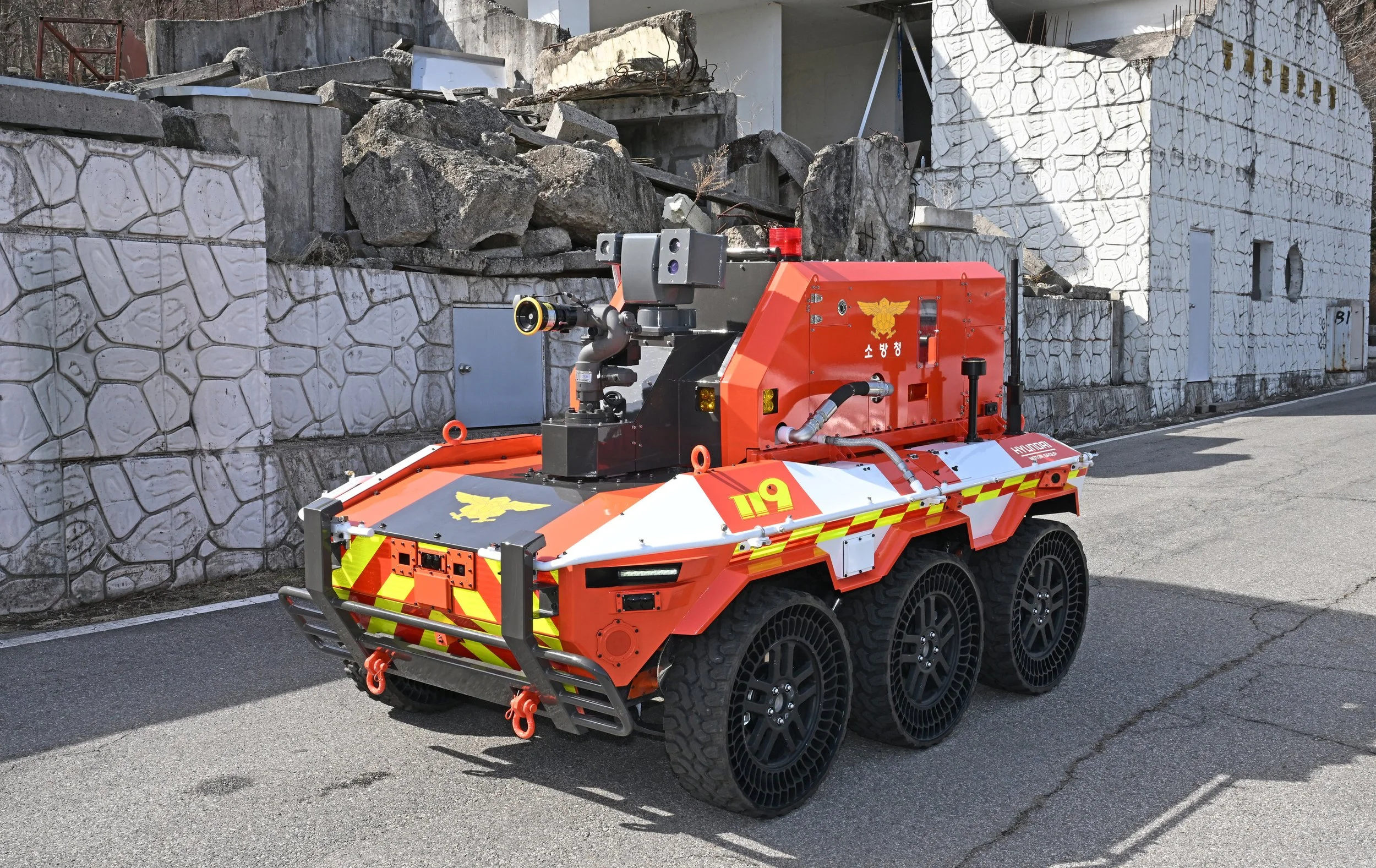
At a ceremony held at the National 119 Rescue Headquarters in Namyangju, Hyundai formally donated four unmanned firefighting robots built on Hyundai Rotem’s HR-Sherpa multi-purpose unmanned platform. Two units are already operating with the Capital and Yeongnam 119 Special Rescue Units, with two more scheduled for deployment to regional fire headquarters.
Hyundai Motor Group Executive Chair Euisun Chung framed the initiative around safety and societal responsibility, emphasizing that technology should help firefighters operate in safer environments. The robots are designed to enter dangerous scenarios ahead of human crews, carrying out initial suppression and reconnaissance tasks in conditions that may be too hazardous for direct human involvement.

A Platform Built for Extreme Environments
The HR-Sherpa-based firefighting robot integrates several features tailored to disaster response:
A front-mounted water cannon capable of both direct and spray suppression.
A self-spraying cooling system that creates a water curtain, allowing operation in temperatures approaching 800°C while maintaining manageable internal heat levels.
Infrared vision-enhancing cameras that detect objects and individuals through smoke and flames.
Remote operation capabilities delivering real-time video and control to operators at a safe distance.
Six-wheel independent drive with high-temperature-resistant tires for mobility across debris-strewn terrain.
Rather than replacing firefighters, the system is intended to extend operational reach — conducting initial suppression, reconnaissance, and search missions where human entry would be high risk or impossible.
Robotics as a New Layer of Emergency Response
The deployment highlights a broader shift in robotics adoption: moving from industrial environments into frontline public safety applications. Acting Korea National Fire Agency Commissioner Seung-ryong Kim described the initiative as the beginning of a “paradigm shift” in disaster response, where public agencies collaborate closely with technology providers to introduce advanced systems directly into operational workflows.
Hyundai’s involvement also underscores the evolving role of mobility companies. Increasingly, automotive and robotics firms are repositioning their expertise in electrification, autonomy, and sensing toward specialized service robots designed for hazardous environments.
Beyond the robot deployment, Hyundai plans to support firefighter rehabilitation through equipment and vehicle donations to South Korea’s first National Fire Hospital, scheduled to open later this year.
From Vehicles to Teammates
If successful, the program may signal the emergence of robotic first responders as standard components of emergency response infrastructure. Rather than standalone technological experiments, these systems are being integrated directly into operational units — suggesting a future where robots routinely serve as the first line into dangerous environments.
The shift reflects a broader industry trajectory: robotics not just as automation tools, but as protective teammates designed to extend human capability while reducing risk.
