Mantis Robotics and the Emergence of the Fenceless Industrial Robot
For decades, industrial automation has been defined by a fundamental compromise: speed versus safety. High-performance industrial robots moved quickly and efficiently—but behind fences. Collaborative robots (cobots) removed barriers, but often at the cost of speed and throughput. This tradeoff shaped factory layouts, workflow design, and even the economics of automation deployment.
Now, Mantis Robotics is attempting to redraw that line.
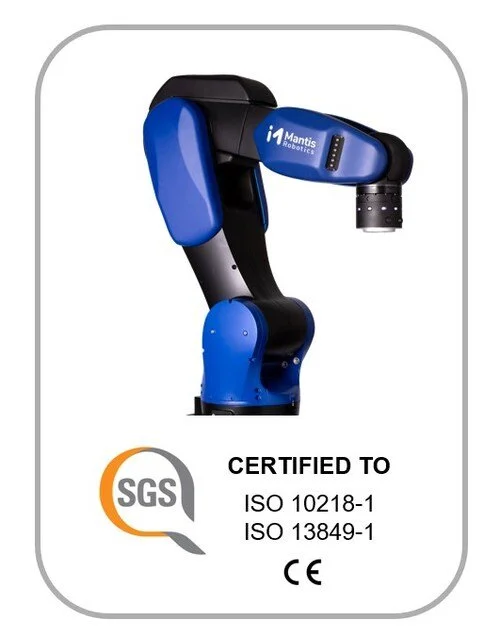
The company recently announced that its flagship MR-1 robot arm has achieved certification to ISO 10218-1 and ISO 13849-1, becoming what it describes as the first fenceless, high-speed industrial robot to meet these safety standards. The milestone represents more than just another certified robot; it signals a broader shift toward safety architectures designed for shared human environments rather than isolated robotic cells.
Safety as the Real Bottleneck
In the race toward AI-enabled robotics—and increasingly toward humanoids—intelligence has captured most of the headlines. But across factories and warehouses, the primary constraint has rarely been intelligence alone. Instead, safety integration determines how quickly robots can move, where they can be deployed, and how easily they scale.
Traditional industrial robots achieve high throughput by isolating risk. Physical barriers, guarded cells, and predefined safety zones create predictable environments that allow robots to operate at full speed without direct human interaction. Cobots reversed this approach by introducing force-limiting and compliant motion, enabling human collaboration—but often at reduced speeds to maintain safety compliance.
Mantis Robotics claims to bridge this gap through proprietary proximity detection and “Physical AI,” enabling the MR-1 to dynamically adjust its behavior while maintaining industrial-level performance.
If successful, this approach could represent a meaningful shift in how safety is engineered—not as a static constraint but as an adaptive system.
A Platform Approach to Human-Robot Collaboration
The MR-1 incorporates 47 embedded safety functions—far more than the typical safety feature set found in conventional robots or cobots—and all are certified to Performance Level d (PL=d) under ISO 13849 functional safety requirements.
Central to this capability is the company’s SafetyCore architecture and range-based object detection system, designed to continuously monitor surrounding environments. Instead of relying on physical separation, the robot modulates its speed and behavior based on real-time proximity awareness.
This reflects a broader industry trend: moving from hardware-based safety toward sensor-driven safety intelligence. As AI systems increasingly operate in mixed human environments, safety becomes less about restricting movement and more about enabling predictable, verifiable interaction.
In many ways, this mirrors the transition seen in autonomous vehicles, where sensing and decision systems replace fixed safety barriers.
Beyond Hardware: Toward Scalable Deployment
The MR-1 also highlights another emerging theme in industrial robotics—the push toward faster deployment cycles. Mantis includes code-free programming tools, a digital twin environment, and modeling software aimed at reducing integration complexity.
This matters because adoption barriers are rarely technical alone. Integration costs, workflow redesign, and workforce training often determine whether automation delivers value. By targeting rapid deployment alongside safety certification, the company is positioning its platform as both a technical and operational solution.
The robot itself features a 5 kg payload, speeds up to 10 m/s, and a reach of 900 mm, placing it within a performance range traditionally associated with fenced industrial arms rather than collaborative systems.
What This Means for the Future of Robotics
Certification to ISO 10218 and ISO 13849 represents more than regulatory compliance—it signals readiness for real-world deployment at scale. As robots move from isolated cells into shared human spaces, safety certification becomes the gateway to adoption.
The implications extend beyond factories. If adaptive safety architectures can maintain high throughput while enabling human coexistence, they could accelerate robotics deployment across logistics, retail, healthcare, and eventually domestic environments.
In other words, the question is no longer just whether robots can become smarter—it is whether they can become trustworthy enough to work alongside us without slowing down.
If companies like Mantis Robotics succeed, the long-standing safety-speed compromise may finally begin to dissolve, opening the door to a new generation of human-centric industrial automation.
