Inside Ohio State’s AIMS Lab: Where AI, Robotics, and Manufacturing Converge
At The Ohio State University’s Center for Design and Manufacturing Excellence (CDME), a growing experiment in the future of manufacturing is taking shape. The Artificially Intelligent Manufacturing Systems (AIMS) Lab is redefining how robotics, artificial intelligence, and human expertise intersect — not just to advance automation, but to rethink how manufacturing systems learn, adapt, and evolve.
Since opening in 2019, the AIMS Lab has positioned itself at the intersection of applied research and workforce development, combining machine learning, advanced robotics, and sensor-driven automation into a living testbed for next-generation manufacturing.
Manufacturing as a Learning System
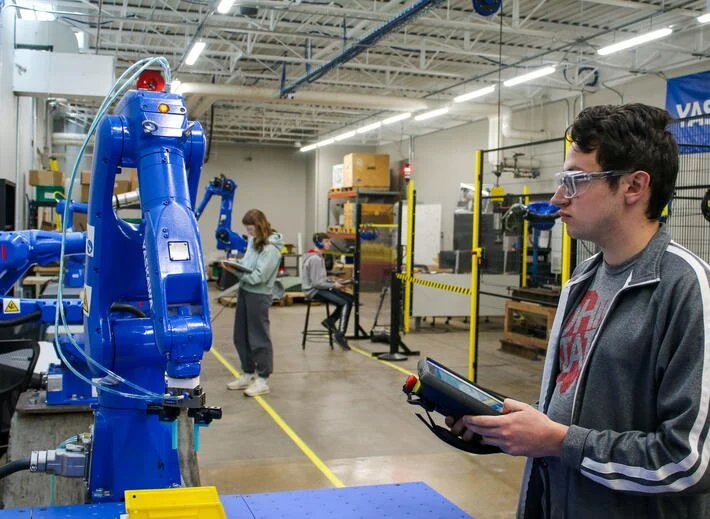
Unlike traditional automation environments focused solely on repeatability, AIMS treats manufacturing as an adaptive system. Robots in the lab are trained to collaborate, respond to changing conditions, and refine processes through data.
The lab’s projects span a wide range of advanced manufacturing tasks — painting, welding, grinding, forging, and additive manufacturing — many of which historically required years of human craftsmanship. By integrating robotics with AI-driven modeling and sensing, researchers aim to accelerate these artisanal processes without sacrificing quality or flexibility.
“We get to work on the latest technologies to move manufacturing forward while giving students the opportunity to grow along the way,” said AIMS Lab director Stephen Levesque. That dual mission — innovation alongside education — is central to the lab’s identity.
Scaling Up Intelligent Automation
As research activity expanded, so did the lab itself. A recent renovation grew the facility to more than 3,000 square feet and increased its robotic fleet from five systems to twelve.
The new layout mirrors modern industrial environments, enabling multiple robots to operate simultaneously without interference. Smaller collaborative systems occupy one area, while larger industrial robots and heavy-duty processes operate in another, creating a microcosm of contemporary manufacturing floors.
This flexibility allows researchers to test end-to-end workflows — from simulation and process design to sensing, execution, and data analysis — within a single integrated space.
The Rise of Robotic Forging
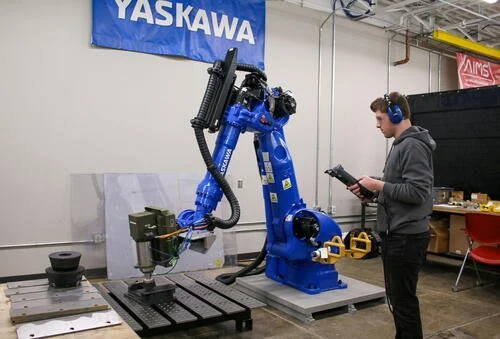
One of the lab’s emerging focus areas is robotic forging, a manufacturing process that blends traditional metallurgy with advanced automation.
Using digital models, robots execute incremental deformation sequences, shaping materials through repeated impacts guided by sensors and algorithms. Each strike adjusts based on feedback, allowing the process to refine material properties dynamically.
The goal is not simply automation but adaptability — reducing costs and increasing flexibility by allowing robots to perform complex forming tasks traditionally dependent on highly skilled human operators.
Behind these capabilities is a growing “data foundry,” where AI models learn from manufacturing operations and refine control strategies over time.
Industry Partnerships and Real-World Impact
AIMS has maintained a close relationship with Yaskawa Motoman Robotics, whose systems form a significant portion of the lab’s infrastructure. The collaboration reflects a model in which industry partners contribute equipment and expertise while benefiting from applied research insights.
According to Levesque, this arrangement allows the lab to scale strategically, acquiring new robotic systems as research programs mature and industry needs evolve.
Training the Next Generation of Automation Engineers
Perhaps the most distinctive aspect of AIMS is its emphasis on undergraduate participation. Students from mechanical engineering, computer science, materials science, and industrial engineering work directly on research projects — designing sensors, programming robotic behaviors, planning layouts, and analyzing data.
Rather than treating students as observers, the lab integrates them into full system development, often culminating in presentations to industry or government stakeholders.
Lead engineer Adam Buynak, who began in the lab as an undergraduate, describes AIMS as a rare environment where advanced software and AI directly shape industrial automation.
“That is the future of manufacturing,” he said. “It’s opened up a whole career path for me.”
A Glimpse of Physical AI in Manufacturing
The AIMS Lab reflects a broader shift underway across industry: the move toward “physical AI,” where machine learning is embedded directly into production environments.
As manufacturing systems become more intelligent, the boundaries between robotics, software, and human expertise continue to blur. Facilities like AIMS offer a preview of how future factories may operate — not as rigid automated lines, but as adaptive ecosystems where machines learn alongside the people who build and operate them.
And perhaps most importantly, they demonstrate that the transformation of manufacturing will depend as much on education and collaboration as it does on technology itself.
