Jevons Robotics and Newmont Australia Expand Automation into Highwall Mining
Automation in mining continues to advance beyond remote monitoring and autonomous haulage, moving deeper into some of the most hazardous operational environments. A new agreement between Jevons Robotics and Newmont Australia signals the next phase of that shift, bringing robotic automation directly into highwall mining through an automated pre-split loading solution designed to reduce human exposure while maintaining operational consistency.
The deployment introduces a new payload extension for Jevons Robotics’ ARTEV1000 battery-electric robotic platform, marking a significant milestone for the Australian robotics company as it expands its capabilities into drill-and-blast applications.
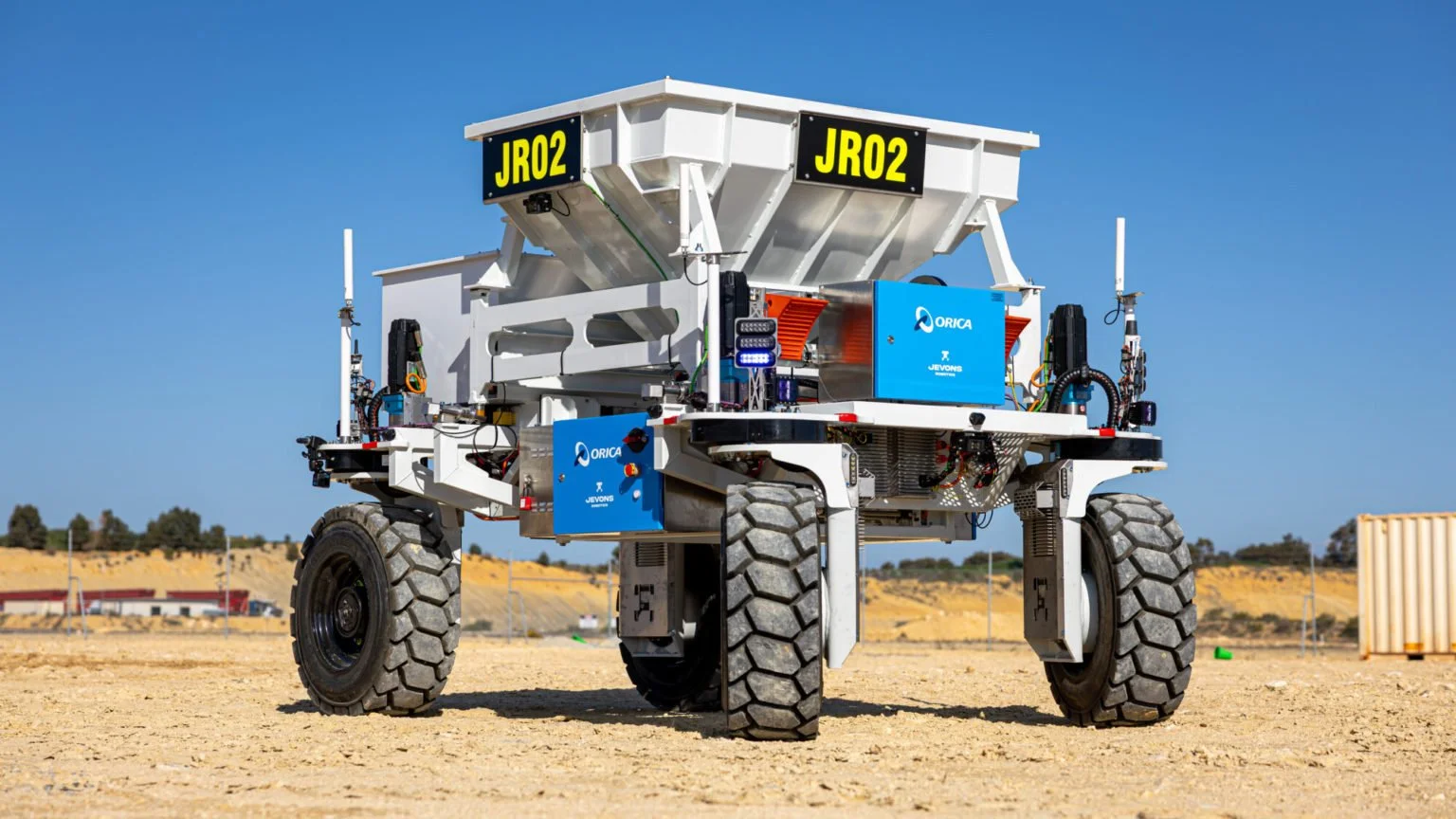
Automation Meets One of Mining’s Most Dangerous Tasks
Highwall mining environments present unique safety challenges. Workers operating near steep rock faces and blasting zones face risks from unstable ground conditions, falling debris, and heavy equipment interactions. Pre-split loading — a process used to control rock fragmentation and improve blast outcomes — traditionally requires personnel to work in close proximity to these hazards.
Jevons Robotics’ automated solution aims to remove humans from these high-risk areas by integrating a rugged, battery-electric robotic system capable of performing the task autonomously while maintaining consistent loading results.
The robot is designed to integrate with existing workflows and consumables, an approach that reflects a broader trend in industrial robotics deployment: successful automation often adapts to current processes rather than forcing organizations to rebuild their operations from scratch.
“We are really proud to be able to deliver this world-leading product to an organisation so focused on improving safety and productivity outcomes,” said Jevons Robotics CEO Todd Peate. “This agreement represents the first payload extension of our existing ARTEV1000 platform and reinforces the value our robotic solutions deliver to global miners.”
From Platform to Ecosystem: Expanding the ARTEV1000
Rather than introducing an entirely new machine, the project expands the capabilities of the ARTEV1000 platform, highlighting a growing industry shift toward modular robotic systems. By extending payload functionality, companies can deploy new applications on proven hardware, reducing integration risks and accelerating adoption timelines.
For mining operators, this platform-based approach may offer advantages beyond technical capability. Standardizing around a flexible robotic base allows for easier maintenance, workforce training, and operational scaling — factors that increasingly determine whether automation projects succeed commercially.
Safety as the Primary Driver
Mining has long been an early adopter of automation technologies, but recent deployments increasingly emphasize safety as the central value proposition rather than purely productivity gains.
By targeting drill-and-blast operations — among the most hazardous tasks in mining — the Jevons Robotics deployment aligns with industry-wide efforts to remove personnel from dangerous environments wherever possible.
Battery-electric platforms also support broader decarbonization and operational efficiency goals, reducing emissions and enabling quieter, lower-maintenance systems compared to traditional diesel-powered equipment.
A Broader Trend in Mining Automation
The agreement reflects growing momentum across the mining sector as companies seek robotic solutions capable of operating in extreme conditions. While autonomous haul trucks and remote drilling systems have gained widespread adoption, smaller task-specific robots are now beginning to fill operational gaps where traditional automation has struggled.
These targeted deployments often succeed because they focus on clearly defined workflows with measurable outcomes — a lesson increasingly echoed across robotics industries.
High-risk environments like highwall mining provide strong use cases for automation because safety improvements and productivity gains can be quantified directly, making business cases easier to justify.
The Path Forward
For Jevons Robotics, the Newmont Australia collaboration represents more than a single deployment. It signals a broader effort to industrialize robotic technologies across drill-and-blast operations, demonstrating how modular platforms can expand into new applications over time.
For the mining industry as a whole, the move highlights a continuing shift toward robotics not as experimental technology, but as operational infrastructure — particularly in environments where removing humans from danger zones is both a safety imperative and a strategic advantage.
As mining companies face increasing pressure to improve safety outcomes, reduce costs, and maintain production efficiency, robotic systems designed for hazardous environments may become less of a competitive differentiator and more of a baseline expectation.
