LG Electronics has announced a new AI-enabled home robot, LG CLOiD™, which will make its first public demonstration at CES 2026 in Las Vegas. Designed to perform and coordinate everyday household tasks, the robot represents LG’s latest step toward what it calls the “Zero Labor Home,” where AI systems reduce the time and physical effort required for domestic chores.
LG CLOiD is built to operate across a connected home, integrating with LG’s existing smart home platforms, including its ThinQ ecosystem and the Self-Driving AI Home Hub (LG Q9). According to the company, the robot is intended to function as both a physical helper and a mobile AI hub capable of learning household routines and managing appliances accordingly.
Demonstrated in Real-World Home Scenarios
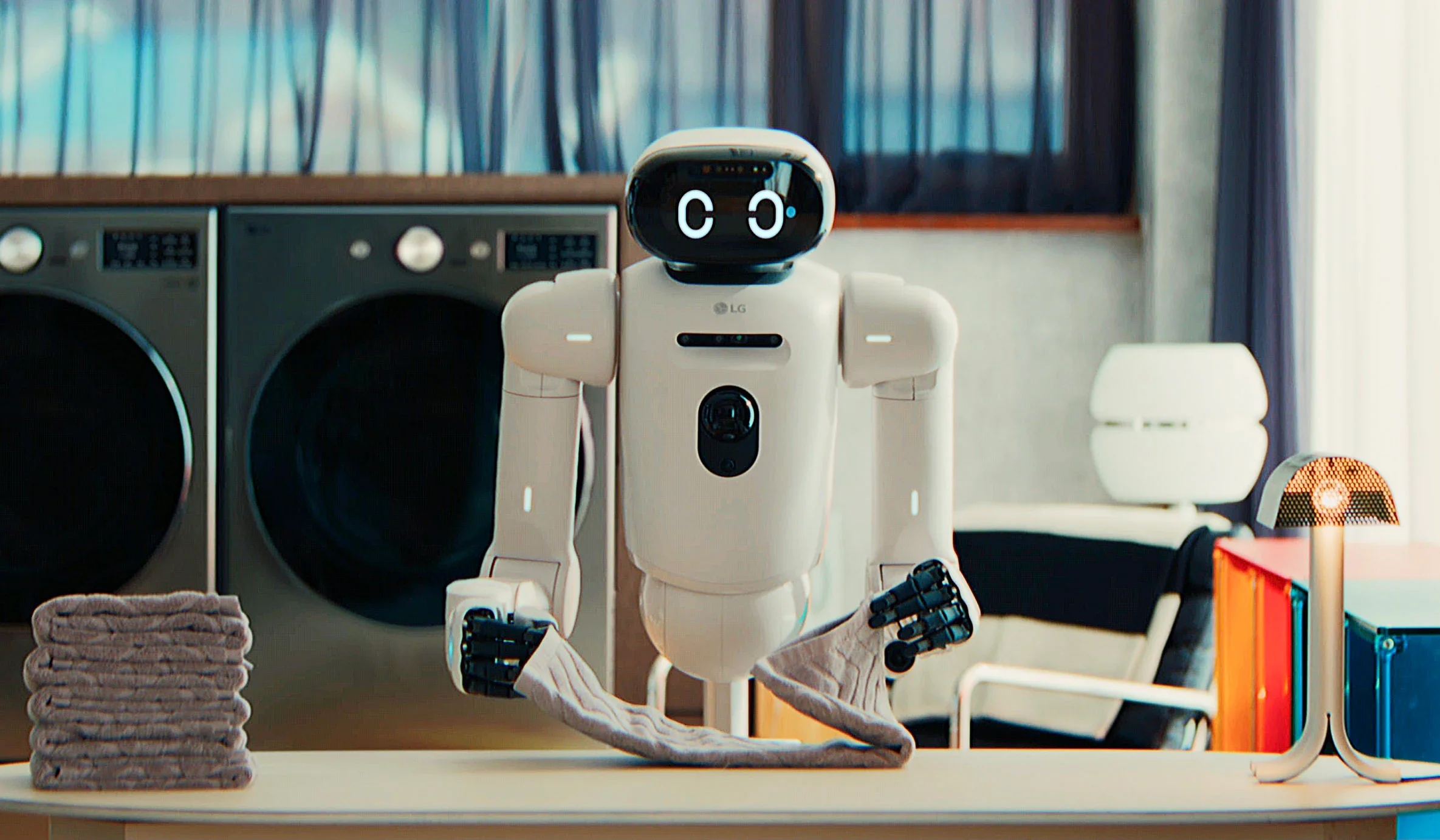
At CES 2026, LG will showcase CLOiD in simulated home environments. Demonstrations include preparing breakfast by retrieving milk from a refrigerator and placing food into an oven, initiating laundry cycles after occupants leave the house, and folding and stacking clothes once drying is complete. These scenarios are designed to highlight the robot’s ability to interpret context, understand user habits and precisely control connected appliances.
Hardware Built for Living Spaces
LG CLOiD features a head unit mounted on a torso with two articulated arms and a wheeled base. The torso can tilt to adjust working height, allowing the robot to pick up items from knee level or higher surfaces. Each arm has seven degrees of freedom—comparable to a human arm—and ends in a five-fingered hand with independently actuated digits for fine manipulation.
The wheeled base incorporates autonomous navigation technology derived from LG’s robot vacuum portfolio and the LG Q9 platform. LG says this design was chosen for stability and safety, with a low center of gravity intended to minimize tipping risks around children and pets.
Physical AI at the Core
At the system level, LG CLOiD relies on the company’s Physical AI approach, combining Vision Language Models (VLMs) and Vision Language Action (VLA) models. Together, these systems allow the robot to translate visual and verbal input into physical actions, such as opening doors or transferring objects. LG says the models have been trained on tens of thousands of hours of household task data.
Expanding the Robotics Stack
Alongside CLOiD, LG introduced LG Actuator AXIUM™, a new line of robotic actuators aimed at service and home robots. Actuators—combining motors, drives and reducers—are among the most critical and costly robot components. LG plans to leverage its appliance manufacturing expertise to deliver compact, high-torque and modular actuator designs suitable for a wide range of robotic applications.
Toward the AI Home
Looking ahead, LG says it will continue developing practical home robots while embedding robotics technologies directly into appliances, creating “robotized appliances” that can sense and respond to human presence. The company’s long-term vision is an AI-driven home where routine housework is handled autonomously.
“The LG CLOiD home robot is designed to naturally engage with and understand the humans it serves,” said Steve Baek, president of the LG Home Appliance Solution Company. “Our goal is to make housework a thing of the past, so customers can spend more time on what really matters.”
LG CLOiD will be on display at LG’s CES 2026 booth (#15004) at the Las Vegas Convention Center from January 6–9.
