Europe’s Counter-Drone Future May Depend on Procurement as Much as Technology
As low-cost drones and loitering munitions continue reshaping modern warfare, much of the defense world’s attention has focused on the technologies needed to stop them: AI-powered targeting, autonomous interceptors, electronic warfare systems, radar fusion, and rapidly deployable air-defense networks.
But a quieter battle is emerging underneath the technology itself.
Procurement.
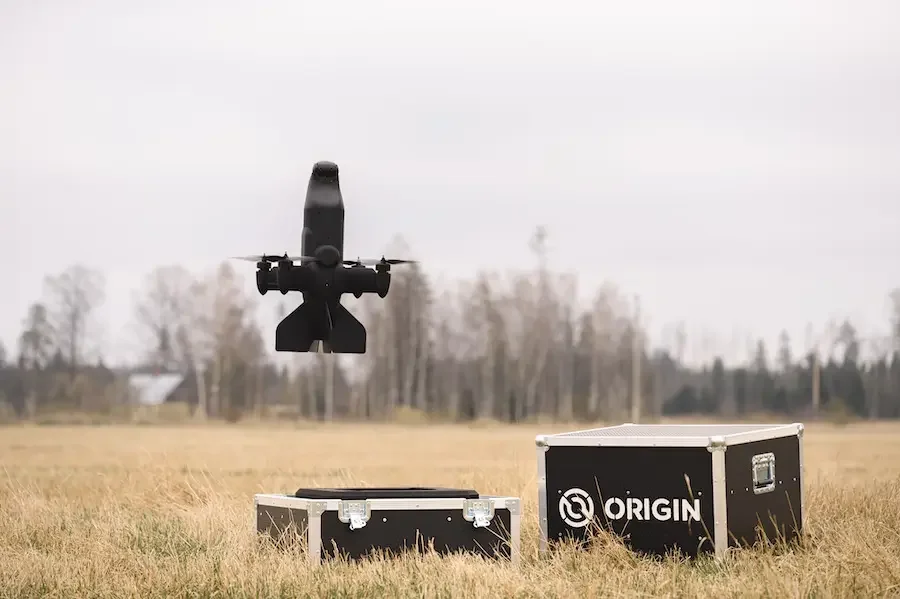
This week, Latvian defense technology company Origin Robotics announced a multi-year framework agreement with the Latvian Armed Forces for continued supply of its BLAZE autonomous interceptor drone systems. At first glance, the deal looks like another European counter-UAS procurement announcement in an increasingly crowded market.
In reality, the structure of the agreement may be just as important as the interceptor itself.
Because the deeper challenge facing Europe’s defense ecosystem is no longer simply whether it can build autonomous defense systems.
It is whether democracies can procure and evolve those systems fast enough to match the pace of modern conflict.
The Procurement Problem Behind Modern Drone Warfare
The wars in Ukraine and the Middle East have exposed an uncomfortable reality for Western defense establishments: low-cost autonomous systems are evolving far faster than traditional military acquisition cycles.
A drone platform that is state-of-the-art today can become tactically outdated within months as adversaries adapt software, guidance systems, payloads, and operational tactics. AI-enabled computer vision systems improve continuously. Sensor fusion evolves rapidly. Autonomy stacks mature through constant battlefield iteration.
Yet traditional defense procurement systems were largely designed for another era — one dominated by expensive, slow-moving hardware platforms with multi-decade operational lifespans.
Modern autonomous systems do not behave that way.
Software-defined warfare moves closer to consumer technology cycles than Cold War procurement logic.
That tension sits at the center of Origin Robotics’ agreement with Latvia.
Unlike conventional defense contracts that freeze technical specifications at the moment of signing, the BLAZE framework allows annual renegotiation of system specifications. That means the platform can evolve continuously as improvements emerge in artificial intelligence, computer vision, autonomy, and sensor integration.
In effect, Latvia is not simply buying a drone interceptor.
It is buying into an evolving capability pipeline.
The Rise of the “Upgradeable Weapon System”
That distinction may become increasingly important across defense robotics.
Historically, military systems were procured as relatively static platforms. Upgrades occurred slowly through block modernization programs, often separated by years or even decades.
Autonomous systems fundamentally disrupt that model because much of their capability is software-defined.
The effectiveness of a counter-UAS interceptor may depend less on the airframe itself and more on:
Target recognition algorithms
Sensor fusion quality
AI classification models
Navigation autonomy
Swarm coordination logic
Electronic warfare resilience
Edge-computing performance
These are iterative technologies, not fixed technologies.
Origin Robotics appears to be embracing this reality directly. CEO Agris Kipurs described the framework as a mechanism that eliminates procurement gaps while allowing Latvia to continuously receive updated versions of the BLAZE system as the technology evolves.
That is a very different philosophy from traditional military acquisition.
And it may reflect where autonomous defense systems are heading more broadly.
NATO’s Eastern Flank Is Becoming a Robotics Testbed
There is also a larger geopolitical context behind this agreement.
The Baltic states have emerged as some of the most aggressive adopters of autonomous defense systems in Europe, driven largely by their proximity to Russia and the lessons emerging from Ukraine.
Latvia, Estonia, and Belgium are now among the first European countries fielding fully autonomous, warhead-equipped drone interceptors. The urgency is understandable. Ukraine has demonstrated that inexpensive drones and loitering munitions can threaten assets worth millions of dollars while overwhelming conventional air-defense systems through scale and attrition.
That asymmetry is forcing militaries to rethink cost structures entirely.
Traditional missile-based air defense becomes economically unsustainable when interceptors cost dramatically more than the threats they are destroying. Autonomous interceptor drones like BLAZE represent part of a broader search for lower-cost, rapidly deployable countermeasures that can operate closer to the economics of the threat itself.
In many ways, NATO’s eastern flank is becoming a live experimentation zone for next-generation autonomous defense concepts.
Europe’s Push for Defense Autonomy
The deal also reflects Europe’s growing effort to build sovereign defense-industrial capability around autonomous systems.
Origin Robotics emphasized that BLAZE is designed, developed, and manufactured entirely in Latvia, allowing it to qualify as a European-origin system under EU SAFE criteria. That matters because Europe is increasingly attempting to reduce dependence on non-European defense supply chains while accelerating domestic production capacity for emerging military technologies.
The SAFE financing mechanism attached to the framework could further lower procurement barriers for EU member states seeking counter-drone systems.
And perhaps most interestingly, the structure allows allied nations to join the existing framework agreement rather than launching entirely separate procurement programs from scratch.
That could create something resembling a shared European procurement pathway for rapidly evolving autonomous defense technologies.
If successful, it may become a model that extends far beyond counter-UAS systems.
The Shift From Platforms to Ecosystems
The BLAZE system itself reflects many of the technological trends now defining defense robotics:
AI-powered computer vision
Operator-supervised autonomy
Radar-guided interception
Rapid deployment capability
Portable battlefield operation
Networked sensing and targeting
But the larger story may not be the drone itself.
It may be the emergence of a new philosophy around defense technology acquisition.
Modern autonomous systems evolve too quickly for static procurement frameworks. The battlefield adaptation cycle is accelerating. AI models improve continuously. Countermeasures evolve dynamically. Operational feedback loops now happen in near real time.
That means the future competitive advantage may belong not simply to nations with the best autonomous systems, but to nations with the most adaptive procurement ecosystems.
In that sense, Origin Robotics’ agreement with Latvia is about more than a drone interceptor.
It is an early signal that the defense world is beginning to understand that autonomy changes not only warfare itself, but the industrial and procurement structures surrounding it.
And that realization may ultimately prove just as disruptive as the drones.
