Locus Robotics Acquires Nexera, Bringing Advanced Grasping to Mobile Manipulation Platform
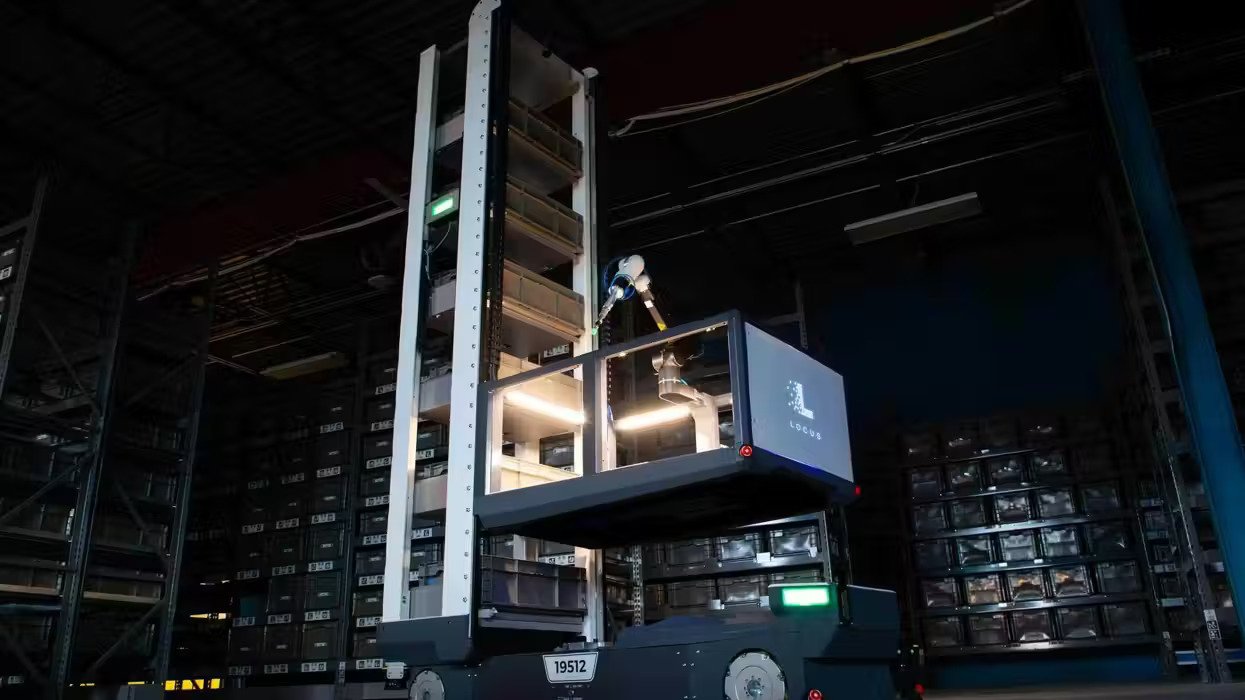
Locus Robotics announced today that it has acquired Nexera Robotics, a Vancouver-based startup whose patented NeuraGrasp end-effector technology is designed to handle the kinds of awkward, irregular, and delicate items that have long frustrated automated picking systems. The deal folds Nexera's grasping intelligence into Locus Array, the company's autonomous mobile picking platform, and signals an aggressive push deeper into AI-driven warehouse manipulation.
For Locus, the timing is deliberate. Locus Array debuted at MODEX 2026 earlier this year, where it landed as a top-three finalist for Best New Innovation out of more than 200 submissions, and is now running in live customer deployments with more sites in the pipeline. Adding Nexera widens what the platform can autonomously pick — and, by extension, the slice of the fulfillment market Locus can credibly chase.
"The frontier of warehouse robotics today is AI-driven mobile manipulation at enterprise scale," said Rick Faulk, CEO of Locus Robotics. "Being able to efficiently grasp millions of SKU types with both speed and precision is where the next decade of value gets created. Nexera has built something technically significant in that space, and combining it with Locus Array puts us at the forefront of leveling up mobile manipulation across the industry."
What NeuraGrasp actually does
Robotic picking has been stuck on a stubborn problem for years: real warehouses don't stock the clean, rigid, uniformly-shaped boxes that grippers like. They stock porous textiles, loosely bagged items, perforated polybags, contoured products, thin packaging, and a long tail of one-off shapes. A gripper that aces a demo on shampoo bottles often fails the moment a t-shirt in a plastic bag shows up.
NeuraGrasp is Nexera's answer. It combines AI-driven grasping intelligence, onboard sensors, computer vision, and a patented soft membrane structure that physically conforms to whatever it touches. The result, according to the company, is a single gripper that adapts on the fly to variations in shape, surface texture, material, porosity, and weight. Nexera developed the technology over five years across six hardware generations, and says it has been validated with thousands of hours of operation and tens of millions of picks, including broad SKU testing alongside commercial partners.
"We built NeuraGrasp to solve the manipulation challenges that have held robotic picking back for years," said Roy Belak, CEO of Nexera Robotics. "Joining Locus Robotics gives us the platform, scale, and customer base to bring this breakthrough technology into the high-velocity fulfillment environments it was designed for, where speed, reliability, and real-world adaptability matter most."
A bet on mobile manipulation over fixed infrastructure
The acquisition reflects a broader strategic stance Locus has been pushing: that mobile manipulation, rather than fixed, heavily-engineered automation cells, offers the most flexible and scalable path to fully autonomous fulfillment. Fixed systems require warehouses to be rebuilt around them; mobile systems flex around the warehouse you already have. The trade-off has always been capability — until recently, fixed systems could do things mobile robots couldn't. Closing that gap on the manipulation side is what makes Nexera strategically interesting.
Deal structure and timing
Nexera will be wholly owned and operated as part of Locus Robotics. The full Nexera team and leadership are joining Locus to accelerate integration of NeuraGrasp into the Locus Array roadmap. The acquisition also strengthens Locus's intellectual property position in mobile manipulation and adds specialized AI manipulation and end-effector expertise to its engineering organization. Locus says integration work begins immediately, with NeuraGrasp-equipped capabilities expected to roll out to the Locus Array platform in the coming months.
Locus Robotics, headquartered in Wilmington, Massachusetts, is used by more than 150 retail, healthcare, 3PL, and industrial brands across 350+ sites worldwide, delivered through a Robots-as-a-Service model.
