Robotics is often measured in breakthroughs.
A faster robot. A smarter AI model. A new manipulation capability. A record-setting deployment.
But behind every breakthrough is a researcher whose work may have taken years—or decades—to reach the spotlight.
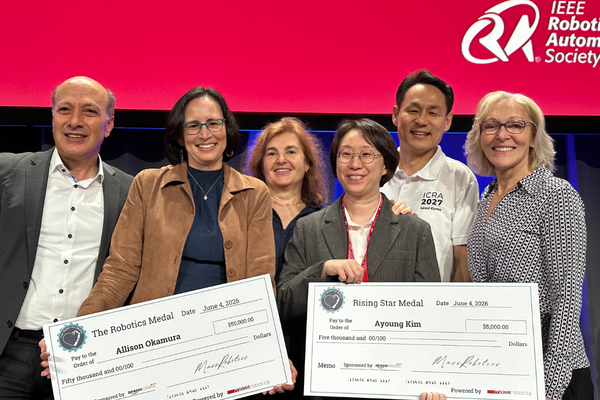
At the IEEE International Conference on Robotics and Automation (ICRA) 2026 in Vienna, MassRobotics announced the recipients of its fourth annual Robotics Medal and Rising Star Medal, recognizing two researchers whose contributions have helped shape modern robotics and whose work will likely influence its future.
This year's Robotics Medal was awarded to Dr. Allison Okamura of Stanford University, while the Rising Star Medal was presented to Dr. Ayoung Kim of Seoul National University.
The awards, supported by Amazon Robotics, are among the few global honors specifically dedicated to recognizing women in robotics research.
Recognizing Impact Beyond the Headlines
The Robotics Medal was established in 2022 to highlight the achievements of female researchers whose work has had a lasting impact on robotics.
This year's recipient, Allison Okamura, has spent much of her career working at the intersection of robotics, medicine, and human interaction.
Her contributions to haptics—the science of touch and force feedback—have helped advance fields ranging from surgical robotics to teleoperation. Her work has influenced how robots interact with people, how surgeons receive tactile information during procedures, and how engineers think about designing robots that work safely and effectively alongside humans.
Beyond her research contributions, Okamura has become widely recognized for her efforts in robotics education and mentorship, helping shape a generation of researchers entering the field.
While many robotics awards focus narrowly on technical achievements, the Robotics Medal takes a broader view, recognizing both scientific contributions and leadership within the robotics community.
The Next Generation of Robotics Leaders
The Rising Star Medal recognizes researchers earlier in their careers who are already making significant contributions.
This year's recipient, Ayoung Kim, has become one of the leading figures in robotic perception and localization.
Her work on Scan Context transformed LiDAR-based place recognition, providing robots with a more effective way to understand where they are and where they have been. The technique has become widely used across autonomous systems research and has influenced numerous commercial applications.
Kim has also advanced resilient multi-sensor SLAM (Simultaneous Localization and Mapping), a foundational capability that allows robots to navigate reliably in complex and changing environments.
Perhaps equally important, many of her datasets and software tools have been released to the broader robotics community, helping accelerate research across academia and industry.
As robotics increasingly moves from structured environments into real-world settings, advances in localization, mapping, and perception will remain critical to achieving robust autonomy.
Why Representation Still Matters
The awards arrive at a time when robotics is experiencing unprecedented growth.
Physical AI, autonomous systems, humanoids, medical robotics, logistics automation, and advanced manufacturing are attracting billions of dollars in investment and drawing talent from around the world.
Yet despite this growth, representation remains uneven.
According to data cited by MassRobotics, women account for nearly half of the overall workforce but only approximately 35 percent of STEM professionals and just 16 percent of engineering and robotics roles.
Those numbers highlight a challenge facing not only robotics but the broader technology sector.
As demand for robotics talent continues to rise, expanding participation becomes more than a diversity initiative—it becomes an economic necessity.
The future workforce required to build, deploy, maintain, and govern robotics systems will need to draw from the widest possible pool of talent.
Building the Pipeline
Recognition is only one part of the equation.
MassRobotics has spent nearly a decade building programs aimed at expanding participation in robotics, particularly among younger students.
Its Jumpstart Fellowship program has graduated nearly 120 students over the past six years, many of whom have gone on to study at institutions including MIT, Stanford, Harvard, Cornell, Princeton, Georgia Tech, Purdue, and the University of Michigan.
The organization also continues to host STEM and robotics initiatives specifically designed to encourage participation among high school women.
These efforts reflect a broader understanding that building the robotics workforce begins long before a student enters graduate school or joins a robotics company.
The future leaders of robotics are often inspired years before they publish their first paper or start their first company.
More Than an Award
For MassRobotics, the Robotics Medal serves a purpose beyond recognition.
The organization has grown from a Boston-based robotics incubator into one of the world's most visible robotics hubs, supporting nearly 100 startups while serving as a connector between industry, academia, investors, and governments.
The award reflects a belief that robotics advances when excellence is visible and when the people driving that excellence are celebrated.
As robotics enters a new era defined by Physical AI, autonomous systems, and increasingly capable machines, the field will need more than technology breakthroughs. It will need researchers, mentors, educators, and leaders capable of inspiring the next generation.
The work of Allison Okamura and Ayoung Kim demonstrates what that future can look like.
And for the students watching from the audience at ICRA—or from a classroom halfway around the world—that may be just as important as the technologies themselves.
