NYU Launches Center for Robotics and Embodied Intelligence, Building a Major East Coast Hub for AI in the Physical World
New York University’s Tandon School of Engineering has launched the Center for Robotics and Embodied Intelligence, a major new research hub aimed at advancing intelligent machines that can sense, navigate, and act autonomously in complex real-world environments—from hospital operating rooms to disaster zones and city streets.
The new Center represents another milestone in NYU’s $1 billion investment in engineering, announced three years ago, and reflects the university’s broader push to expand interdisciplinary research across engineering, computing, data science, and health. Led by Juan de Pablo, NYU’s Anne and Joel Ehrenkranz Executive Vice President for Global Science and Technology and Executive Dean of NYU Tandon, the initiative is designed to accelerate innovation by bringing together researchers who traditionally work across departmental boundaries.
More than 70 NYU faculty members, PhD students, and postdoctoral researchers are now working within the Center across approximately 10,000 square feet of shared experimental space. This includes a new 6,800-square-foot flagship facility on the ground floor of 370 Jay Street in Downtown Brooklyn, along with an additional 2,200-square-foot Tandon space dedicated to large-scale multi-robot experiments. A further 1,000-square-foot manipulation research lab is housed at the newly established NYU Courant Institute School of Mathematics, Computing, and Data Science.
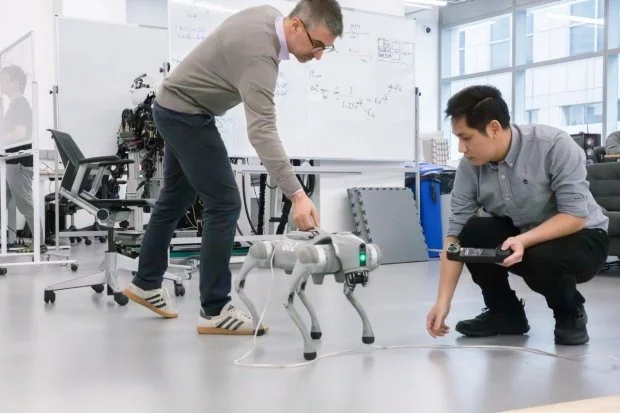
Ludovic Righetti (left), co-director of the Center for Robotics and Embodied Intelligence, demonstrates a quadruped robot with a fellow researcher. Photo credit: NYU Tandon
These open, shared environments are intentionally designed to encourage daily collaboration among mechanical, electrical, and civil engineers, computer scientists, and ethicists—an approach the university sees as essential to making progress in embodied intelligence.
While artificial intelligence has advanced rapidly in virtual and digital domains, translating those capabilities into physical machines has proven far more challenging. Robots operating in the real world must contend with uncertainty, physical interaction, and safety in ways that software systems do not. The Center for Robotics and Embodied Intelligence is explicitly focused on closing this gap, with research spanning healthcare, manufacturing, infrastructure, climate science, space exploration, and disaster response.
“The intersection between robotics and AI offers unprecedented opportunities for technological developments that will bring enormous benefits to industry and society,” said de Pablo. “NYU’s Center for Robotics and Embodied Intelligence will serve as a hub for discovery and innovation at the forefront of this exciting area of research.”
The Center’s faculty have already raised more than $30 million in research funding. Current projects include robots capable of autonomously navigating dense urban environments and new algorithms that allow robots to move more naturally by learning from human motion. Growing research areas include AI-driven robot design, physical human-robot interaction, and systems that can safely collaborate with people in shared spaces.
Responsible robotics is a core pillar of the Center’s mission. Co-director Professor Ludovic Righetti emphasized that ethical and societal considerations are being embedded directly into the research environment, rather than treated as an afterthought. Righetti also works with organizations such as the United Nations and the Stockholm International Peace Research Institute on robotics policy.
“Our Center will lead the development of intelligent systems that benefit society, and how we develop them matters as much as what we create,” Righetti said. “By integrating responsible robotics principles directly into our research environment, we ensure that our innovations are safe, ethical, and designed for the benefit of a full breadth of people and communities.”
The Center maintains industry partnerships with companies including Meta, Google, Amazon, NVIDIA, Qualcomm, General Motors, Bosch, Honda, Toyota, Hyundai, Ultra, Reflex, and Wandercraft, helping to bridge academic research and real-world deployment. It has also established international academic collaborations with institutions such as KAIST in South Korea and France’s ANITI, CNRS, and INRIA.
Beyond global partnerships, the Center aims to become a regional focal point for robotics on the East Coast, engaging researchers from across the New York metropolitan area and working with local government and community stakeholders.
“We want people to think of the East Coast—not just Silicon Valley—when they think about robotics and embodied AI,” said co-director Chen Feng, an associate professor at NYU Tandon. “We aspire to be a true center of gravity that unites robotics innovators from academia, industry, local government, and our surrounding communities.”
Looking ahead, the Center plans to launch what it describes as the first Master of Science degree in Robotics and Embodied Intelligence in the United States, along with a new doctoral track focused on embodied intelligence. Lerrel Pinto, assistant professor of computer science at the NYU Courant Institute, joins Righetti and Feng as a co-director of the Center.
The launch also aligns with NYU’s broader expansion of interdisciplinary scientific infrastructure. Over the past year, the university has announced initiatives including the Institute for Engineering Health, the Urban Institute, the Quantum Institute, and the Courant Institute School of Mathematics, Computing, and Data Science—each reinforcing NYU’s strategy to position itself at the forefront of emerging technologies that operate at the intersection of the digital and physical worlds.
