America’s Robotics Industry Just Organized for Washington
A quiet but important shift happened in Washington on May 8th.
Not another humanoid demo. Not another AI funding round. Not another promise that robots are “just around the corner.”
Instead, something arguably more consequential took place: the American robotics industry began organizing itself politically.
At the SCSP AI+ Expo in Washington, D.C., a new coalition called Robots for America officially launched, bringing together robotics companies, automation providers, manufacturers, and industrial technology organizations around a coordinated national policy platform.
According to the coalition, the effort itself emerged at the request of officials from the Office of Science and Technology Policy, the Department of Commerce, the Small Business Administration, and members of the U.S. Senate, who asked the robotics industry to organize and present a practical response to America’s manufacturing competitiveness challenge.
That detail matters more than it may initially appear.
For years, the conversation around robotics policy in the United States has remained fragmented. Companies pushed their own agendas. Trade groups defended existing market positions. Policymakers talked broadly about reshoring, AI, or advanced manufacturing, but rarely treated robotics deployment itself as a coordinated national capability.
Robots for America suggests that may be starting to change.
What emerged in Washington was not simply another advocacy organization. It was an acknowledgment that robotics is increasingly being viewed as national infrastructure — tied directly to industrial productivity, supply chain resilience, workforce competitiveness, and geopolitical positioning.
That represents a meaningful shift in how automation is being discussed in America.
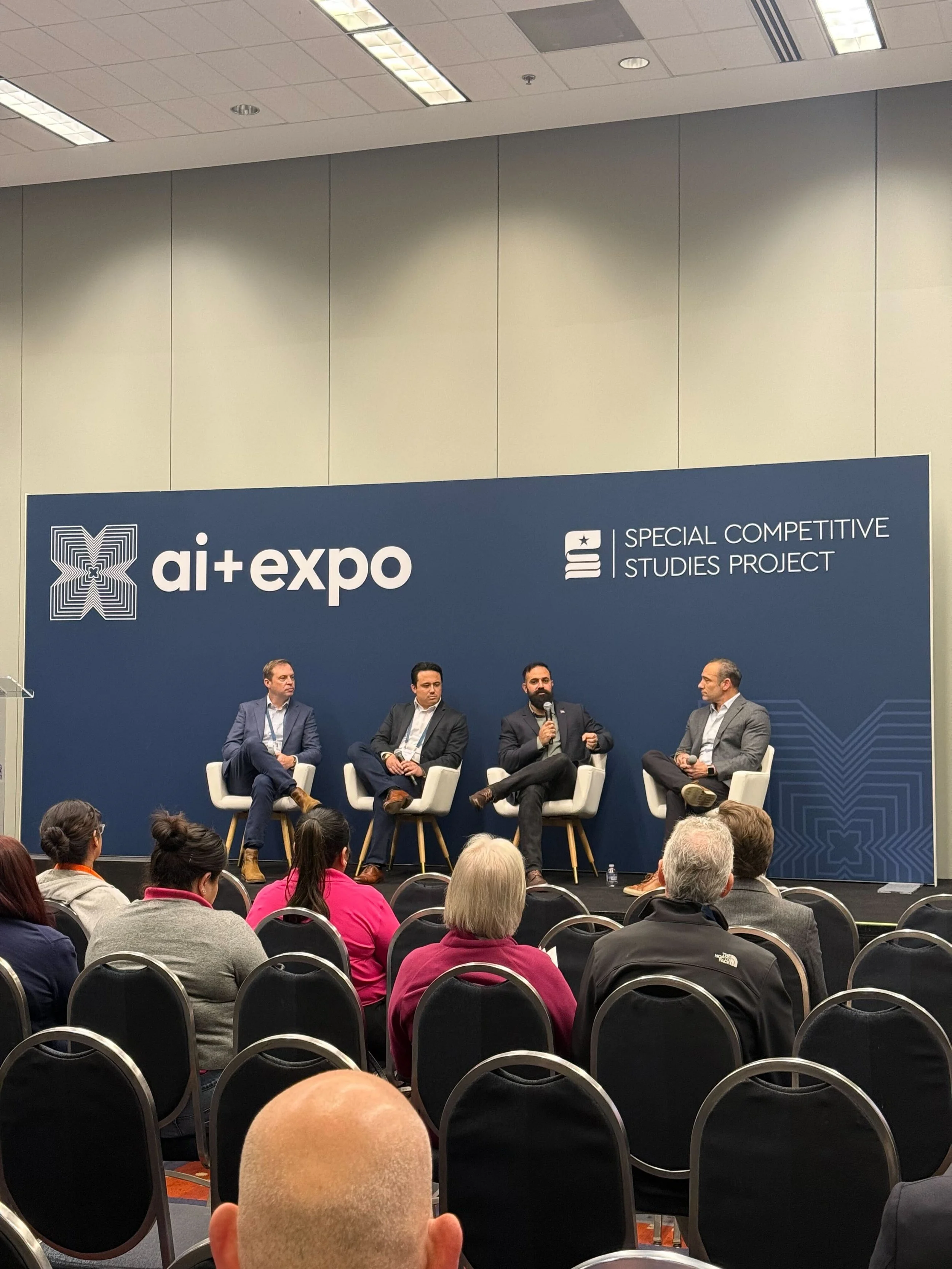
Robots for America Founding Members at AI+ Expo panel discussion, "Robots for America: Driving American Industry Forward." From left to right: Micah Murphy (New American Industrial Alliance), Nick Ayala (GrayMatter Robotics), Edward Mehr (Machina Labs), Dean Banks (Formic).
The United States Is Entering a Different Robotics Era
For decades, industrial automation in the United States largely evolved through market forces alone. Companies adopted robots when economics justified it. Integrators solved deployment problems one facility at a time. Large manufacturers often found pathways forward, while small and mid-sized operators struggled with cost, expertise, and implementation risk.
Other countries approached the challenge differently.
Nations like China, South Korea, and Germany spent years building coordinated industrial strategies around automation, robotics adoption, workforce development, and manufacturing modernization. Robotics was treated not simply as a private-sector efficiency tool, but as a strategic national capability.
The United States often treated automation as an optimization problem.
Others treated it as industrial policy.
That difference increasingly matters.
American manufacturers are now operating under growing pressure from labor shortages, rising operating costs, supply chain instability, and increasingly aggressive global competition. At the same time, the rise of physical AI and adaptive robotics is changing what automation systems are capable of doing on real factory floors.
Capabilities that once seemed experimental are beginning to move into production environments. Robots are becoming more flexible, more adaptive, and easier to deploy across variable tasks that historically resisted automation.
The robotics industry increasingly believes the country is reaching an inflection point.
And that inflection point may have less to do with the robots themselves than with whether the United States develops the surrounding infrastructure — policy, workforce systems, financing mechanisms, and governance frameworks — needed to scale deployment across industry.
Physical AI Is Lowering Old Barriers
Part of what makes this moment different is that the robotics stack itself is changing.
Traditional industrial automation was built around predictability. Systems were carefully programmed for tightly controlled environments. Integration timelines stretched for months. Facilities often had to redesign workflows around the robot rather than the other way around.
That model delivered extraordinary reliability, but it also limited flexibility.
The rise of physical AI is beginning to alter that equation.
Adaptive robotic systems powered by advanced perception, simulation, foundation models, and AI-driven control architectures are reducing some of the friction that historically made automation inaccessible to much of American manufacturing.
Tasks that once required enormous engineering effort can increasingly be adapted through demonstration learning, synthetic training environments, and generalized perception systems. Robots are becoming less dependent on perfectly structured environments and more capable of operating in the variability of real industrial settings.
That shift matters most for small and mid-sized manufacturers.
Historically, large enterprises could absorb the risk of failed deployments, long implementation timelines, and expensive integration projects. Smaller manufacturers often could not. Many lacked in-house robotics expertise entirely. Others could not justify tying up capital in systems that might take years to fully operationalize.
Robots for America repeatedly emphasizes this point because mid-market manufacturers increasingly sit at the center of the competitiveness problem.
The coalition frames automation not as a luxury for large corporations, but as an increasingly necessary capability for the broader industrial base.
That reframing is important.
It shifts the conversation away from robotics as a futuristic technology story and toward robotics as an economic survival issue for American production.
A Coalition Built Around Deployment Reality
The makeup of the coalition itself reveals a great deal about where the industry believes the future is heading.
Founding members include companies such as Formic, Machina Labs, Dexterity, Path Robotics, Chef Robotics, GrayMatter Robotics, Mytra, and Mujin, among others.
These are not primarily legacy trade organizations protecting mature market positions.
Many are companies actively deploying next-generation robotics systems into warehouses, factories, and industrial environments today. Their concerns are grounded less in theoretical innovation policy and more in the operational realities that continue to slow adoption: financing risk, workforce readiness, regulatory friction, implementation complexity, and inconsistent public policy.
Saman Farid, CEO of Formic and a founding member of the coalition, summarized the issue directly:
“What has been missing is a coordinated policy framework that removes the real barriers standing between American manufacturers and the automation they need. That is what Robots for America exists to build.”
That statement captures something important about the current robotics moment.
The conversation is increasingly shifting from:
“Can robots do this?”
to:
“What is preventing deployment at scale?”
Those are very different questions.
The technology itself is advancing quickly. The larger bottlenecks increasingly exist in financing, governance, integration capacity, workforce systems, permitting, procurement, and industrial coordination.
Robotics Policy Is Becoming Industrial Policy
Perhaps the most significant aspect of Robots for America is that its agenda extends well beyond robotics hardware itself.
The coalition’s policy priorities include reducing the financial risk of robotic trials, modernizing tax treatment around automation, streamlining permitting and regulatory processes, building workforce pipelines, and enabling autonomous logistics infrastructure.
Those are not narrow technology-sector concerns.
They are industrial policy concerns.
That distinction matters because it suggests the robotics conversation in Washington may be evolving from a focus on supporting robotics companies toward a broader conversation about modernizing American production infrastructure itself.
The rhetoric surrounding the coalition reflects that shift.
Edward Mehr, CEO of Machina Labs, argued during the launch event that the government must begin thinking far more strategically about the future architecture of manufacturing systems:
“It is time for the government to step into the supply chain and set requirements for what manufacturing looks like in 10 to 20 years.”
That is a remarkable statement because it moves the robotics conversation far beyond labor substitution or factory efficiency.
Increasingly, the debate is about national industrial capacity itself.
The Governance Layer Is Coming Into Focus
There is another layer emerging beneath the policy conversation as well.
Physical AI is beginning to blur the line between robotics policy and AI governance.
Adaptive robotic systems powered by foundation models introduce challenges that traditional industrial frameworks were never designed to address:
How should autonomous systems be validated?
What happens when models drift?
Who owns operational robot data?
How should adaptive behavior be certified?
What cybersecurity risks emerge when industrial robots become cloud-connected AI platforms?
This is where the broader standards ecosystem is beginning to move.
Organizations like ASTM International recently launched ASTM Committee F50 on Artificial Intelligence in Manufacturing Systems specifically to address governance, terminology, validation, and data-management issues surrounding AI-enabled manufacturing systems.
That development is significant because it reflects a growing realization that adaptive AI-enabled systems no longer fit neatly inside legacy industrial governance models.
A robot powered by a foundation model is no longer simply a machine executing predefined instructions. It increasingly behaves more like a continuously evolving software system attached to physical hardware.
That changes the governance challenge entirely.
The question is no longer just whether robots can be deployed safely.
It is whether institutions can evolve quickly enough to govern adaptive industrial intelligence at scale.
The Bigger Signal Behind Robots for America
The launch of Robots for America does not mean the United States suddenly has a coherent robotics strategy.
But it does suggest something important: both industry and policymakers increasingly recognize the absence of one.
And perhaps most importantly, it reflects a growing understanding that robotics deployment is no longer just a technology issue. It is becoming a foundational economic and geopolitical issue tied directly to manufacturing resilience, industrial competitiveness, workforce stability, and national infrastructure.
For years, robotics often operated as a collection of disconnected sectors:
industrial automation,
warehouse robotics,
AI startups,
autonomous mobility,
manufacturing software,
defense systems.
Physical AI is beginning to collapse many of those boundaries.
Now the politics may be starting to consolidate as well.
The next several years will determine whether the United States continues treating robotics as a fragmented technology market — or begins treating it as foundational infrastructure for the next industrial era.
