Samsung-backed Config raises $27M to become the "TSMC of robot data"
South Korea's biggest manufacturers are placing a coordinated bet on the unsexy part of the robotics stack: the data.
Config, a Seoul- and San Jose-based startup building the data layer for robotic foundation models, has closed an oversubscribed $27 million seed round led by Samsung Venture Investment at a valuation north of $200 million. The round brings the company's total funding to $35 million and lines up a strategic roster that reads like a who's-who of Korean industry — Hyundai Motor's ZER01NE Ventures, LG Tech Ventures, and SKT America all joined, alongside Mirae Asset Ventures, Korea Development Bank, GS Futures, Kakao Ventures, and Z Ventures. Pieter Abbeel, the UC Berkeley professor and Covariant AI co-founder, came in as an angel.
That investor list is the story as much as the dollar figure. Asia's push into physical AI is being driven by the same manufacturing base that made the region an industrial powerhouse, and South Korea, Japan, China, and Taiwan have economies structurally tilted toward large-scale production and export-driven supply chains rather than software and services. That foundation is now shaping where AI capital flows — and Config is one of the clearest examples yet of strategic money lining up behind the data layer rather than the robots themselves.
The data problem nobody wants to solve
Config was founded in January 2025 by CEO Minjoon Seo, a former Meta researcher and ex-chief scientist at Twelve Labs, together with three co-founders who came out of Waymo, Google, and Naver. The team made an early decision not to build robots. Instead, they're focused on supplying the training data those robots need.
The logic comes down to economics. Training a large language model is expensive because of the compute required, but the raw material — text scraped from the internet — is essentially free. Robotics is the opposite problem.
"Every piece of training data has to be physically collected," Seo told TechCrunch. "You need the robot, the facility to run it, and people to operate it." That makes robot AI dramatically more costly to develop than a chatbot, and the cost curve gets steeper as companies push toward more capable systems.
Config's pitch is that someone needs to industrialize that collection process, and it shouldn't be the same company trying to build the robot. Seo and his team compare the role to TSMC, the Taiwanese foundry that manufactures chips for Apple, Nvidia, and AMD without competing with any of them. Config wants to be the neutral supplier of the input — data — that everyone else's robot AI depends on.
Why the manufacturers are buying in
That positioning is landing at a useful moment. Large manufacturers are increasingly trying to build their own proprietary robot AI rather than depend entirely on outside vendors, and that creates appetite for a partner who supplies the raw material without competing for the end product. It's the market Config is betting on, and the strategic backing from Samsung, Hyundai, LG, and SKT suggests those manufacturers see the same opening.
The company is already generating revenue, according to COO and co-founder Jack Bang. Current customers include large manufacturers, system integrators, and companies in agriculture and defense. Competitors in the space include Physical Intelligence, Generalist AI, and Skild AI — all chasing pieces of the same emerging stack.
100,000 hours and counting
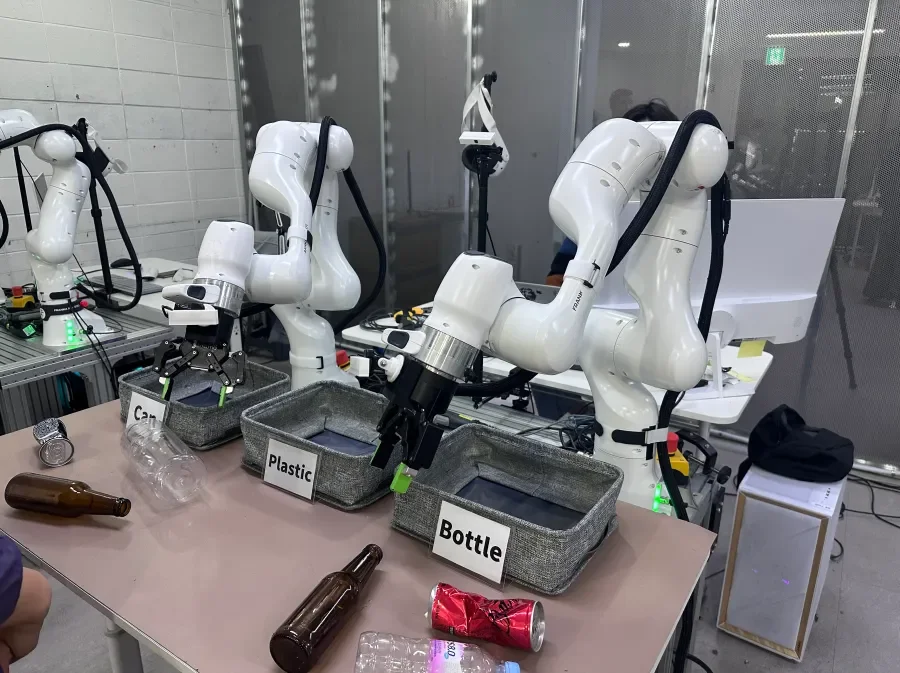
Config records humans performing physical tasks, both in controlled studio environments and in the field. The operation runs out of Seoul and Hanoi, with a workforce approaching 300 people handling data production. So far, the company has accumulated more than 100,000 hours of human motion data — roughly 30 times the size of AgiBot World, the largest comparable open-source dataset at around 3,000 hours.
What Config does with that data is where Seo argues the real differentiation sits. Most robotics teams train their models on human motion data and then try to adapt the resulting model for a robot. Config inverts the process — transforming the data itself before training begins, so it's already suited to the way a robot moves and interacts with the world.
Seo reaches for a language analogy. Training on one type of motion data and expecting it to transfer cleanly to a different embodiment is, he said, like trying to teach Korean using only English-language materials.
"The data must be converted, not the model," he said. "This conversion technology is Config's core technical differentiator."
What the money buys
The new funding is earmarked for three priorities: scaling the Vietnam and Seoul data operation toward one million hours of collected motion data, growing the enterprise platform business to $10 million in ARR by the end of 2027, and launching a cloud-based Robot-as-a-Service product that would let companies run Config's foundation model without onboard hardware.
If that last piece works, it changes the shape of the business — from supplier of data and models to operator of a remote inference layer that anyone with a robot could plug into. It's also where the TSMC comparison either holds up or breaks down. TSMC's leverage comes from being indispensable to its customers without threatening them. Whether Config can hold that line as it moves up the stack is the question the next two years will answer.
