Rebalancing the Human Body: How a Hip Exoskeleton Could Change Stroke Recovery
Hemiparesis — a condition that causes weakness and impaired motor control on one side of the body — remains one of the leading causes of disability in the United States. Affecting roughly 80% of stroke survivors, it fundamentally reshapes how people move, work, and experience daily life.
Walking, something most of us take for granted, becomes a complex and energy-intensive challenge.
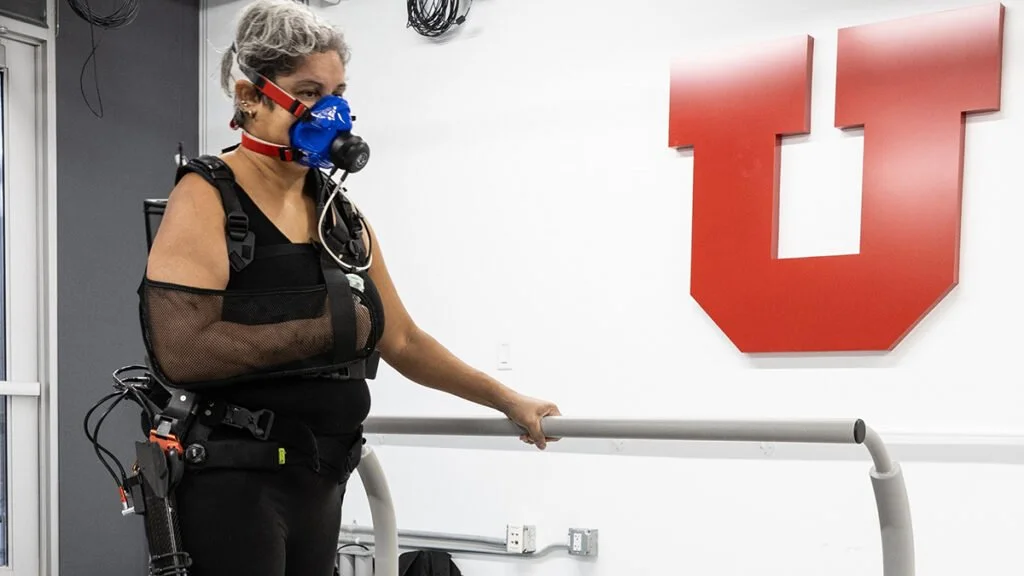
Now, researchers at the University of Utah’s John and Marcia Price College of Engineering are demonstrating how robotics may help restore balance — literally and figuratively. In a recent study published in Nature Communications, the team introduced a portable hip exoskeleton that significantly reduces the metabolic cost of walking for individuals with hemiparesis.
The results suggest a promising new direction for rehabilitation robotics.
When Walking Becomes Work
Human walking depends on a delicate orchestration of biomechanics. Even a small loss of strength on one side of the body can trigger compensatory movements across the entire gait cycle.
For individuals with hemiparesis, these compensations come at a steep cost. Walking can require up to 60% more energy compared to individuals with healthy mobility. This translates into slower speeds, reduced endurance, greater fatigue, and an increased risk of falls — all of which diminish independence and quality of life.
Traditional rehabilitation strategies have sought ways to restore symmetry, but many technological solutions have focused primarily on the ankle.
The Utah research team took a different approach.
Shifting the Focus to the Hip
Led by associate professor Tommaso Lenzi, the researchers developed a lightweight, five-and-a-half-pound hip exoskeleton designed to provide targeted assistance during walking.
Rather than addressing ankle weakness directly, the team recognized that many patients compensate for ankle impairments through increased hip movement — an adaptation that demands significantly more energy.
By assisting hip motion instead, the device reduces the burden on the body’s compensatory mechanisms.
Battery-powered motors provide real-time assistance during key moments of the gait cycle, synchronized through an intelligent control system that adapts to each user. Assistance levels are customized, ensuring that the robot complements rather than overrides natural movement.
This design also enables a lighter system: because the device is positioned near the body’s center of mass, it requires less torque than ankle-based systems.
Measurable Gains
The study involved seven participants with hemiparesis, whose gait and metabolic energy expenditure were analyzed using motion capture and calorimetry while walking with and without the device.
The findings were significant:
Nearly 30% reduction in hip joint workload
Approximately 18% decrease in overall metabolic cost of walking
For context, researchers compared the energy savings to removing a 30-pound backpack from someone with a healthy gait — a difference that could transform daily mobility for stroke survivors.
Participants also reported noticeable improvements. One stroke survivor described regaining movement she initially thought lost, while her partner observed lasting benefits even after removing the device.
Beyond Rehabilitation: Robotics as Enabling Technology
While powered exoskeletons have long captured the imagination, this research highlights a shift from experimental prototypes toward practical assistive technologies designed for everyday use.
The next phase will focus on expanding the device’s capabilities beyond treadmill walking into real-world environments. The research team is collaborating with prosthetics and orthotics specialists to translate the technology into a scalable, usable product.
More broadly, the study underscores an important trend in robotics: the most transformative systems are often those that enhance human capability rather than replace it.
In this case, the goal is not automation — it is restoration.
As Lenzi puts it, the vision is simple but profound: ensuring that a stroke does not define where a person can go or how they live.
