Renault to Deploy 350 Humanoid Robots in Industrial Automation Push
Renault Group has announced plans to deploy 350 humanoid robots across its manufacturing facilities within the next 18 months, marking one of the most significant real-world commitments to the technology by a major industrial company to date.
The robots, developed in partnership with French robotics firm Wandercraft, are already operational. At Renault's Douai plant in northern France, a humanoid known as Calvin is performing tyre-handling operations — physically demanding work that has long posed ergonomic challenges for human workers. The deployment signals that the technology has moved decisively beyond the lab.
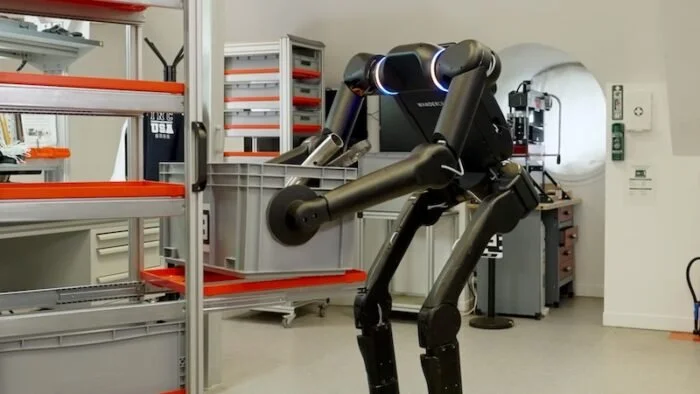
From prototype to factory floor
For years, humanoid robots have been a fixture of trade show demonstrations and carefully choreographed videos. Renault's move is different in kind. Rather than targeting the long-term goal of a fully capable general-purpose robot, the company has focused on a narrower and more immediately achievable objective: deploying machines that can handle specific, repetitive, physically taxing tasks within existing production environments.
The Calvin-40 variant at the centre of the rollout is designed to operate within facilities built for humans — navigating autonomously, handling heavy components, and working continuously without the need for the structured, purpose-built cells that traditional industrial robots require. That flexibility is key. Most factory automation today depends on fixed installations and highly controlled conditions. Humanoid robots, in theory, can slot into workflows that conventional machines cannot easily reach.
Augmenting, not replacing
Renault is careful to frame the deployment as additive. The humanoid robots are being introduced alongside existing automation, not in place of it. The focus is on so-called brownfield applications — tasks in legacy facilities that are difficult or costly to automate through conventional means. In this context, the humanoid form factor becomes a practical solution to a real operational constraint, rather than a statement about the future of work.
The rollout is expected to contribute to reductions in production costs and improvements in manufacturing efficiency, though the company has not disclosed specific targets.
A broader shift taking shape
Renault's initiative builds on a partnership with Wandercraft announced in 2025, which included a minority investment and a joint development agreement. Wandercraft's origins lie in self-balancing robotic systems for medical exoskeletons — technology that underpins the Calvin platform's ability to move safely and stably in human-centric spaces.
The scale of the planned deployment puts Renault ahead of most of its peers. While several automakers and technology companies have experimented with humanoid robotics, few have committed to industrial-scale rollouts with defined timelines. If Renault's programme delivers on its targets, it could serve as a proof of concept that accelerates adoption across the wider manufacturing sector.
The deeper significance, however, may lie in what the deployment represents for the factory of the future. As humanoid robots become more capable and more connected, they are expected to function not just as labour assets but as mobile participants in broader digital manufacturing ecosystems — feeding data into quality systems, responding to real-time production feedback, and operating within environments that are becoming increasingly automated and adaptive.
For now, Renault's ambitions are grounded and specific. But the direction of travel is clear.
