Saga Robotics Doubles Down on U.S. Vineyards as Autonomous UV-C Farming Scales
Saga Robotics is accelerating its push into the U.S. vineyard market, combining new leadership, fresh capital, and rapid operational growth to expand the use of autonomous robots in viticulture.
The Norway-based ag robotics company has appointed Caine Thompson, former general manager at O’Neill Vintners & Distillers, as its new U.S. general manager and secured additional funding from Xinomavro Ventures, a venture firm focused on wine-industry technology. The investment follows Saga’s $11.2 million funding round in 2025 and signals growing investor confidence in robotics-driven crop protection.
Saga founder Pål Johan From will transition from leading U.S. operations to a newly created chief growth officer role, focusing on strategic partnerships, technology development, and expansion into new crops and markets. To ensure continuity during the critical 2026 season, he will remain involved in U.S. operations through June.
Robots, UV-C, and the Fight Against Powdery Mildew
At the center of Saga’s strategy is its Thorvald autonomous platform, which uses UV-C light to combat powdery mildew—a persistent fungal disease in vineyards. Unlike traditional chemical fungicides, UV-C disrupts fungal DNA and cellular function, preventing reproduction.
Thorvald operates at night for a critical reason: sunlight triggers a repair mechanism in fungi that can undo UV-C damage. By treating crops in darkness, the system maximizes effectiveness while reducing reliance on chemical inputs.
During the 2025 California wine grape season, Saga reported a tenfold increase in acres treated, with expectations to nearly triple that figure again in 2026. The growth reflects both rising disease pressure and a broader shift toward sustainable agricultural practices.
Scaling Through Precision and Business Model Innovation
Saga’s approach differs from other UV-C robotics players. While some competitors build large machines designed for open-field applications, Saga focuses on smaller, highly precise robots suited to vineyards and tabletop strawberry systems.
The company operates under a Robots-as-a-Service (RaaS) model, charging growers per acre rather than selling robots outright. This lowers the barrier to adoption and aligns costs with measurable outcomes—yield improvements, labor savings, and reduced chemical use.
Thompson describes the technology as a rare convergence of sustainability and practicality.
“Chemical-free winegrowing is the holy grail,” he said. “The Thorvald UV-C robot lowers the barrier to sustainable and regenerative viticulture by eliminating the need for synthetic chemicals.”
Beyond Disease Control: Data as a Second Product
Saga’s latest robots are equipped with cameras and sensing systems that collect vineyard data, enabling early disease detection, yield prediction, and additional agronomic insights. The company is exploring add-on capabilities such as virus detection, beneficial insect release, weed control, and other vineyard operations.
This dual role—physical automation and data generation—positions Saga not just as a robotics provider but as a platform for precision agriculture.
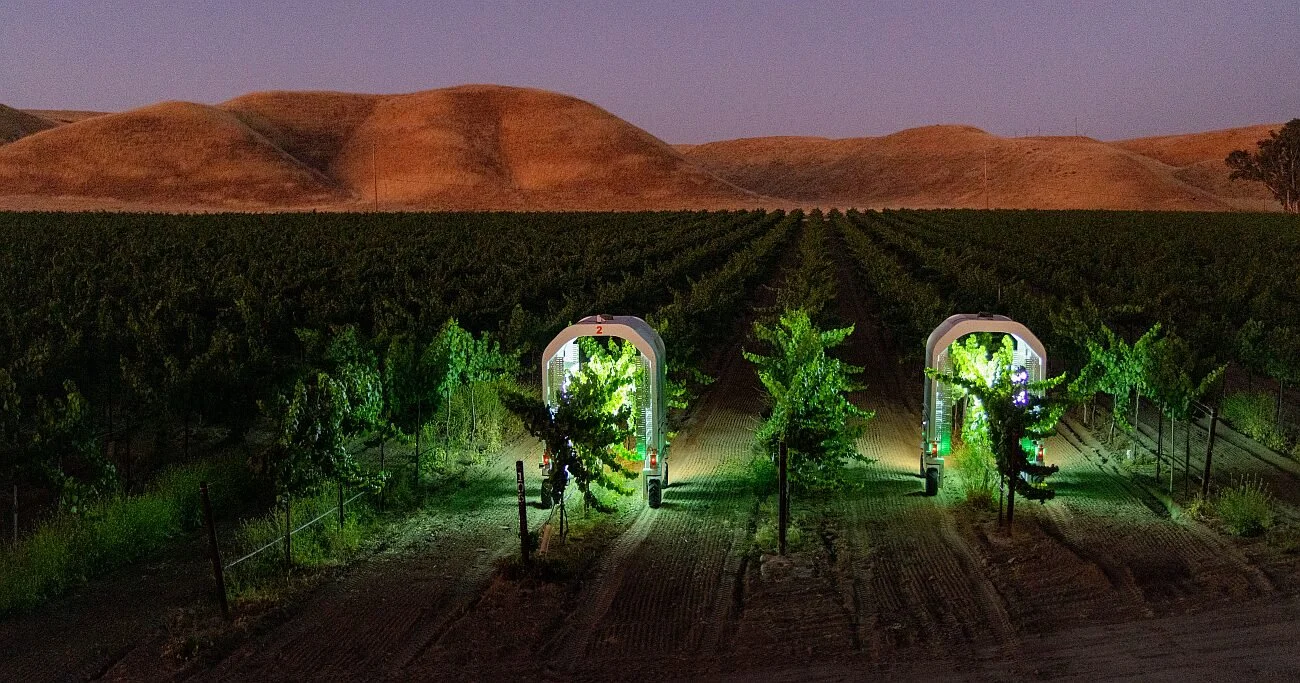
Saga Robotics’ Thorvald system applies UV-C at night because sunlight—especially blue light—triggers a repair mechanism in fungi that can undo UV-C damage. Treating in darkness prevents this repair, making the treatment more effective. Image credit: Jason Henry
Trust, Adoption, and the Mindset Shift
Saga’s expansion highlights a broader challenge in agricultural robotics: technology readiness often outpaces industry adoption.
According to From, growers typically start with limited deployments before scaling.
“We might begin with 10–20 hectares in season one, expand in season two, and reach full-farm deployment by season three,” he said. “Once growers see performance exceeding chemical approaches, scaling becomes much faster.”
Independent research validating UV-C effectiveness, combined with visible success among early adopters, has helped accelerate acceptance.
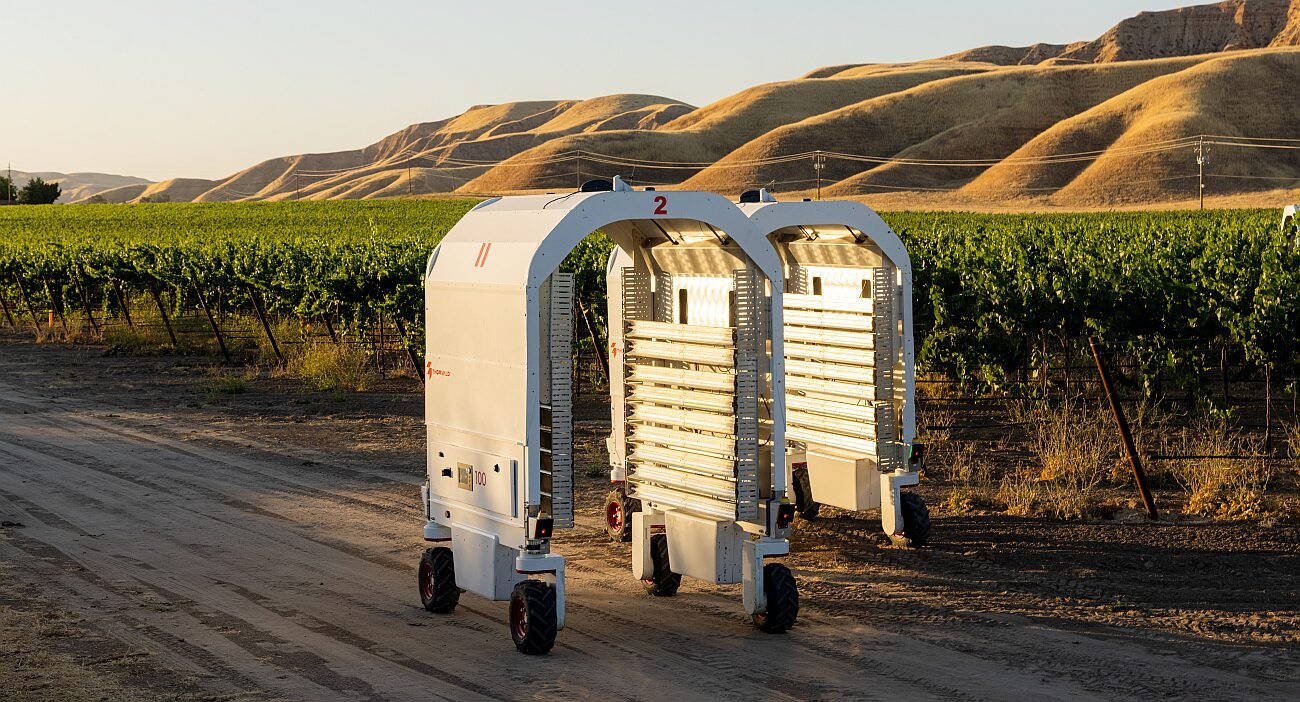
For yield prediction, which began generating commercial revenue in 2025, Saga collects data on the number and size of clusters and grapes, or, for strawberries, the number of flowers. Image credit: Jason Henry
A Signal of Where Ag Robotics Is Heading
Saga Robotics’ momentum in U.S. vineyards reflects a larger trend in agriculture: robotics is moving from experimental pilots to operational infrastructure.
As fungicides lose effectiveness and labor constraints intensify, autonomous systems that deliver measurable economic and environmental benefits are gaining traction. For vineyards, the shift is not just technological—it represents a fundamental rethinking of how crops are protected, managed, and optimized.
In that sense, Saga’s expansion is less about robots replacing tractors and more about robotics redefining the logic of modern farming.
