The Robotification of Warfare: From Ukraine’s drone raids to the U.S. Army’s warning about a “robotic Maginot Line”
On June 1, 2025, Ukraine pulled off an operation that looked less like classic airpower and more like a software update to sabotage. First-person-view drones—small, cheap, and hard to attribute in the moment—struck Russian air bases deep inside Russia. Satellite imagery and post-strike analysis suggested meaningful damage to strategic bombers that are difficult (and in some cases impossible) to replace.
The details vary by source—as they often do in wartime assessments—but the shape of the event is what matters: Ukraine reportedly used 117 drones, concealed and launched close to targets, to hit high-value aircraft that usually live behind layers of air defense and geography. Even U.S. officials, while estimating fewer aircraft destroyed than Ukrainian claims, still described the strike as significant.
Verified video of a Ukrainian FPV drone shown attacking a Russian bomber. Video obtained by Reuters via Ukrainian Presidential Press Service.
This is the kind of moment that forces militaries to ask a painful question: If a nation can threaten strategic aviation with a swarm of expendable drones, what else becomes “soft” in the modern order of battle? Air bases. Logistics hubs. Command posts. Patriot batteries. Port infrastructure. And—most destabilizing of all—the assumption that high-end platforms remain survivable because they are high-end.
That is the opening frame of The Robotification of Warfare: Strategic Imperatives for the Robotic Age, published in November 2025 by the Association of the U.S. Army (AUSA). Its author, LTC Richard Brennan III, argues that we are watching the character of warfare evolve in real time: robotic and autonomous systems are not simply shaping warfare, but increasingly defining it.
What makes Brennan’s paper unusually useful is that it doesn’t stop at “drones are important.” It argues that robotics is creating an era shift on the scale of mechanization—and that the United States risks responding the way many militaries respond to disruptive change: by grafting the new technology onto old concepts until the technology’s meaning is diluted. Brennan gives that failure mode a memorable label: a robotic Maginot Line.
Let’s take a deep dive into Brennan’s thesis—starting in Ukraine, detouring through the mechanization analogy, landing on U.S. reforms, and ending with what the Army (and the broader defense enterprise) should do next.
Ukraine’s drone war isn’t a sideshow. It’s the lab.
Ukraine’s drone ecosystem has been described as a “drone economy”—a fast iteration loop where design, production, tactics, countermeasures, and training co-evolve. The Spiderweb-style raids are the headline-grabbers, but the deeper lesson is mundane and therefore dangerous: cheap systems, used at scale, can create strategic effects—especially when they exploit the cost curve of the defender.
That cost curve is the most important hidden variable in modern warfare. When attackers can trade a few thousand dollars of drone for hundreds of thousands (or millions) in defensive missiles—or for a strategic asset worth far more—war becomes less about exquisite performance and more about sustainable math.
And Ukraine is showing two additional realities that appear in every modern drone fight:
The electromagnetic spectrum is the battlefield. Drones are only drones if they can communicate, navigate, and survive interference. If jamming breaks your link, “autonomy” suddenly matters more. If spoofing compromises your navigation, “resilience” matters more. (This dynamic shows up repeatedly in Western analysis of the war’s drone evolution and the rise of counter-drone tactics.)
Adaptation speed is a weapon. In one U.S. Army analysis of modern adaptation, drone warfare in Ukraine is described as evolving through multiple “generations” of tactics and technologies within roughly two years—precisely the kind of pace that breaks traditional acquisition and requirements cycles.
Put those together and you get the core pressure Brennan is highlighting: if robotics changes warfare at commercial speed, a military that modernizes at bureaucracy speed risks arriving late to its own future.
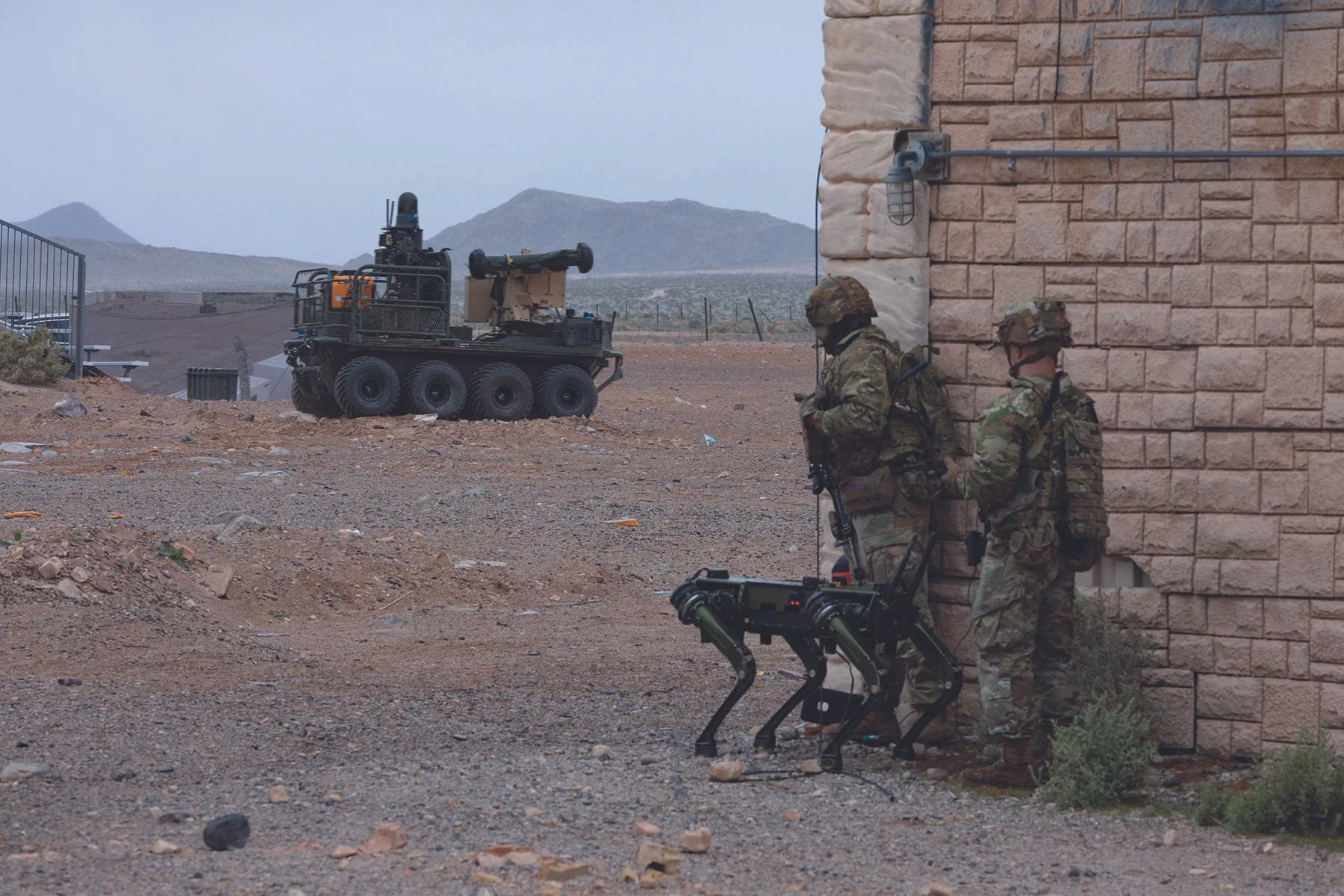
Soldiers from the 1st Battalion, 29th Infantry Regiment at Fort Moore, Georgia, participate in a human-machine integration demonstration with a Ghost robotic dog and a Small Multipurpose Equipment Transport (SMET) during Project Convergence–Capstone 4 at Fort Irwin, California, on March 15, 2024. The robotic dog provides reconnaissance and situational awareness, while the eight-wheeled SMET functions as a robotic mule supporting combat and sustainment operations. (Photo by Spc. Samarion Hick, U.S. Army)
Mechanization as a warning: don’t repeat the interwar mistake
Brennan’s key historical analogy is mechanization—the shift from animal-powered mobility to internal-combustion mobility that eventually produced the tank, mechanized logistics, and air-ground integration. In his framing, mechanization is not merely “new vehicles,” but a redefinition of mobility, protection, and firepower that forced changes to doctrine, organization, and leadership.
He invokes military historian Trevor Dupuy’s idea that eras of warfare are marked when innovations become incorporated into processes, doctrine, and strategy—and when markets and industrial systems scale them. That scaling point is crucial. Many militaries had tanks in World War I. Not many understood what tanks meant.
Mechanization’s lesson is not “buy tanks.” It is: when a technology changes the geometry of war, you must change how you think about war.
That’s where the Maginot Line enters the story. The Maginot Line was not a failure of engineering; it was a failure of imagination about what mechanized maneuver and airpower would do to fixed defenses. Brennan uses it as a metaphor for a future where the U.S. builds an elaborate architecture of robotic add-ons—counter-drone systems, exquisite autonomous platforms, incremental upgrades—yet still tries to wage 20th-century maneuver warfare as if the battlefield hasn’t been remade.
He illustrates the danger with a wonderfully humiliating image: using trucks to keep horse cavalry fed—technologically impressive, doctrinally backward.
This is the intellectual pivot of the paper. Brennan argues the correct question is not “How do we use robotics to fight better?” but: “What is warfare in the robotic age?”
That question is destabilizing because it implies the answers may reorder everything:
force structure (what a brigade is),
command-and-control (who decides, when),
industrial policy (what can be produced quickly),
training (who is valuable),
ethics and law (how autonomy is constrained),
and deterrence (what counts as escalation).
The U.S. Army’s response: Transforming in Contact
Brennan points to the U.S. Army’s Transforming in Contact initiative as evidence the institution is attempting to compress the loop between learning, fielding, and organizational change.
In Army language, Transforming in Contact is about delivering new technology into the hands of Soldiers so they can experiment, innovate, and adapt in realistic training—often using commercial-off-the-shelf solutions—rather than waiting years for a perfect, program-of-record system.
If you want the essence of this approach, it’s here: technology is not capability by itself. Capability comes from formations that are organized, trained, and equipped—and building it requires changes across doctrine, organization, training, materiel, leadership, personnel, facilities, and policy.
That’s a profound admission, and it mirrors mechanization’s lesson: buying machines is easy; building a warfighting system around machines is hard.
Transforming in Contact also implicitly acknowledges a modern reality: the Army’s traditional requirement and funding cycles can take about two years even for existing technologies—yet AI-enabled robotics evolves much faster. If your procurement cadence cannot match the learning cadence of the battlefield, you’re not modernizing—you’re archiving.
So the Army is trying to create an adaptation pipeline: get systems into units, learn fast, revise requirements in real time, and scale what works. The goal isn’t to chase every gadget; it’s to avoid being surprised by the next doctrinal discontinuity—especially against peer competitors who can scale manufacturing and iterate rapidly.
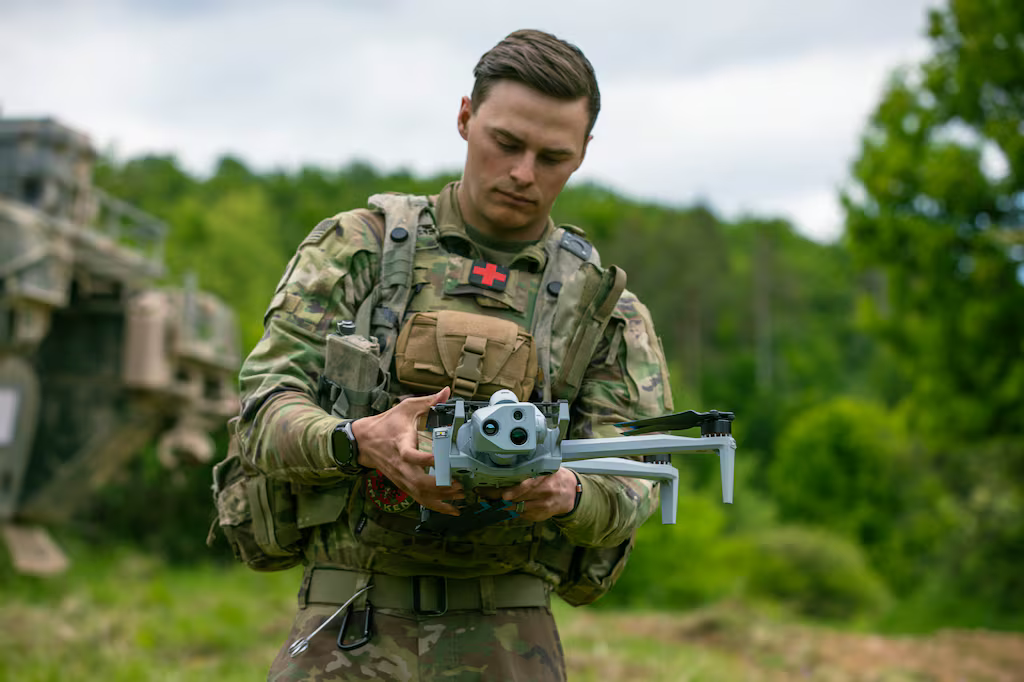
Spc. Anton Lane, a combat medic with specialized drone training, assigned to 5-7 Cavalry 3rd Infantry Division, puts away a Skydio X10E4TT drone as part of a Transformation in Contact exercise. (Sgt. Samantha Hill/Army)
The “robotic Maginot Line”: what it looks like in practice
It’s easy to treat the phrase “robotic Maginot Line” as a clever jab. But Brennan is making a precise warning: the U.S. could invest heavily in robotics while still missing the transformation.
Here are three ways that failure can happen—even with good intentions:
1) Robotics as accessories, not actors
If drones are treated as attachments to legacy formations (“a platoon plus a drone kit”), rather than as warfighting entities that reshape reconnaissance, fires, deception, logistics, and protection, then robotics remains peripheral.
Mechanization succeeded when it became central to operational design—not when it was a better wagon.
2) Countering your way out of change
There is a natural institutional impulse to treat drones as a threat category to be defeated, the way IEDs were treated as a tactical scourge. But the drone threat isn’t just a thing to “solve.” It’s evidence of a shift in how lethality and mass can be generated.
In a robotic age, counter-robotics will always be necessary—but counter-robotics alone is not a strategy.
3) Exquisite platforms without sustainable scale
A robotic force that depends primarily on expensive, slow-to-produce systems risks being fragile under attrition. Ukraine’s drone lessons—reinforced by the broader economics of modern drone warfare—point to a future where scale and replaceability are as critical as performance.
The modern battlefield is punishing to anything that cannot be replenished.
What to do next: five moves for a robotic-age military
Brennan’s paper is a strategic argument, not a procurement checklist. But it points clearly toward what a robotic-age course correction looks like. Here are five moves that follow naturally from his framework—each aimed at avoiding a robotic Maginot Line and building real robotic-age advantage.
1) Redefine the basic unit of combat around human-machine teams
If robotics is becoming defining, then the “unit” cannot be purely human with robotic accessories. The basic building block should be a human-led formation designed to command, protect, supply, and fight with a family of unmanned systems across air and ground (and increasingly maritime).
This is as much about organization and training as it is about gear.
2) Treat the electromagnetic spectrum as a primary maneuver space
Drones, autonomy, and robotics live and die in contested EW conditions. That means every operational concept must assume interference, spoofing, degraded comms, and cyber intrusion—and still function. Ukraine’s drone war makes this non-negotiable; the Army’s own transformation writing emphasizes that modern tech changes too fast for slow requirements cycles precisely because countermeasures evolve so quickly.
Resilience is not a feature. It is table stakes.
3) Fix the speed mismatch: field, learn, revise, scale
Transforming in Contact is an attempt to solve the speed mismatch between battlefield learning and bureaucracy. The next step is institutionalizing that model so it can scale without becoming chaos: broader capability-based requirements, faster funding pivots, and earlier fielding in meaningful quantities.
In a robotic age, the advantage often belongs to the side that iterates faster, not the side that perfects first.
4) Separate “robotic systems” from “smart munitions” in doctrine and budgeting
One of the most practical clarifications in Brennan’s argument is that reusable robotic systems and expendable smart munitions behave differently—and should be planned, sustained, and procured differently.
If you treat everything as “unmanned,” you will build the wrong sustainment models, the wrong training pipelines, and the wrong industrial assumptions.
5) Make scale a strategic requirement, not a nice-to-have
Ukraine’s deep strikes underscore that massed, low-cost systems can threaten strategic assets—and force adversaries to redistribute defenses. A robotic-age military must therefore treat scale—production capacity, repairability, modularity, and supply resilience—as a first-order capability.
Industrial policy becomes operational power.
The bottom line
Ukraine’s drone war is not just a story about clever tactics. It’s a live demonstration that robotics can compress distance, saturate defenses, and shift the cost curves of combat—sometimes with strategic consequences.
Brennan’s Land Warfare Paper argues this is an era shift akin to mechanization: robotics isn’t just enhancing human warfighting; it is increasingly substituting for humans in roles once defined by presence and risk. And that shift comes with a trap: investing in robotics while trying to preserve old methods—building a robotic Maginot Line—until an adversary uses robotics to rewrite the battlefield faster than you can adapt.
The most important sentence in the paper may be the simplest: we must move beyond trying to fight 20th-century warfare better—and ask what war is in the robotic age.
Because if the answer is “more of the same, just with drones,” then we have already missed the point.
