The Startup Trying to Rebuild Construction From the Ground Up—with Robots
Construction is the world’s largest industry—and one of its most stubbornly unchanged. Despite decades of innovation elsewhere, building projects still rely on fragmented workflows, manual labor, and slow-moving coordination that would feel familiar to a contractor from the 1970s. Productivity has barely moved in half a century.
European startup All3 is betting that the problem isn’t a lack of tools—it’s the entire system.
This week, the company announced a $25 million seed round led by RTP Global, with participation from SuperSeed, Begin Capital, s16vc, and VNV Global. The funding will push forward a bold idea: vertically integrating construction into a robotics-first pipeline that replaces much of the traditional value chain.
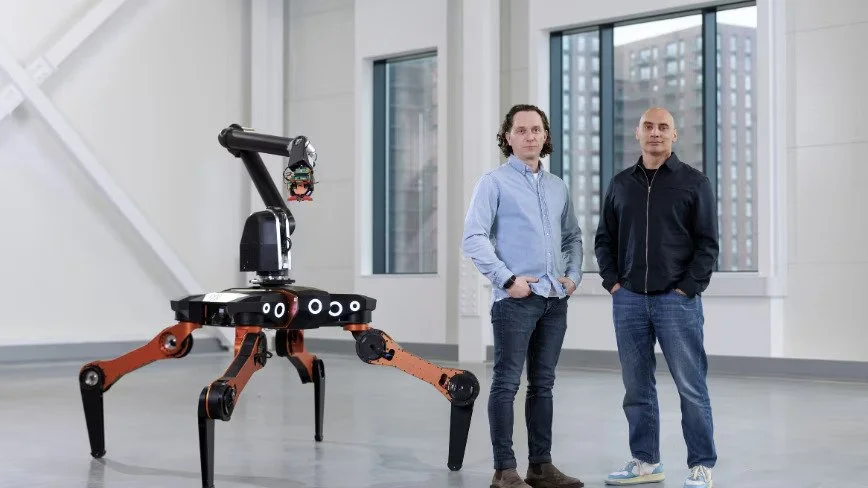
Unlike startups that target narrow slices of the process—bricklaying, prefabrication, or site inspection—All3 is designing a full-stack approach. Its platform starts with AI-driven building design, translating site constraints and regulatory requirements into optimized plans. From there, modular robotic factories fabricate timber composite components with high precision. Finally, an autonomous legged robot—called the Mantis—handles on-site assembly, from placement to finishing.
It’s a clean narrative: software designs, robots build, humans step back.
The material choice reinforces the pitch. All3 uses structural timber composites, positioning itself as a lower-carbon alternative to concrete, which accounts for roughly 7–8% of global emissions. The company claims its system could cut costs by up to 30%, timelines by 50%, and embodied carbon by 25%—though those figures remain unaudited.
Germany will serve as the first proving ground, with initial projects expected to begin in 2026. The market is well chosen: Europe faces both a housing shortage and a shrinking construction workforce, making it fertile territory for automation narratives.
But All3’s ambition is also its risk.
Rebuilding construction around robotics isn’t just an engineering challenge—it’s a governance and integration problem. Permitting, developer trust, safety validation, and on-site unpredictability all stand between prototype and scaled deployment. Legged robots operating in dense, active construction sites introduce complexities that extend far beyond factory automation.
All3 is not alone in chasing this opportunity. Other European players are attacking pieces of the problem, from robotic bricklaying to prefab systems. What differentiates All3 is its willingness to take on the entire stack at once.
That’s either how you unlock a stagnant industry—or how you overreach.
For now, All3 sits at the intersection of two powerful narratives: Europe’s push for “physical AI” champions and construction’s long-overdue productivity reset. Whether those narratives converge into reality will depend less on what All3 promises—and more on what it can actually build on a job site in Germany.
