World-First Study Tests Home-Based Social Robot Support for Young Autistic Children
LuxAI, in partnership with the Luxembourg Institute of Health (LIH) and the University of Birmingham, has launched what it calls the world’s first large-scale, long-term scientific study of a social robot–led early development programme at home for young autistic children.
The project will evaluate QTrobot, LuxAI’s humanoid social robot, as a tool to support autistic children aged 2.5–4.5 years in areas such as communication, language, social skills and learning. The study will involve 69 families and is expected to conclude by the end of 2026.
Funded jointly by the Luxembourg National Research Fund and the Luxembourg Ministry of the Economy, the study positions QTrobot as an assistive educational tool for at-home early autism intervention. The robot delivers interactive learning activities through games and guided exercises, adjusting to each child’s pace while offering families structured support they can use day to day.
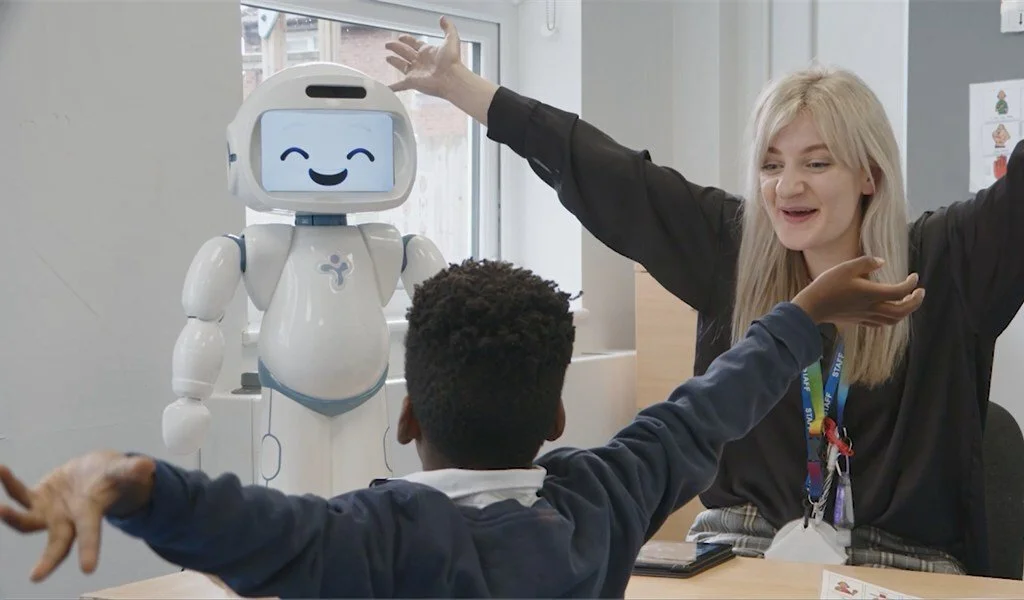
QTrobot, an assistive educational tool for at-home early autism intervention and support
“This is a landmark study for both early autism research and technology-supported learning,” said Dr. Manon Gantenbein, Head of the Clinical and Epidemiological Investigation Center at LIH. “So far, technologies like robots have shown very promising results in short-term, small-scale studies, but their long-term effectiveness and usability have never been systematically examined.”
“For the first time, we are conducting a large-scale, long-term study to rigorously assess the impact of a robot-led programme designed to empower both children and their families through home-based support,” she added.
Families in the West Midlands, UK, will take part in the 10-month programme. Researchers will track both child development and parental self-efficacy to understand how robot-assisted interventions might strengthen early developmental outcomes and confidence in supporting children at home.
“Access to high-quality early support is still limited for many families across the world,” said Prof. Karen Guldberg, Head of the School of Education at the University of Birmingham. “By combining research excellence and technology, this study could pave the way for engaging early support for autistic children and their families.”
For LuxAI, the trial is a chance to test QTrobot in real homes, at scale, over an extended period—conditions that are rarely captured in existing research on socially assistive robots.
“We are proud to see QTrobot and its early-years development programme at the heart of such pioneering research,” said Dr. Aida Nazari, COO of LuxAI. “This study represents a crucial step in understanding how robots can deliver consistent, personalised support in the child’s own environment, where they are most comfortable and where families often need additional support. By bringing 69 families through this 10-month journey, we will gain invaluable insights into real-world impact.”
Recruitment is now under way in the West Midlands for families with autistic children aged 2.5–4.5 years. Interested families can learn more by emailing Dr. Barbara Sandland and Dr. Rebecca Bartram at qtrobot@contacts.bham.ac.uk.
