BMW Brings “Physical AI” to Europe with Humanoid Robot Pilot in Leipzig
The BMW Group is accelerating the digital transformation of its global production network by bringing “Physical AI” to Europe for the first time. Following a successful U.S. pilot, the company has launched a humanoid robot project at BMW Group Plant Leipzig, aiming to integrate AI-enabled robots directly into series car production and battery manufacturing.
From Digital AI to Physical AI
Physical AI represents the fusion of digital intelligence with real-world machines. At BMW, that means AI agents that not only analyze data but also control robots capable of operating inside active production environments.
Artificial intelligence is already embedded throughout BMW’s manufacturing system — from digital twins in its virtual factories to AI-driven quality control and autonomous intralogistics. A unified IT and data platform across production sites ensures consistent, standardized data, allowing AI agents to learn, adapt, and operate autonomously in increasingly complex settings.
According to Milan Nedeljković, BMW AG Board Member for Production, the combination of engineering expertise and AI is unlocking “entirely new possibilities” for global competitiveness.
Building on Spartanburg’s Success
BMW’s first humanoid deployment occurred in 2025 at BMW Group Plant Spartanburg in partnership with Figure AI. The Figure 02 robot supported production of more than 30,000 BMW X3 vehicles over ten months, working daily ten-hour shifts.
The robot performed precision sheet metal positioning for welding — a repetitive and physically demanding task. It handled over 90,000 components, logged approximately 1,250 operating hours, and demonstrated millimeter-level accuracy under real production conditions.
One key insight: the transition from laboratory training to stable shift operation was faster than expected. Integration into BMW’s Smart Robotics ecosystem via standardized interfaces enabled safe coexistence with existing automation systems.
Leipzig: Europe’s First Physical AI Pilot
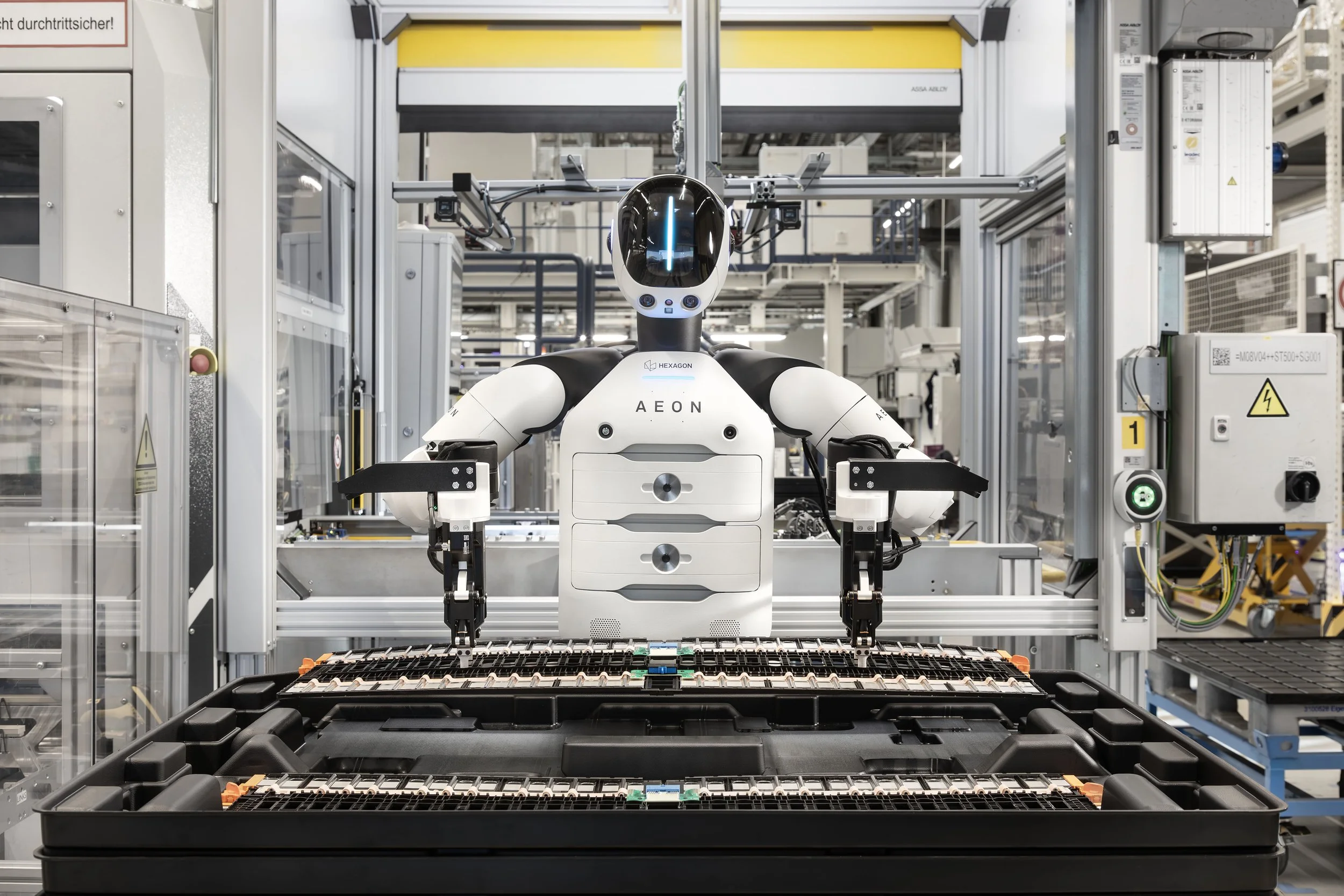
Now, BMW is extending these learnings to Europe. In collaboration with Hexagon Robotics, the company is piloting the humanoid robot AEON at Plant Leipzig. AEON, introduced in 2025, features a human-like form with interchangeable hands, grippers, and scanning tools, and is mobile on wheels for dynamic deployment.
After laboratory validation and initial testing in late 2025, a phased integration plan will continue through 2026, with a full pilot phase expected in summer. The focus areas include high-voltage battery assembly and component manufacturing.
Complementing, Not Replacing, Automation
BMW positions humanoid robots as a complement to existing automation. Their greatest potential lies in monotonous, ergonomically challenging, or safety-critical tasks — relieving workers while improving conditions on the shop floor.
The newly established Center of Competence for Physical AI in Production consolidates internal AI and robotics expertise, evaluating partners against strict industrialization criteria before deployment. The structured process includes theoretical assessment, lab validation using real BMW use cases, on-site testing, and finally live pilot implementation.
As Michael Nikolaides, Senior Vice President Production Network and Supply Chain Management, noted, early pilot projects ensure that humanoid robots function not just in controlled labs, but within complex automotive manufacturing environments.
With Leipzig now online, BMW is positioning Physical AI not as a futuristic concept — but as an operational reality in modern industrial production.
