Brightpick Introduces Gridpicker, Redefining High-Throughput Warehouse Automation
Warehouse automation has long been dominated by a familiar architecture: fixed infrastructure, shuttle systems, and carefully orchestrated flows of goods moving through rigid lanes. It works—but it comes at a cost. High capital expenditure, long installation timelines, and systems that are difficult to adapt once deployed.
Now, Brightpick is making a case for a different model—one that blends the flexibility of mobile robots with the density and throughput of traditional grid systems.
Their latest system, Gridpicker, is less an incremental improvement and more a reframing of how warehouse automation should be designed.
Breaking the Shuttle System Paradigm
Today, roughly three-quarters of automated storage and retrieval systems (AS/RS) still rely on shuttle-based designs. These systems are fast and reliable, but they are also expensive, infrastructure-heavy, and slow to deploy.
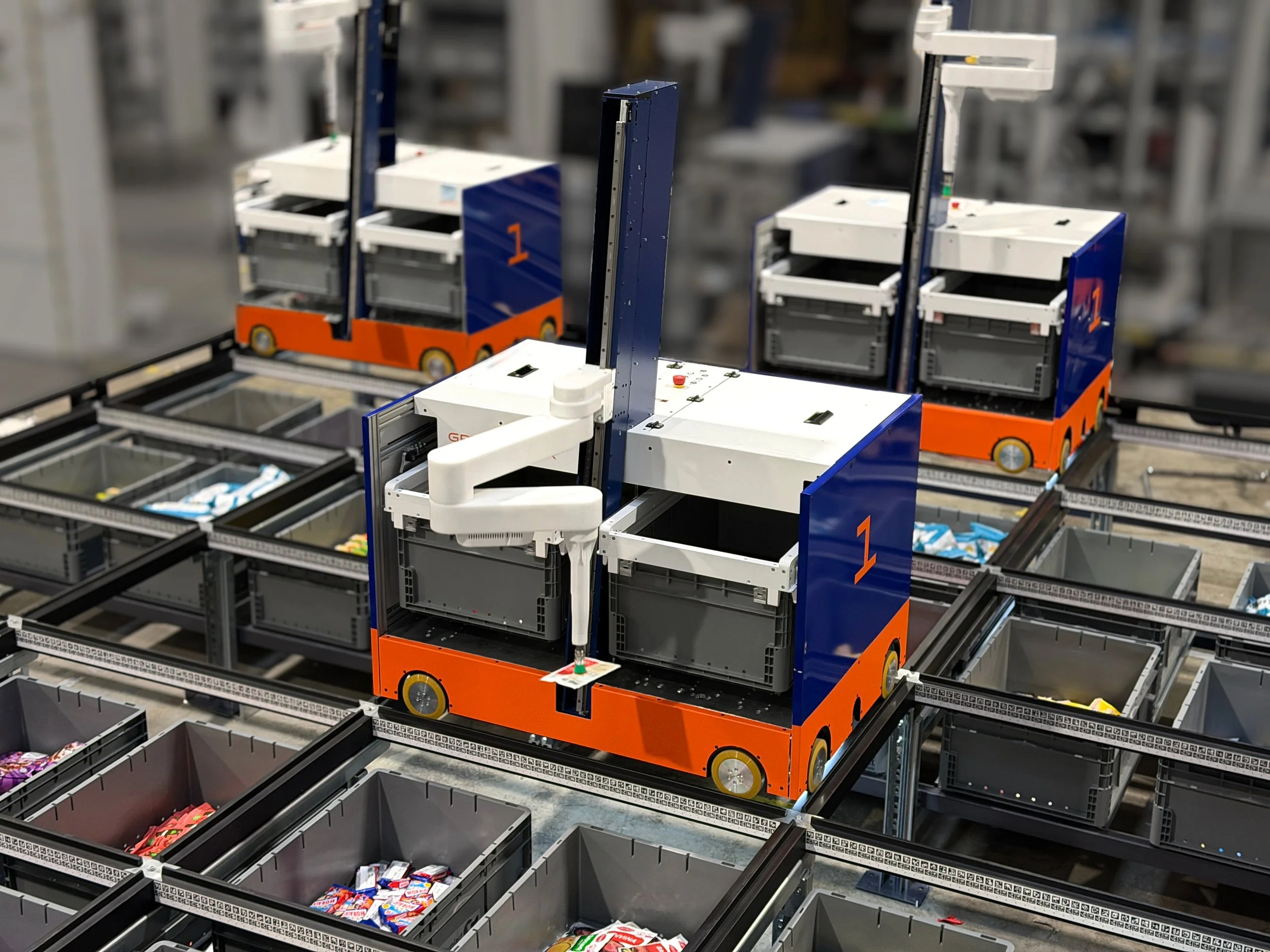
Gridpicker challenges that model by flipping a core assumption: instead of bringing goods to people—or even to fixed robotic stations—it brings mobile manipulators directly into a high-density grid.
The concept is deceptively simple. Take Brightpick’s existing Autopicker robots, place them on an overhead grid, and allow them to pick directly from storage totes positioned at the top of shelving. The result is a system that behaves like a shuttle in terms of throughput, but like an autonomous mobile robot (AMR) system in terms of flexibility.
According to Brightpick, the performance gains are significant—up to twice the throughput per square meter compared to traditional shuttle systems, while reducing both cost and labor requirements.
But the real shift is architectural. This is not just a faster system. It is a different kind of system.
A Warehouse That Gets Cheaper as It Automates
One of the more counterintuitive claims behind Gridpicker is that its cost decreases as automation increases.
In traditional automation environments, increasing robotic capability often means adding more hardware—robotic picking cells, additional conveyors, more integration layers. Each step toward automation adds complexity and cost.
Gridpicker reverses that dynamic.
Because the system is built around mobile manipulators that can already pick items directly, increasing the number of robotically “pickable” SKUs actually improves efficiency. Each robot becomes more productive, meaning fewer robots are needed to achieve the same throughput.
This creates a feedback loop: more AI capability leads to higher productivity, which leads to lower system cost.
It is a subtle but important shift—one that aligns warehouse economics with advances in embodied AI.
The Rise of the Mobile Manipulator
At the heart of Gridpicker is a technology that has been steadily gaining traction across robotics: the mobile manipulator.
These are not just robots that move, or robots that pick—they do both. They navigate, perceive, grasp, and transport items within a single system. Brightpick’s robots, already deployed across hundreds of sites, have collectively completed over a billion picks in real-world environments.
That scale matters.
It provides the data foundation for improving pick success rates, expanding the range of items robots can handle, and refining the AI models that govern perception and manipulation. In Gridpicker, that experience is embedded directly into the system’s design.
Each robot can carry two order totes simultaneously and achieve more than 100 picks per hour, operating above the grid while coordinating with auxiliary “Fetcher” robots that bring inventory to accessible positions.
The result is a layered system—robots above, robots within, all orchestrated to minimize idle time and maximize flow.
The Digital Brain of the Warehouse
If the grid is the skeleton, and the robots are the muscles, then Brightpick Intuition is the brain.
The AI-powered orchestration platform maintains a real-time digital twin of the warehouse, continuously optimizing task allocation, robot movement, and order flow. It enables robots to perceive their environment, plan actions, and execute tasks with a level of adaptability that begins to resemble human decision-making.
This is where warehouse automation is heading—not just toward mechanization, but toward coordination.
The challenge is no longer simply moving goods efficiently. It is managing complexity at scale.
Toward the Lights-Out Warehouse
Gridpicker’s end goal is not just efficiency—it is autonomy.
By integrating picking, buffering, sortation, and consolidation into a single system, it enables what the industry often calls “lights-out” operations: warehouses that can run overnight with little to no human presence.
That does not mean humans disappear from the system. It means their role shifts—away from repetitive picking tasks and toward supervision, exception handling, and system management.
For high-volume fulfillment centers, particularly those serving omni-channel and B2B operations, this kind of end-to-end automation represents a significant step forward. It reduces the need for new facilities, compresses operational footprints, and redefines how throughput is achieved.
A New Phase of Warehouse Design
Gridpicker will make its public debut at LogiMAT 2026 in Stuttgart, where Brightpick plans to showcase the system and announce its European launch partners.
But the broader story extends beyond a single product launch.
What Gridpicker represents is a convergence—of mobile robotics, high-density storage, and AI-driven orchestration. It suggests that the next phase of warehouse automation will not be defined by choosing between flexibility and performance, but by systems that deliver both.
In that sense, the grid is not just infrastructure.
It is a platform for a new kind of warehouse—one that doesn’t just store and move goods, but actively thinks about how to do it better.
