The Robot That Carries the Weight of War
Modern warfare has always been, at its core, a contest of endurance—of how long soldiers can move, carry, communicate, and survive under pressure. Increasingly, that burden is no longer carried by humans alone.
HDT Robotics is now deploying its Hunter WOLF unmanned ground vehicle (UGV) into military training and operational evaluation, offering a glimpse into how robotics is quietly reshaping the realities of the battlefield. But this is not a story about futuristic autonomy replacing soldiers. It is a story about redistribution—of weight, of risk, and of time.
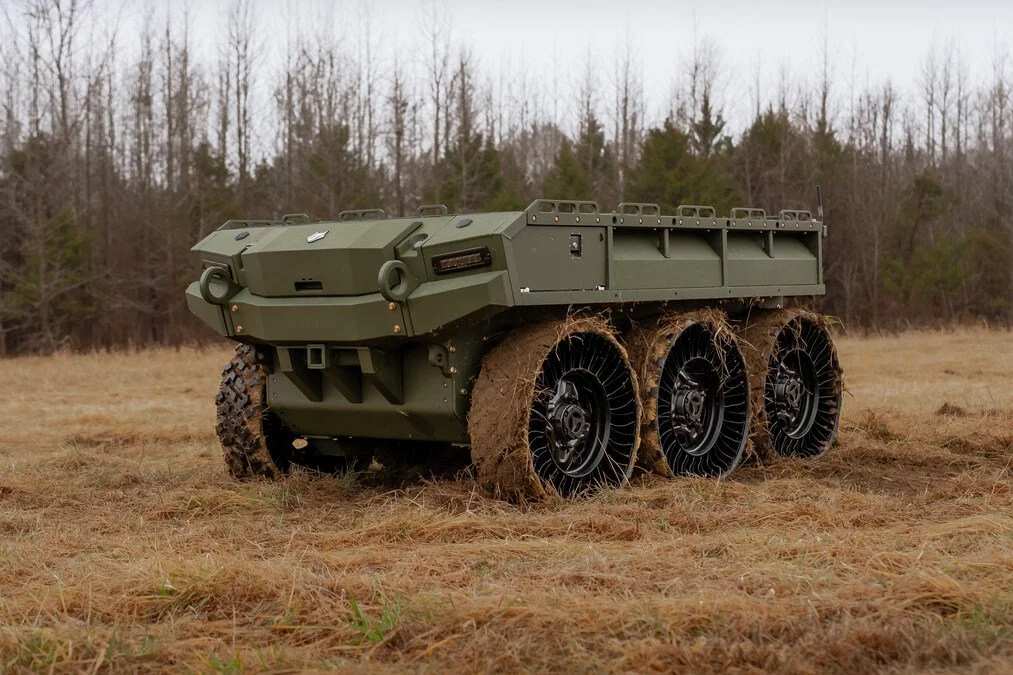
The Hunter WOLF platform, developed through HDT’s Advanced Battle Lab, is designed to do something deceptively simple: take on the tasks that wear humans down the fastest. It moves equipment, extends communications, generates power, purifies water, and even evacuates casualties. In doing so, it stretches the operational capacity of a unit—not by making soldiers faster, but by making them last longer.
That distinction matters.
For decades, militaries have optimized for speed, precision, and firepower. But endurance—the ability to sustain operations over long durations with limited fatigue—has remained one of the most stubborn constraints. Every pound of gear, every battery, every liter of water adds up. The Hunter WOLF is built to absorb that accumulation.
In training exercises, soldiers are not just learning how to operate a robot; they are learning how to offload parts of their mission. Configurations include tactical radio systems for communications, battery charging units to sustain electronic equipment, mobile power export systems, and water purification modules that reduce logistical dependency. The platform can also be rapidly reconfigured for casualty evacuation or intelligence, surveillance, and reconnaissance (ISR) missions.
This modularity is the real story. The Hunter WOLF is not a single-purpose machine—it is an adaptable node in a broader operational network. It reflects a shift away from rigid platforms toward flexible systems that can be repurposed in real time based on mission needs.
Equally important is how the system is built. By leveraging commercially available components, HDT has prioritized maintainability in the field. This is a subtle but critical design choice. In contested or remote environments, the most advanced system is only as useful as its ability to stay operational. Simplicity, in this context, becomes a strategic advantage.
Tom Van Doren, President of HDT’s Robotics Sector, frames the goal clearly: reduce exposure to risk while enhancing capability. That balance—between augmentation and protection—is where ground robotics is finding its footing. Unlike aerial drones, which transformed surveillance and strike capabilities, ground systems are evolving more slowly, constrained by terrain, complexity, and the realities of human-robot interaction in close proximity.
But that is beginning to change.
The introduction of autonomy kits and hands-on operator training signals a transition point. These systems are no longer experimental add-ons; they are becoming integrated tools that soldiers must understand, trust, and rely on. Training, in this sense, is not just about operation—it is about adoption.
What emerges is a different vision of the future battlefield. Not one dominated by fully autonomous systems, but one where robots operate alongside humans as logistical partners, power sources, communication relays, and, when necessary, lifelines.
The Hunter WOLF does not replace the soldier. It redefines what the soldier has to carry—physically and cognitively.
And in doing so, it points to a broader truth about robotics in defense: the most immediate impact is not in replacing humans, but in making it possible for them to endure more, risk less, and stay in the fight longer.
