Micropolis Unveils Autonomous Logistics Platform at UMEX 2026, Signaling a Shift in Industrial Robotics
At the UMEX 2026 exhibition in Abu Dhabi, Micropolis Robotics formally introduced its Autonomous Logistics Platform, marking a significant step in the evolution of heavy-duty autonomous systems for industrial environments. The reveal, hosted on the stand of EDGE Group, the UAE’s leading advanced technology and defense manufacturer, reflects both the growing ambition of the region’s robotics sector and the accelerating demand for automation in large-scale industrial operations.
Built on Micropolis’ M01 unmanned ground vehicle platform, the Autonomous Logistics Platform is designed specifically for controlled industrial settings such as manufacturing facilities, logistics corridors, and secured industrial zones. Unlike consumer-facing robots or experimental autonomous vehicles, the system targets a pragmatic challenge: the movement of goods and equipment across complex industrial campuses where efficiency, safety, and reliability are critical.
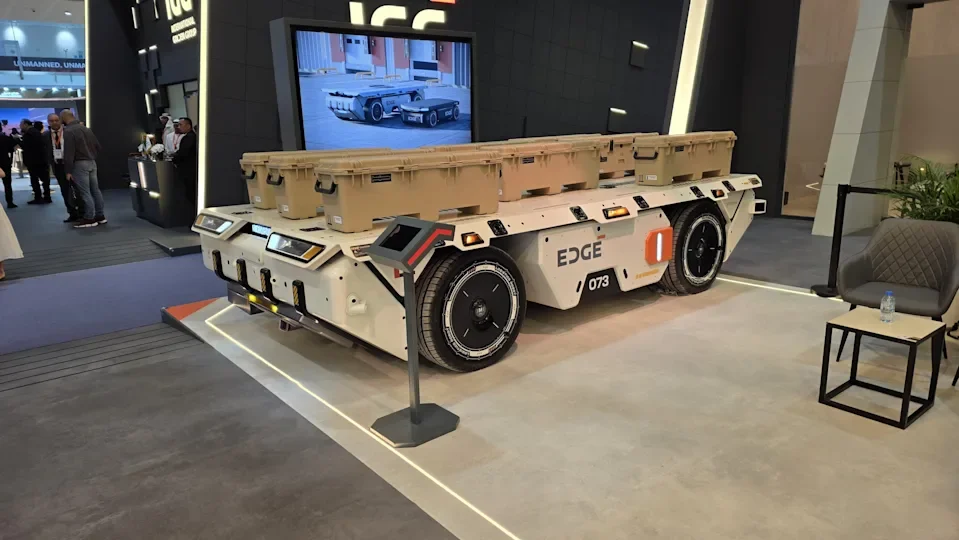
Fareed Aljawhari, founder and chief executive officer of Micropolis, described the launch as a milestone for the company, emphasizing that the platform was engineered to meet real operational needs rather than speculative use cases. He highlighted its industrial-grade payload capabilities, extended operational endurance, and advanced autonomy, positioning the system as a foundation for scalable, round-the-clock logistics automation. The decision to showcase the platform alongside EDGE Group underscored a broader strategic narrative—one that aligns robotics innovation with the UAE’s push for sovereign technological capabilities.
Technically, the platform is engineered for demanding environments, combining high payload capacity with long operational endurance. Its architecture is designed to support continuous operations across large industrial sites, where manual transportation systems often create bottlenecks, safety risks, and inefficiencies. By automating repetitive transport tasks, the system aims to reduce reliance on human labor while improving operational predictability and safety.
At the core of the platform is Micropolis’ proprietary Rule-Based Community Autonomous System, an autonomy stack optimized for structured environments. Rather than pursuing fully open-ended autonomy, the system focuses on deterministic decision-making within controlled spaces, reflecting a broader trend in industrial robotics toward reliability over generality. Integrated mission planning, fleet management, and warehouse management capabilities allow the platform to function as part of a broader digital logistics ecosystem, connecting autonomous vehicles directly with inventory systems and operational workflows.
The intended applications reflect the realities of modern industrial infrastructure. From factory-to-factory transport and secured logistics routes to warehousing corridors and restricted facilities, the platform is positioned as a solution for environments where traceability, scheduling, and controlled access are essential. In these settings, autonomy is less about spectacle and more about orchestration—coordinating machines, data, and physical infrastructure into a cohesive system.
Micropolis’ unveiling comes at a moment when industrial robotics is undergoing a subtle but consequential shift. While much public attention remains focused on humanoid robots and consumer-facing AI, the most immediate impact of autonomy is unfolding in less visible spaces: industrial campuses, logistics hubs, and secured operational zones. The Autonomous Logistics Platform represents this quieter revolution—one in which autonomy is not defined by novelty, but by integration into the mundane, mission-critical flows of industrial life.
As global competition in robotics intensifies, the launch also signals the UAE’s growing role in shaping the future of autonomous systems. With vertically integrated capabilities spanning hardware, software, and AI, Micropolis exemplifies a new generation of robotics companies emerging outside traditional tech hubs. Whether platforms like this will redefine industrial logistics at scale remains an open question, but their trajectory is clear: autonomy is moving from the laboratory to the infrastructure of everyday industry.
