North Carolina State develops robots for vegetable field labor
In the Marvel universe, Thor wields a hammer with godlike endurance. At North Carolina State University, Thor is something else entirely—a hammer-wielding robot being trained to tackle one of agriculture’s most physically demanding jobs: tending vegetables.
Despite decades of mechanization in crops like corn, wheat, and soybeans, much of the world’s fruit and vegetable production still depends on manual labor. Tasks such as staking tomatoes, weaving twine supports, monitoring plant health, and harvesting delicate produce remain labor-intensive, costly, and increasingly difficult to staff. Researchers at NC State are trying to change that, using artificial intelligence and robotics to reimagine how specialty crops are grown.
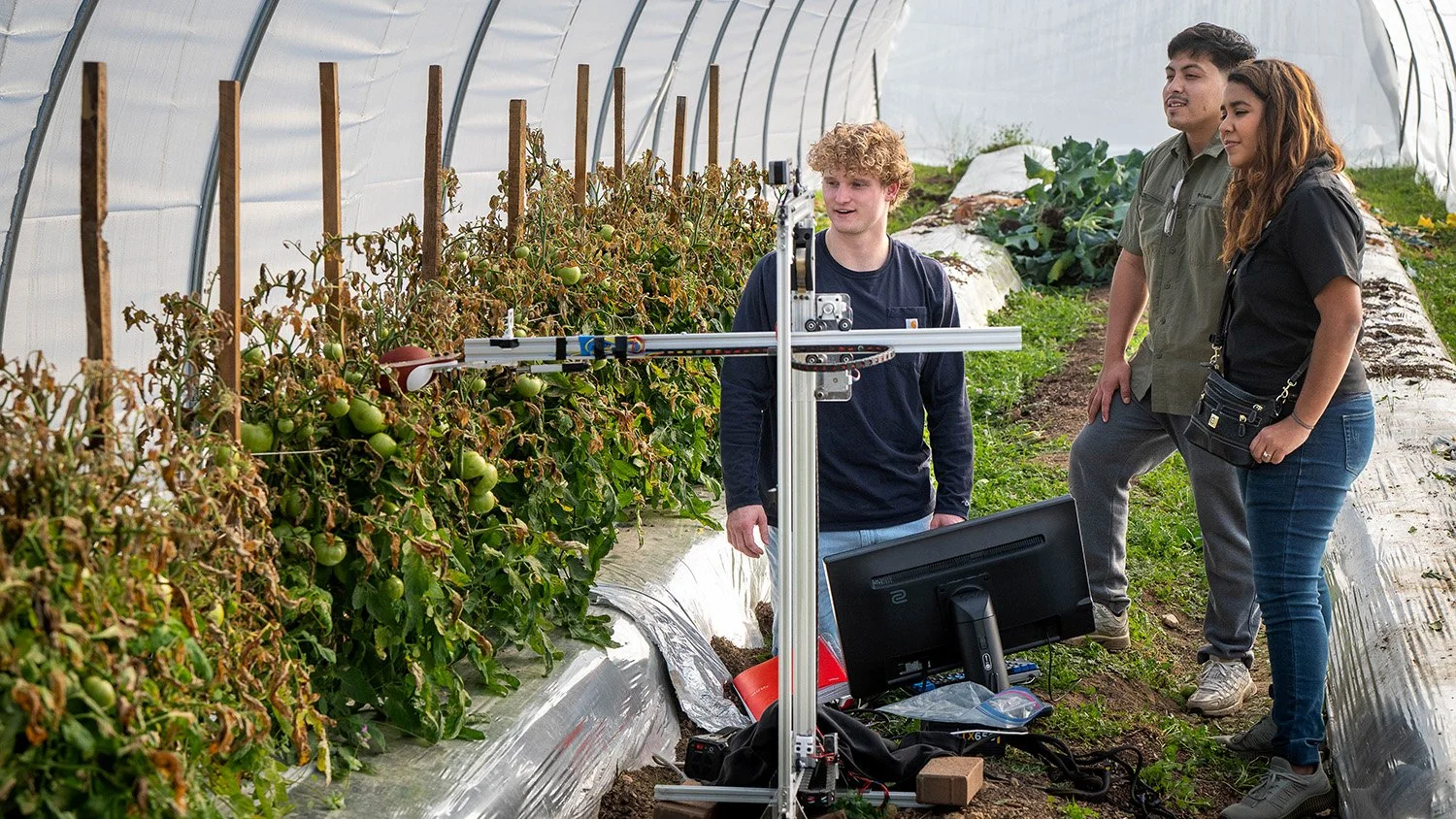
Electrical and computer engineering students Luke Holt (left) and Raul Hernandez demonstrate their prototype of a tomato-harvesting robot as N.C. PSI Makerspace Director Andrea Monteza looks on. Photo by Marc Hall.
At the center of the effort is a modular robotic platform roughly the size of a golf cart, equipped with stereo cameras and LiDAR sensors to navigate fields and understand crop environments. Mounted on this platform are a growing family of superhero-inspired tools. Thor drives stakes into the ground with precision, while SpiderBot weaves twine to support top-heavy plants like tomatoes and peppers—tasks traditionally performed by crews of workers using heavy equipment.
To make these robots intelligent enough to operate in complex farm environments, researchers built another system: Hawkeye. Mounted on a tractor, Hawkeye uses high-resolution cameras and low-cost computing hardware to collect massive datasets of crop images. In its first field trials, the system captured more than 50,000 images, providing the training data needed to teach AI models how to distinguish crops from weeds and identify plant health issues such as pests or nutrient deficiencies.
The project extends beyond infrastructure tasks. Students and engineers are also developing robotic arms capable of harvesting tomatoes without damaging them—a challenge that highlights the complexity of agricultural manipulation. Using depth-sensing cameras and soft silicone grippers, the prototypes aim to locate ripe fruit and pick it gently, even when tomatoes are partially hidden among leaves.
Additional tools are also emerging, including a prototype “bug vacuum” designed to identify insect populations in fields, potentially transforming how farmers monitor and manage pests.
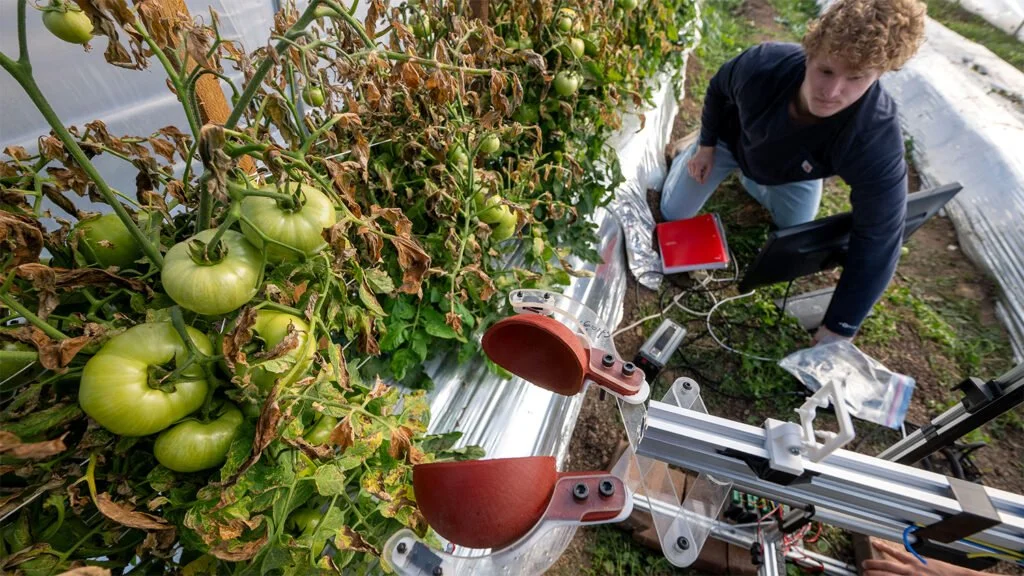
The tomato-harvesting robot features a soft silicone gripper mounted on a mechanical arm guided by artificial intelligence and a depth-sensing camera. Photo by Marc Hall.
Together, these systems reflect a broader shift in agricultural robotics: from automating large-scale commodity crops to tackling the nuanced, variable tasks of specialty agriculture. While human workers still outperform machines in speed and dexterity, the long-term promise is clear. Robots can operate continuously, generate data at unprecedented scale, and eventually reduce the labor burden in one of farming’s most demanding sectors.
For NC State’s researchers, the goal is not to build single-purpose machines, but flexible robotic tools that can adapt across crops and tasks. If successful, their Marvel-inspired lineup may help usher in a new era of intelligent, autonomous agriculture—where robots don’t just harvest fields, but reshape how food is grown.
