Fieldwork Robotics Raises £3M to Scale Autonomous Harvesting Technology
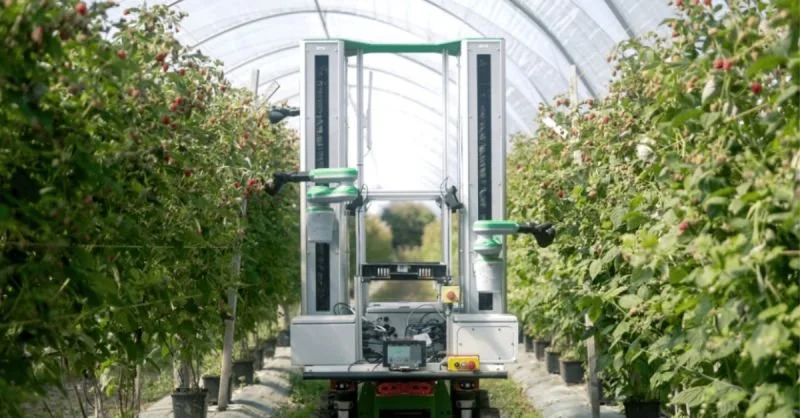
For years, agricultural robotics has lived in a familiar space: promising prototypes, controlled trials, and carefully staged demonstrations. Fieldwork Robotics Ltd. now appears to be stepping beyond that phase. With £3 million in new funding—led by Elbow Beach Capital—the company is positioning itself to move from proving its technology works to proving it can operate at scale in real farm environments.
This transition matters. In robotics, the gap between validation and deployment is often where momentum stalls. Fieldwork’s focus on selective, adaptive harvesting—particularly for delicate crops like berries—has already demonstrated technical feasibility. The question now is not whether the robots can pick fruit, but whether they can do so reliably, continuously, and economically across entire farms.

Labor, Economics, and the Pressure to Automate
The backdrop to this shift is structural. Berry growers globally are facing a convergence of pressures: rising labor costs, persistent shortages of seasonal workers, and increasing supply chain volatility. These dynamics are not temporary—they are reshaping the economics of agriculture.
In that context, automation is less about efficiency gains and more about operational viability. Fieldwork’s approach—autonomous harvesting delivered through a service model—targets this pressure directly. By reducing dependence on manual labor while maintaining throughput, the company is aligning its technology with one of the sector’s most immediate needs: stability.
But the implications extend beyond cost. Labor shortages contribute to unharvested crops, which in turn drive food waste and downstream price increases. If autonomous systems can reliably close that gap, they begin to influence not just farm economics, but broader supply chain outcomes.
From Pilot to System: What Scale Will Require
The next phase of Fieldwork’s development will unfold through a two-year “harvesting-as-a-service” program in the UK, with deployments in Norfolk and Staffordshire. These trials are designed not simply to test the robots themselves, but to evaluate the surrounding system—logistics, infrastructure, and integration into existing farm operations.
This is where many robotics efforts encounter friction. Scaling is not just about producing more units; it is about ensuring that those systems can operate within the variability of real environments. Farms are not controlled settings. Weather, crop conditions, and field layouts introduce constant uncertainty.
Fieldwork’s longer-term vision—multi-robot fleets operating by 2027 and expansion into international markets such as Portugal and Australia—depends on resolving those variables. It also reflects a broader shift in robotics: from single-machine deployments to coordinated systems operating across entire workflows.
In that sense, the company’s funding announcement is less about capital raised and more about timing. It signals that agricultural robotics, like many other domains, is entering a phase where success will be defined not by technical capability alone, but by the ability to integrate, adapt, and deliver value at scale.
