Hong Kong’s Bet on Embodied AI Is Bigger Than a Research Lab
Hong Kong has officially entered the embodied AI race — and it is doing so with a strategy that says as much about geopolitics, supply chains, and talent development as it does robotics itself.
This week, the Chinese University of Hong Kong (CUHK) announced the launch of the city’s first full-stack interactive robotics laboratory: the Hong Kong Embodied AI Lab. Backed through the government’s InnoHK initiative, the lab is partnering with 24 technology firms to develop humanoid robotics capabilities over the next five years.
At first glance, this may sound like another university robotics center announcement. It is not.
The structure of the partnership tells a much larger story about where embodied AI is heading globally — and about how China and Hong Kong increasingly view robotics as strategic infrastructure.
The partnership roster alone is revealing. The majority of participating companies are mainland Chinese firms, including major robotics players such as AgiBot, Deep Robotics, and Unitree Robotics. Hong Kong-based partners include Lenovo’s Capital and Incubator Group, while Vietnam-based VinMotion adds an international dimension to the effort.
This is not simply an academic collaboration. It is an attempt to create an embodied AI ecosystem.
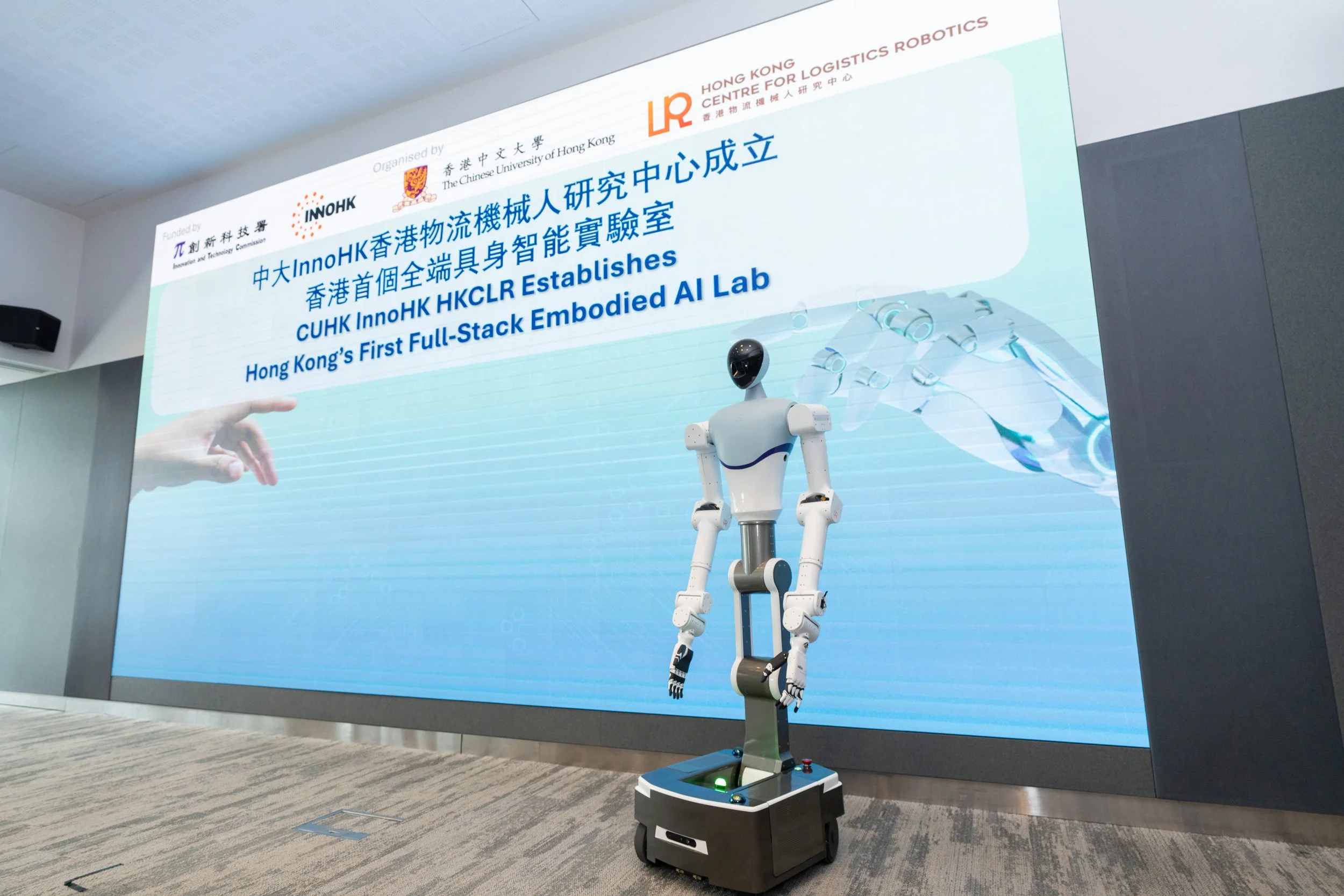
Hong Kong’s first AI-powered dual-arm robotic platform
From “AI That Thinks” to “AI That Acts”
Professor Li Zhongyu, co-director of the lab, described embodied AI as the next evolution beyond traditional AI systems that merely process information. The distinction matters.
Large language models can generate text, summarize reports, or answer questions. Embodied AI systems must perceive the physical world, interpret changing environments, make decisions in real time, and physically act within human spaces.
That shift — from cognition to action — is where the next major robotics competition is emerging.
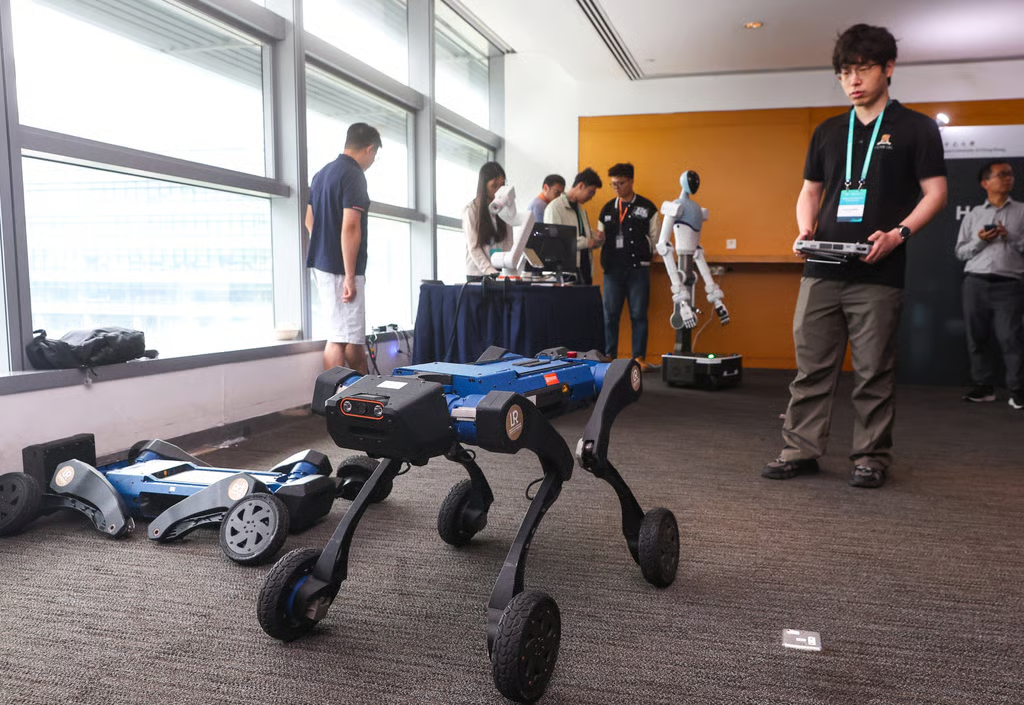
The CUHK lab is already refining Hong Kong-developed robotic arms and quadruped robots while pursuing longer-term humanoid robot designs. The upgraded quadruped reportedly can now travel up to 20 kilometers and has already been deployed for drainage and confined-space inspections in GPS-denied environments.
That detail is important.
Around the world, many embodied AI conversations remain centered on humanoid demonstrations staged for social media clips and conference keynotes. Hong Kong’s approach appears more grounded in operational deployment. Inspection robots, logistics systems, healthcare support, and industrial automation are tangible entry points where embodied AI can create immediate value while the broader humanoid ecosystem matures.
The Real Advantage: Integration
Perhaps the most revealing statement from the announcement came when Professor Li described Hong Kong’s advantages:
“Hong Kong’s advantage lies in its access to international talent pools, the low-cost mainland supply chain and worldwide large language models.”
That sentence effectively summarizes the emerging embodied AI stack.
Modern robotics is no longer just about mechanical engineering. Success increasingly depends on integrating three layers simultaneously:
Advanced AI models
Affordable robotic hardware
Scalable manufacturing and supply chains
China already dominates much of the robotics manufacturing ecosystem. Hong Kong, meanwhile, positions itself as a bridge between global research talent and mainland production capability.
That combination matters because embodied AI is likely to become supply-chain intensive in ways that resemble smartphones, EVs, and drones. The winners may not simply be the companies with the best AI models, but the ecosystems capable of rapidly iterating hardware, collecting operational data, and scaling deployment.
Humanoids Need Ecosystems, Not Just Prototypes
The most interesting part of the CUHK announcement may not be the robots themselves, but the educational infrastructure surrounding them.
The lab includes more than 40 PhD students and postdoctoral researchers alongside more than 10 professors. It also plans to provide robotics and AI resources to undergraduate and secondary school students.
That is not accidental.
One of the largest bottlenecks in robotics today is not hardware. It is talent. Embodied AI requires experts across robotics, machine learning, perception, controls, simulation, safety engineering, human factors, and systems integration.
Countries and regions that create dense training ecosystems now may hold a long-term advantage later.
This is one reason China’s robotics rise has accelerated so quickly in recent years. The country is not just producing robots. It is producing robotics ecosystems — universities, supply chains, startups, deployment environments, and government-backed industrial strategies that reinforce one another.
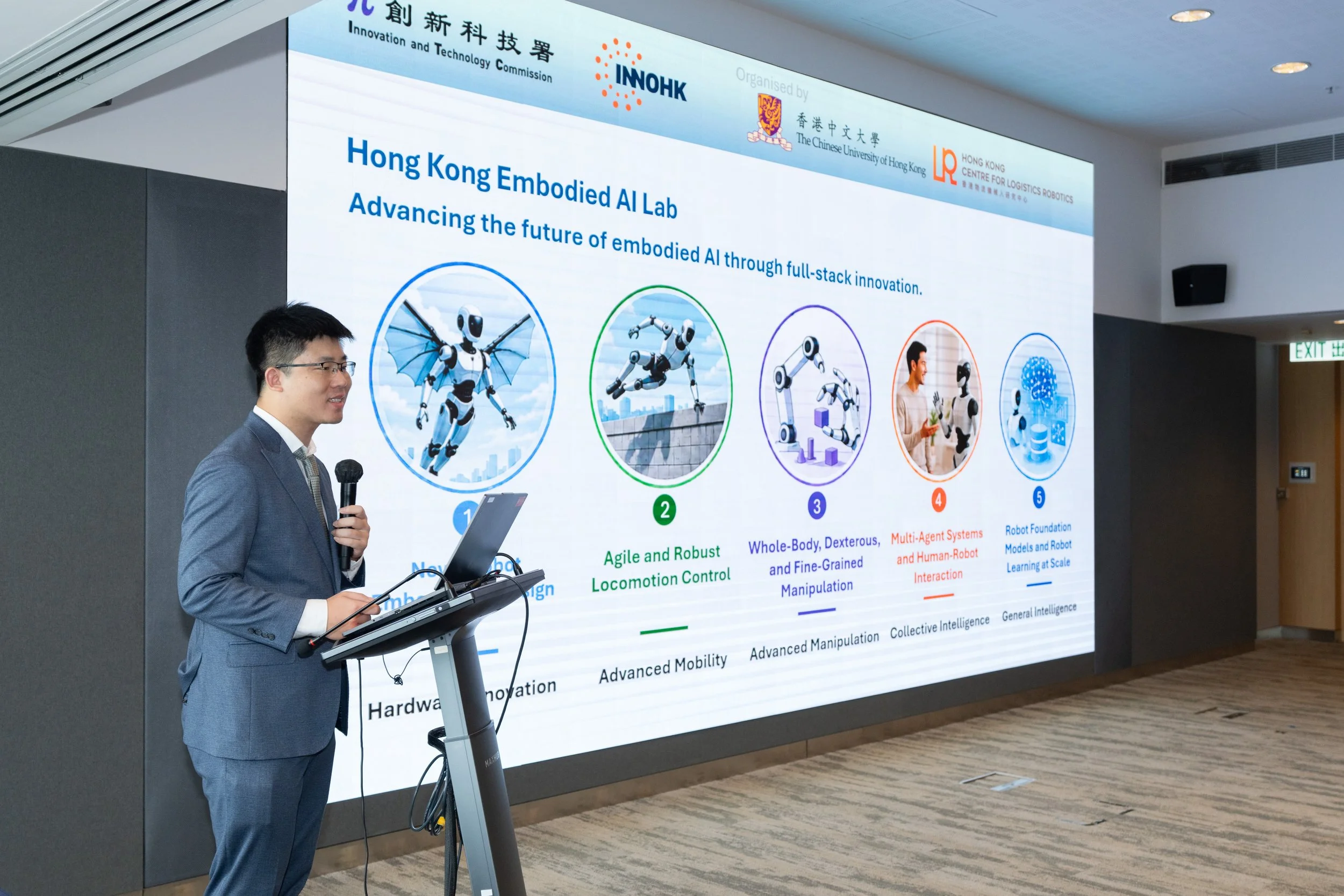
Hong Kong Embodied AI Lab is dedicated building a full-stack research and development platform in embodied intelligence (In the photo: Professor Li Zhongyu, Co-Director of the Hong Kong Embodied AI Lab, delivered a speech)
The Quiet Shift Happening in Robotics
For years, robotics development was often separated into categories:
Industrial robots
Mobile robots
AI research
Humanoids
Automation systems
Embodied AI is collapsing those boundaries.
The same foundational technologies now influence warehouse robots, quadrupeds, autonomous inspection systems, and humanoids. Advances in perception, manipulation, simulation, and foundation models increasingly transfer across platforms.
That is why laboratories like the Hong Kong Embodied AI Lab matter.
They are not merely building individual robots. They are attempting to build the connective tissue between AI, hardware, education, manufacturing, and deployment.
And globally, that may become the real competition.
