KAIST Researchers Unveil Wearable Robot That Walks to Users and Helps Paraplegics Walk
Researchers in South Korea have developed a wearable robot that can autonomously approach paraplegic users, attach itself to their bodies, and enable them to walk, climb stairs, and maneuver through everyday environments.
The system, called the WalkON Suit F1, was created by the Exoskeleton Laboratory at the Korea Advanced Institute of Science and Technology (KAIST). The team says the project is aimed at building assistive robots that integrate seamlessly into daily life rather than requiring users to adapt their routines around the technology.
Unlike conventional exoskeletons that must be manually donned, the WalkON Suit F1 can move toward a user—even when they are seated in a wheelchair—and lock onto their legs and torso to assist with standing and walking.
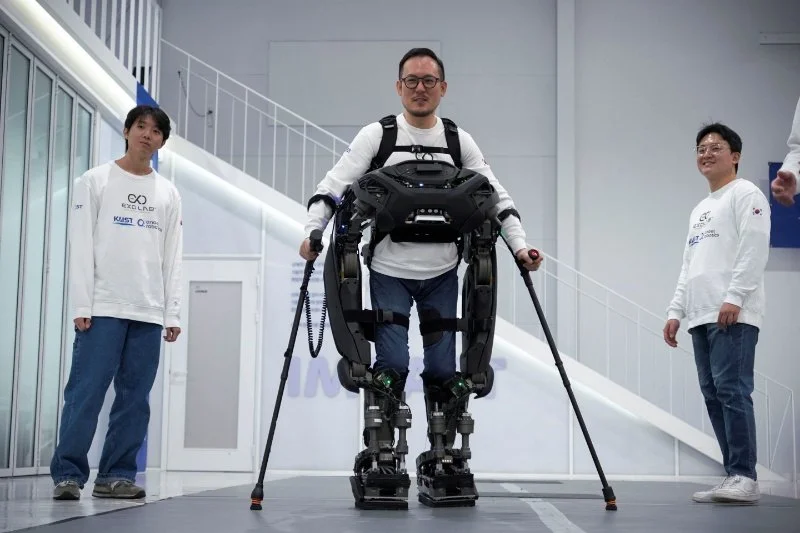
Kim Seung-hwan, who is himself a paraplegic and part of the Exoskeleton Laboratory team at the Korea Advanced Institute of Science and Technology (KAIST), demonstrates the prototype of exoskeleton robot 'WalkON Suit F1' at KAIST in Daejeon, South Korea, November 27, 2024. (Reuters/Sebin Choi)
“It can approach me wherever I am, even when I’m sitting in a wheelchair, and be worn to help me stand up,” said Kim Seung-hwan, a paraplegic researcher who is part of the KAIST development team and has been testing the system. “That is one of its most distinct features.”
During a demonstration at KAIST’s campus in Daejeon, Kim used the prototype to walk at a speed of 3.2 kilometers per hour (about 2 mph), climb a full flight of stairs, and take sideways steps to slide onto a bench—movements that remain challenging for many existing exoskeleton designs.
The WalkON Suit F1 weighs about 50 kilograms (110 pounds) and is constructed from aluminum and titanium. It is powered by 12 electronic motors that replicate the motion of human joints during walking. To maintain balance, the robot relies on sensors embedded in its soles and upper body, processing roughly 1,000 signals per second to anticipate the user’s intended movements.
Cameras mounted on the front of the exoskeleton function as “eyes,” analyzing the surrounding environment to identify obstacles and measure stair height—an important feature for users with complete paraplegia who lack sensory feedback in their lower limbs.
Park Jeong-su, another member of the KAIST team, said his inspiration came from popular culture. “After watching Iron Man, I thought it would be great if I could help people with a robot in real life,” he said.
The technology gained international attention when Kim won a gold medal in the exoskeleton category at Cybathlon 2024, a global competition where people with disabilities demonstrate advanced assistive technologies.
Beyond technical achievement, Kim said the project carries personal meaning. “I wanted to tell my son that I also used to be able to walk,” he said. “I wanted to share a diverse range of experiences with him.”
