Humanoid Introduces KinetIQ: An Agentic AI Framework for Multi-Embodiment Robot Fleet Orchestration
Humanoid, a London-based developer of humanoid robots and mobile manipulation systems, has introduced KinetIQ, a new artificial intelligence framework designed to orchestrate heterogeneous robot fleets across industrial, service, and domestic environments.
Rather than focusing on a single robot platform, KinetIQ is built around coordination — enabling wheeled robots, humanoid platforms, and other embodiments to operate under a unified system architecture. The company describes the framework as a cross-timescale, agentic AI stack structured across four operational layers, each responsible for different decision horizons ranging from high-level fleet optimization to real-time motor control.
The announcement reflects a broader shift within robotics toward agentic systems that combine perception, reasoning, and action across distributed hardware, allowing robots to operate more flexibly within complex environments.
A layered architecture for fleet-scale autonomy
At the core of KinetIQ is a four-layer structure designed to manage operations across multiple temporal scales.
Each layer treats the layer below as a set of “tools,” orchestrating capabilities through prompting and modular coordination. This mirrors emerging agentic AI patterns in frontier systems, where components evolve independently while remaining integrated into a larger decision-making framework.
Humanoid says this layered approach enables scalable deployment across larger fleets and more complex operational environments, ranging from logistics facilities to smart homes.
System 3: The AI fleet orchestrator
The highest layer, referred to as System 3, acts as the agentic fleet manager.
Here, the AI treats individual robots as functional tools within a broader workflow, dynamically allocating tasks and coordinating robot interactions. The system integrates with facility management software across retail, logistics, and manufacturing environments, enabling bidirectional communication between robots and operational infrastructure.
The orchestrator ingests task requests, standard operating procedures, expected outcomes, and real-time operational data. It then assigns tasks across different robot types, manages robot handoffs at workstations, and monitors performance metrics.
Humanoid said System 3 is designed to respond within seconds, optimizing resource allocation and handling exceptions by coordinating with both traditional facility software and AI-based management systems.
System 2: Robot-level reasoning and planning
Below the fleet layer is System 2, a robot-level agentic reasoning layer operating on timescales from seconds to minutes.
Using an omni-modal language model, System 2 interprets high-level instructions and analyzes environmental context to determine how a robot should complete its assigned objectives. Rather than relying on fixed programming, it dynamically generates task sequences based on real-world perception.
These plans can be saved as reusable workflows or standard operating procedures, allowing successful strategies to be shared across the fleet.
System 2 also monitors execution progress and determines when human assistance is needed. Operators can intervene through prompting, teleoperation, or direct low-level control depending on the complexity of the issue.
System 1: Vision-language-action execution
System 1 translates plans into immediate actions.
This layer uses a vision-language-action (VLA) neural network to generate target poses for robot components such as arms, torso, or mobility platforms. Low-level capabilities — including picking, packing, manipulation, and navigation — are exposed as callable functions.
Predictions occur at a sub-second cadence, typically 5–10 Hz, while each prediction contains higher-frequency action sequences executed asynchronously. To maintain consistency between planned and executed actions, KinetIQ uses a technique called prefix conditioning, ensuring that new action segments account for ongoing movements.
System 0: Reinforcement learning for whole-body control
At the foundation of the architecture is System 0, which handles low-level control and dynamic stability.
Running at approximately 50 Hz, this layer uses reinforcement-learning-based whole-body control to achieve pose targets defined by higher layers. The approach applies to both wheeled and bipedal robots, enabling shared locomotion strategies across embodiments.
Humanoid said its locomotion models are trained primarily in simulation using online reinforcement learning, requiring approximately 15,000 hours of simulated experience.
Multiple embodiments, unified orchestration
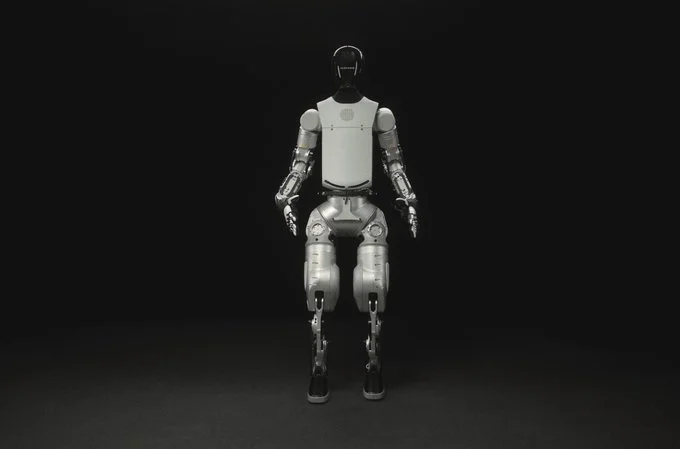
Humanoid’s wheeled-base robots are currently deployed in industrial workflows such as grocery back-of-store picking, packing, and container handling. Meanwhile, its bipedal robot serves as a research platform focused on service and home environments, featuring voice interaction and intelligent grocery handling capabilities.
By combining both under a single orchestration system, the company aims to demonstrate how heterogeneous robot fleets can collaborate within shared environments.
The broader significance
KinetIQ reflects an emerging trend in robotics architecture: separating strategic reasoning, task planning, and low-level control into modular layers tied together through agentic AI frameworks.
As robot deployments scale beyond single-task automation toward coordinated fleets operating in human environments, orchestration systems may become as critical as the hardware itself.
If successful, frameworks like KinetIQ could enable organizations to deploy mixed fleets that combine specialized robots — wheeled platforms for efficiency, humanoids for flexibility — under a unified operational intelligence.
The challenge ahead will be proving that such layered architectures can operate reliably outside controlled environments, where coordination, safety, and human collaboration introduce additional complexity.
