Robotics has traditionally been a discipline of carefully designed bodies. Engineers sketch a machine, build it, test it, and refine it. The robot’s form—whether a wheeled rover, an industrial arm, or a quadruped—remains largely fixed. Its abilities are constrained by the geometry chosen at the start.
A new project from researchers at Northwestern University suggests that assumption may be changing.
Instead of designing a single robot with a permanent body, the team has built robots made from multiple smaller robots. These units can combine, separate, and recombine into entirely new machines depending on what the moment demands. The researchers call them “legged metamachines,” a name that captures the unusual nature of the system: a robot whose body is not fixed but assembled from autonomous parts.
The work, led by roboticist Sam Kriegman and published in Proceedings of the National Academy of Sciences, represents the first modular robotic system capable of agile movement outside controlled laboratory environments.
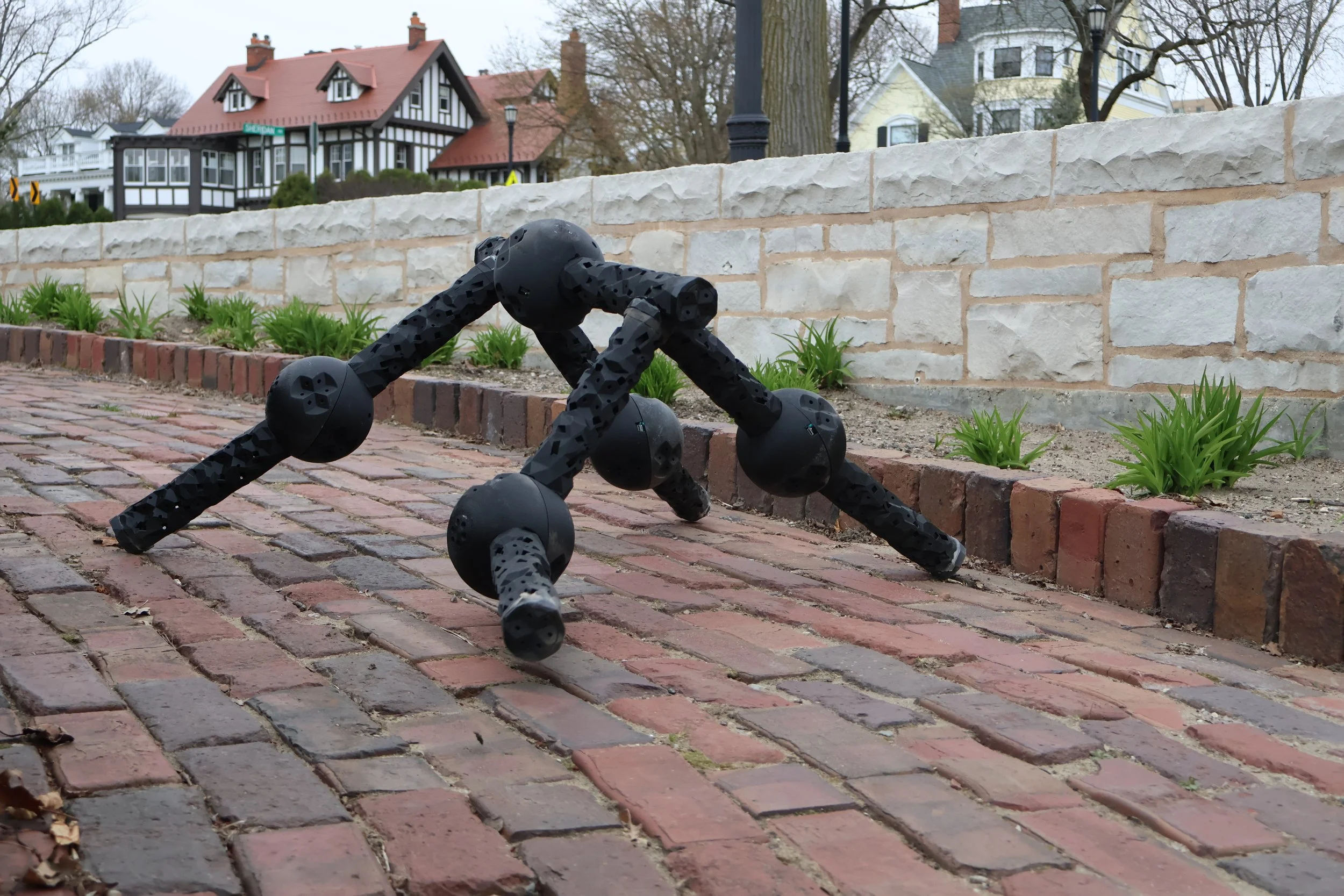
Each piece of the system is a robot in its own right. A single module contains everything required for autonomy: a motor, a battery, a small onboard computer, and sensing capabilities. By itself, the module can roll, turn, and even jump. It is simple, but complete.
The transformation happens when several of these units snap together.
Once connected, the modules form larger structures whose movements are far more complex than any individual piece. Depending on how the pieces are arranged, the resulting machine may undulate across the ground like a seal, bound forward like a lizard, or hop in arcs reminiscent of a kangaroo. The body of the robot is not designed in advance; it is assembled from components that each carry their own intelligence.
What makes the project especially unusual is how those body designs are created. Rather than relying entirely on human engineering intuition, the research team turned to artificial intelligence to generate them.
Using an evolutionary algorithm modeled loosely on natural selection, the system began with simple building blocks—modular legs roughly half a meter long, each consisting of two sticks connected by a central sphere. Inside that sphere lies what Kriegman describes, somewhat playfully, as the robot’s internal life support: its circuitry, battery, and motor.
The algorithm was given a simple goal: discover robot bodies that move efficiently and robustly. It began generating thousands of possible designs in simulation, combining modules in different ways and testing how well each configuration performed. The most successful designs were preserved, while weaker ones were discarded. Over time, new designs emerged through digital “mutation” and recombination, gradually producing machines capable of increasingly effective movement.
What emerged from this evolutionary process were forms that human engineers might not have conceived on their own. In some cases the modules became legs; in others they formed spines or tails that helped propel the robot forward. The system explored strange geometries and unfamiliar gaits, searching for movement strategies that simply worked.
Study co-author Jingxian Wang offers a look inside a robotic module and explains how it works.
Kriegman describes the process as compressing the logic of natural evolution into software. “We simulated the Darwinian process of mutation and selection within a virtual environment,” he explains. In other words, survival of the fittest—accelerated by computers.
Once the algorithm identified promising designs, the researchers assembled the physical robots and took them outside.
For many robotic systems, the real world is where things fall apart. Gravel, grass, uneven surfaces, and unpredictable obstacles quickly expose weaknesses in machines that were tuned in laboratories. Yet the evolved metamachines handled these environments with surprising resilience. They ran across rough terrain, including patches of sand, mud, leaves, and uneven brick, while maintaining stability and mobility.
Perhaps the most striking aspect of the machines, however, is their ability to cope with damage.
Traditional robots tend to be brittle systems. When a key component fails—especially something structural like a leg—the machine often becomes unusable. Repair requires human intervention, and sometimes complete replacement.
Metamachines behave differently. Because the robot is essentially composed of many independent robots, losing a component does not necessarily end the mission. If a leg breaks off, the remaining modules adjust their coordination and continue moving. Meanwhile, the detached piece does not become useless. It remains a functioning robot that can roll or crawl on its own.
In some demonstrations, the separated module even navigated back toward the larger machine, rejoining the collective body.
The robots can also recover from situations that disable many existing systems. When flipped upside down, the metamachine instinctively reorganizes its movements until it rights itself and continues forward. These abilities suggest a machine that is less like a fragile mechanical device and more like an adaptive organism capable of recovering from injury.
The research builds on earlier work from Kriegman’s laboratory exploring how artificial intelligence might design robots automatically. In those earlier experiments, the team demonstrated that evolutionary algorithms could generate entirely new robot structures in simulation. The resulting machines were simple and somewhat limited—they could walk across a table, but little more.
Even so, those early experiments proved something important: artificial intelligence could invent workable robot designs from scratch.
The metamachines represent a significant step beyond that proof of concept. These robots can sense their surroundings, coordinate with other modules, and navigate unpredictable terrain. Most importantly, they do so while maintaining a body that is fundamentally flexible and reconfigurable.
The implications of that shift are difficult to ignore.
Much of modern robotics still assumes that machines should be designed for specific tasks with highly specialized bodies. Industrial robots weld, assemble, or move objects within carefully defined environments. Even newer mobile robots typically retain fixed forms.
But a modular system capable of reassembling itself challenges that assumption. Instead of deploying a single machine designed for one job, engineers could deploy collections of modules capable of forming many different machines depending on the situation.
In environments where damage, uncertainty, or rapidly changing conditions are common—disaster zones, remote exploration, or search and rescue operations—such adaptability could be invaluable.
More broadly, the work hints at a philosophical shift in how robots might be designed. Rather than building rigid machines and hoping they survive the world, engineers may begin building systems that expect disruption and adapt to it.
In that sense, the metamachines resemble biological organisms more than traditional machines. Their bodies are flexible, their movement strategies are discovered rather than prescribed, and their survival does not depend on the perfection of any single component.
If robotics continues along this trajectory, the robots of the future may look less like polished devices and more like dynamic systems—collections of intelligent parts capable of assembling themselves into whatever form the moment requires.
And in that world, a robot losing a limb might not signal failure at all.
It might simply mean the machine reorganizes itself—and keeps moving.
