Sitegeist Raises €4M to Bring AI Robotics to Europe’s Aging Infrastructure
Europe’s infrastructure is aging faster than it can be repaired. From cracked bridges and deteriorating tunnels to worn parking structures and public buildings, the continent faces a mounting backlog of concrete maintenance that traditional methods are struggling to address. Now, a Munich-based robotics startup believes automation could provide a path forward.
German construction automation company Sitegeist has raised €4 million in pre-seed funding to accelerate development and deployment of its AI-enabled robotic systems designed specifically for concrete renovation. The round was co-led by B2Venture and OpenOcean, with participation from prominent angel investors including Verena Pausder, Lea-Sophie Cramer, and Alexander Schwörer.
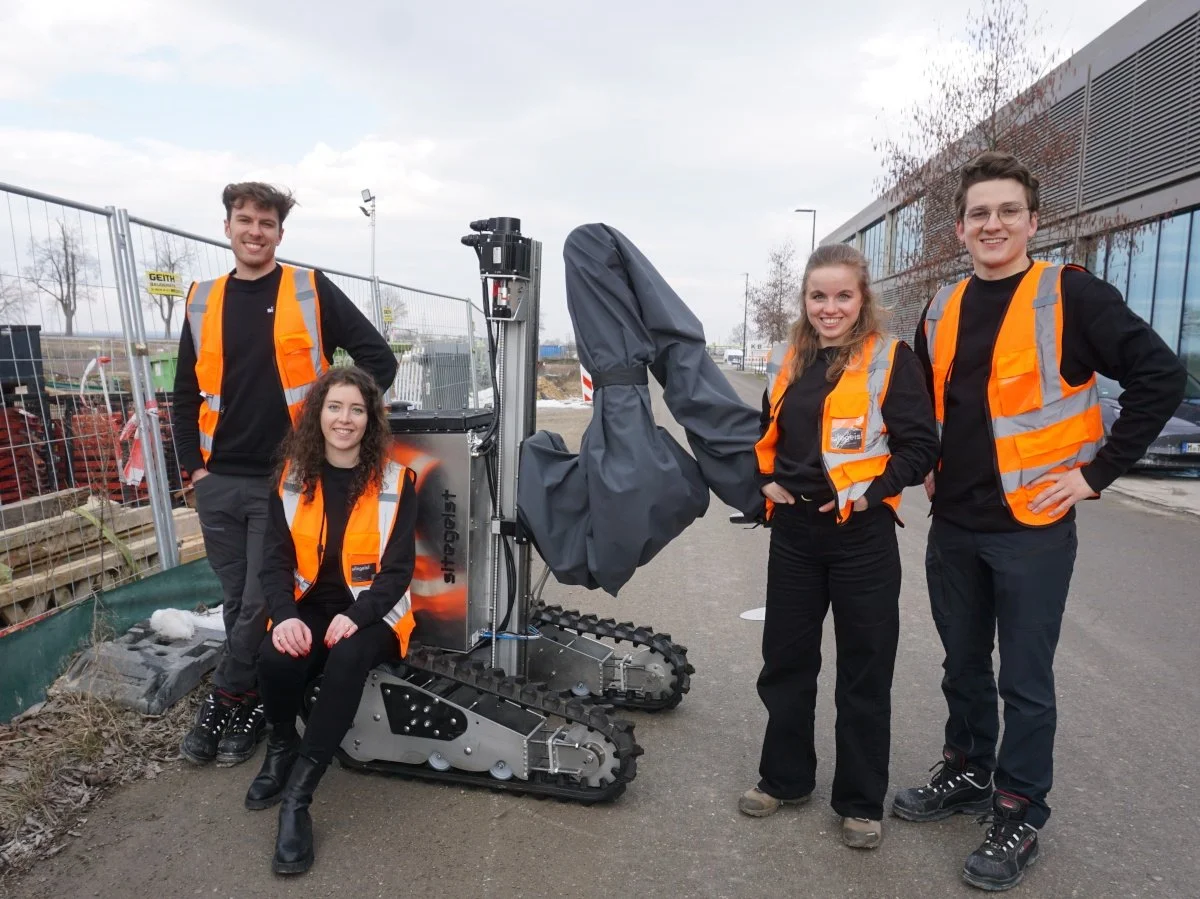
From left: Sitegeist co-founders Julian Hoffmann, Nicola Kolb, Dr Lena-Marie Pätzmann and Claus Carste. Image: Sitegeist
A Growing Infrastructure Bottleneck
Across Europe, infrastructure renewal is increasingly constrained by labor shortages, safety requirements, and the complexity of working on aging structures that were never designed with automation in mind. Concrete renovation in particular remains heavily dependent on manual processes — many of which are physically demanding, time-consuming, and difficult to scale.
“Infrastructure renovation is hitting a critical bottleneck, especially in concrete repair,” said Dr. Lena-Marie Pätzmann, co-founder and CEO of Sitegeist. “Today, deteriorated concrete is still removed using manually intensive processes that are hard to scale. We’re tackling this challenge with specialised automated and modular robots that can perform concrete renovation directly on existing structures.”
The company argues that Europe’s infrastructure backlog represents not only a maintenance challenge but also an opportunity for robotics to address capacity constraints that traditional workforce expansion alone cannot solve.
Robots Built for Reality, Not Perfect Conditions
One of the major barriers to automation in construction has been the unpredictability of real-world environments. Many existing robotic solutions rely heavily on pre-built digital models or standardized site conditions — assumptions that rarely hold true when working with decades-old structures.
Sitegeist’s approach focuses instead on adaptability. Its modular robots are designed to operate directly on existing infrastructure, using advanced perception systems, AI-driven decision support, and adaptive control to handle irregular geometries, varying material conditions, and incomplete data without requiring full prior digitization.
This reflects a broader shift within construction robotics toward systems that can function amid uncertainty rather than requiring tightly controlled environments.
Augmentation, Not Replacement
Investors say the company’s focus on highly specific use cases is key to its potential impact. Rather than pursuing general-purpose humanoid platforms, Sitegeist is targeting a well-defined industrial problem where automation could deliver immediate value.
“The way concrete is removed today by workers is devastating and extremely arduous,” said Florian Schweitzer, partner at B2Venture. “This is the perfect case for augmenting humans with robots.”
OpenOcean partner Sam Hields echoed this sentiment, highlighting the importance of purpose-built systems capable of operating in harsh environments with significant autonomy and physical capability.
A Broader Trend in Construction Robotics
Sitegeist’s emergence comes amid growing interest in robotics for construction and infrastructure maintenance, particularly in areas where safety risks and labor shortages intersect. As governments across Europe increase investment in infrastructure renewal, automation is increasingly viewed as essential to meeting timelines and budget constraints.
The company’s founding team — Pätzmann, Claus Carste, Julian Hoffmann, and Nicola Kolb — originates from the same research ecosystem that produced robotics startup RobCo, signaling the continued expansion of Europe’s deep-tech robotics pipeline.
While still early-stage, Sitegeist’s technology highlights a broader industry trend: robots are increasingly moving beyond controlled factory environments into the messy, unpredictable realities of physical infrastructure. For construction automation, success may depend less on building humanoid machines and more on solving specific, high-value tasks that have resisted efficiency gains for decades.
If the company’s approach proves scalable, AI-driven renovation robots could play a critical role in modernizing Europe’s built environment — not by replacing human workers, but by giving them tools capable of tackling the hardest and most dangerous parts of the job.
