The Navy’s Readiness Problem Meets a Wall-Climbing Solution
Roughly 40% of the United States Navy’s fleet is unavailable at any given time. It is an arresting number, not because ships occasionally need repair—that has always been true—but because of what it implies: at any moment, nearly half of a global naval force is waiting. Waiting in dry dock. Waiting in queue. Waiting for problems to be found, diagnosed, and fixed.
The backlog carries a price tag estimated between $13 billion and $20 billion annually, but the more meaningful cost is time. Ships that cannot sail cannot deter, cannot respond, cannot project power. Readiness, in this context, is not an abstraction. It is a question of whether assets exist when they are needed.
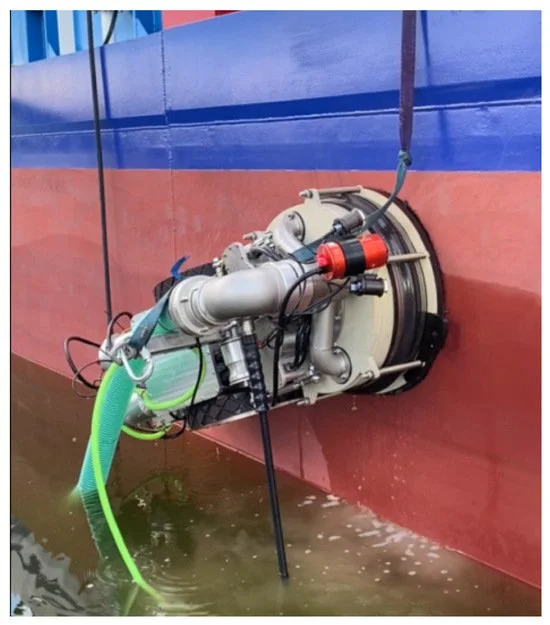
Into that gap steps Gecko Robotics, a Pittsburgh-based company that has spent years building machines designed to crawl, cling, and observe. This week, it announced a five-year IDIQ contract with the U.S. Navy and the General Services Administration, with a ceiling of $71 million and an initial award of $54 million—the largest robotics contract the Navy has signed to date.
The work begins not in theory but in motion. Over the next nine months, Gecko’s robots will inspect 18 ships in the U.S. Pacific Fleet. Destroyers, amphibious vessels, littoral combat ships—each one a layered system of steel, welds, coatings, and stress points that degrade slowly and unevenly over time. Traditionally, understanding that degradation has required human inspectors moving methodically across surfaces, collecting data in fragments, often only once the ship is already in dry dock.
Gecko’s machines approach the problem differently. They climb the hulls. They traverse weld seams. They gather dense streams of data—measurements that would take weeks to assemble by hand. That data flows into the company’s AI platform, Cantilever, where it becomes something more than a report. It becomes a digital twin, a living model of the ship’s structural health, updated as new information arrives.
What changes is not simply speed, though Gecko claims inspections can be performed up to 50 times faster and more accurately than traditional methods. What changes is timing. If a problem can be identified before a ship enters dry dock, then maintenance is no longer a reactive process that begins only after the asset is already offline. Parts can be staged. Crews can be scheduled. Downtime becomes something planned rather than discovered.
This shift matters because the Navy’s maintenance challenges are not merely logistical; they are informational. In 2025, only 41% of ships completed repairs on time, far below the Navy’s stated goals. Targets have since been adjusted, but the underlying issue remains: problems are found too late, and when they are found, the system must scramble to respond.
The consequence is a kind of institutional latency. Ships wait not only for repair, but for understanding.
Gecko’s contract, notably, is structured through the GSA, which means its tools are not confined to the Navy. Any branch of the Department of Defense can access them. This transforms the agreement from a single procurement into something closer to a platform—an infrastructure for seeing the physical world more clearly, and earlier, than before.
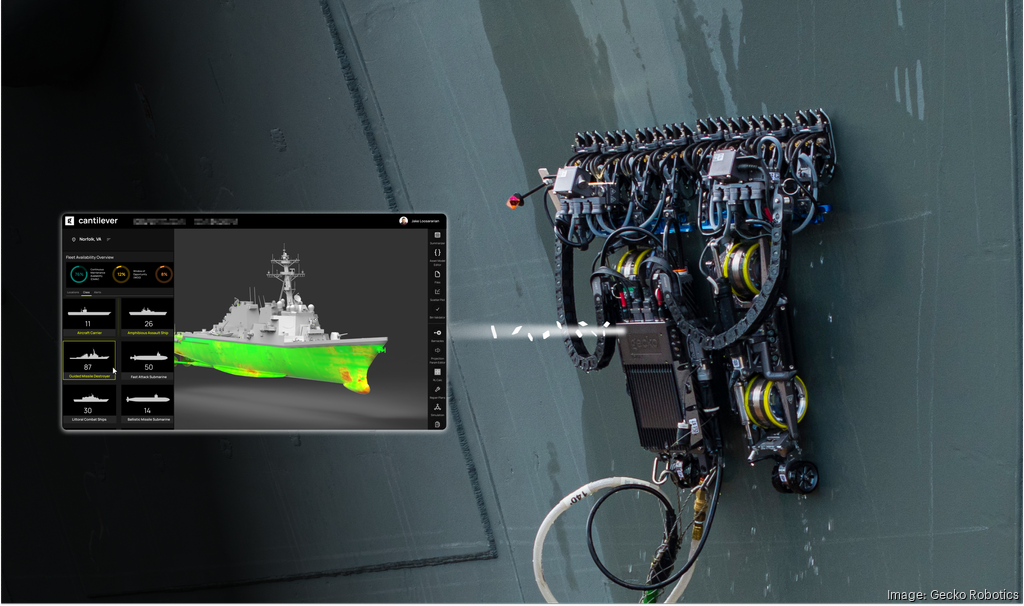
There is a broader context here, one that extends beyond shipyards. The United States is attempting to rebuild aspects of its industrial and defense capacity at a time when global competition, particularly with China, is intensifying. Shipbuilding is part of that story, but so is maintenance. A fleet is not defined solely by how many ships it launches, but by how many it can keep operational.
In that sense, Gecko’s robots are not solving a new problem. They are addressing an old one with a different lens. The physical world—whether a naval vessel, a power plant, or a manufacturing line—does not fail suddenly. It degrades. It signals. It reveals its weaknesses slowly, and only to those who are able to observe closely enough, and often enough, to notice.
For decades, that observation has been intermittent, manual, and constrained by time and access. What robotics and AI introduce is continuity. The ability to watch not just once, but persistently. To replace snapshots with streams.
It is tempting to view this as a story about machines replacing human inspectors. It is not. It is a story about changing the cadence of knowledge. About moving from a world where maintenance begins with discovery to one where discovery is ongoing.
“Readiness isn’t just a metric. It’s all that matters,” Gecko’s CEO Jake Loosararian said. The statement reads like rhetoric, but it carries a quieter implication. Readiness is not achieved through more effort alone. It is achieved through better information, arriving sooner.
The ships themselves have not changed. Steel still corrodes. Welds still fatigue. Systems still age. What is changing is the ability to see those processes before they become failures.
And in a fleet where nearly half the assets are waiting, the difference between seeing late and seeing early is not incremental.
It is operational.
